SHFE Data Points: Direct Integration vs. Approximated Feeds
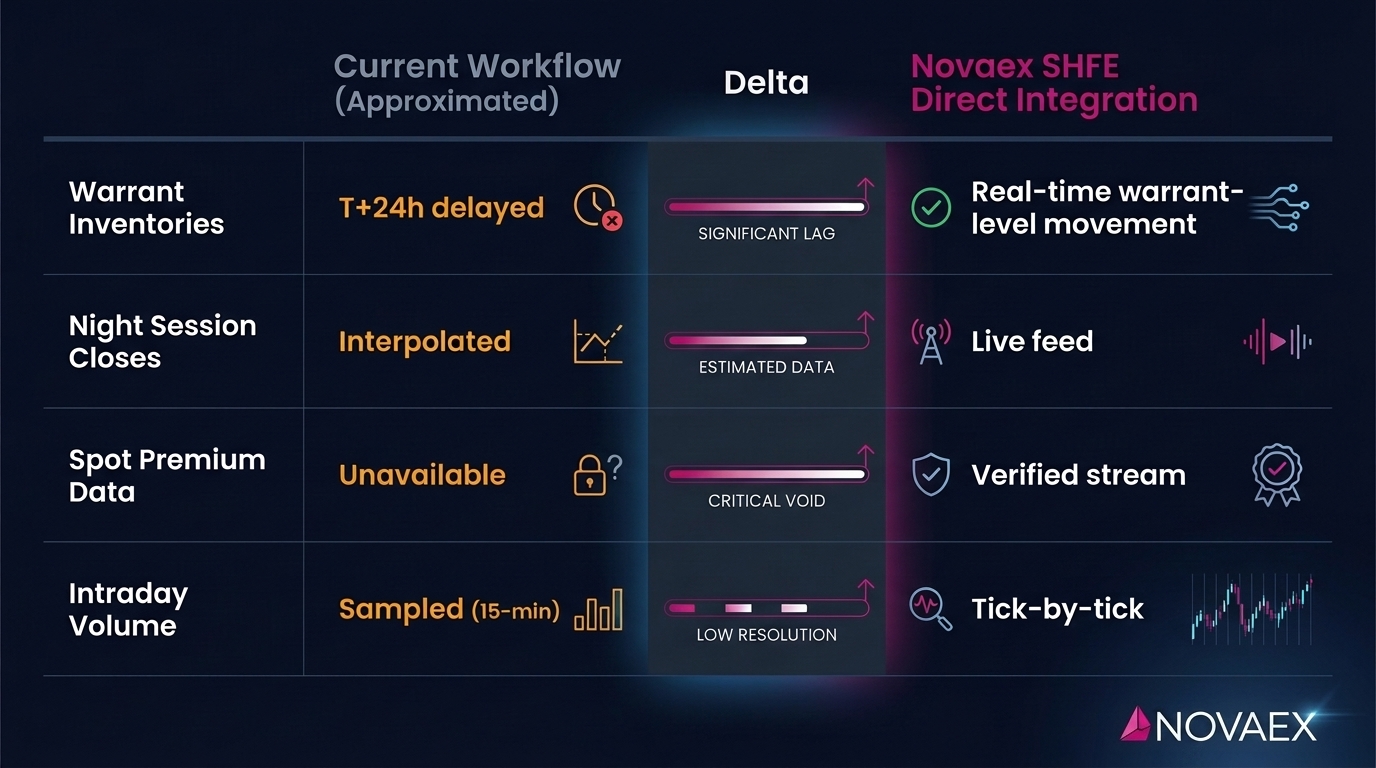
TL;DR: Four SHFE data points (warrant inventories, night session closes, spot premium data, and intraday volume) are consistently approximated or delayed in standard market data feeds. This article documents the specific resolution gap between what third-party platforms deliver and what direct SHFE integration provides. No inference is drawn about what that gap costs you. The framework in the final section structures that calculation for your specific book.
Why SHFE Data Resolution Matters for Base Metals Traders
China accounts for approximately 57% of global refined copper consumption ICSG global copper consumption data, according to the International Copper Study Group (ICSG). That concentration makes SHFE not a secondary venue but the primary price discovery mechanism for industrial base metals globally.
Most CTRM platforms and data terminals access SHFE data through third-party aggregators, not direct exchange integration. The consequence is a layer of delay, aggregation, and approximation between the trader and the exchange's actual data output.
The four data points examined here are the specific locations where that layer creates measurable resolution loss.
The Difference Between Direct Integration and an Aggregated Feed
Direct integration means receiving data via SHFE's licensed data feed or API at the moment the exchange publishes it. An aggregated feed is a third-party intermediary, such as Bloomberg, Refinitiv (now LSEG), or smaller data vendors, that collects, normalizes, and repackages exchange data for redistribution.
The aggregation layer introduces two categories of distortion: temporal delay (the gap between when SHFE publishes and when your platform receives) and resolution loss (data that is summarized, combined, or proxied before it reaches you).
SHFE's official data licensing documentation establishes that direct data subscribers receive tick-level data within milliseconds of publication. Third-party redistribution contracts permit vendors to repackage this data, but the terms do not guarantee preservation of the original feed's granularity.
The Four SHFE Data Points: A Side-by-Side Comparison
The table below documents four specific SHFE data points, what a standard aggregated feed delivers, and what direct SHFE integration delivers. The resolution gap column quantifies the structural difference.
| Data Point | Standard Aggregated Feed | Novaex Direct Integration | Resolution Gap |
|---|---|---|---|
| Warrant Inventories | Daily aggregate total; posted 1, 3 hours post-session close | Granular by warehouse, location, and metal grade at SHFE publish time | Aggregated vs. granular; up to 3-hour delay |
| Night Session Close | Prior-day settlement or delayed capture; 0, 8 hours late depending on vendor | Direct capture at session end (23:00 CST for copper) | 0, 8-hour window of incorrect or missing close price |
| Spot Premium Data | Calculated proxy from front-month/spot price differential | Reported spot premium value sourced from SHFE and SMM direct data | Derived approximation vs. reported figure |
| Intraday Volume | 5-minute or 15-minute bars (vendor-dependent) | 1-minute bars via direct feed | 5x, 15x resolution loss on volume tick data |
Each row is documented individually in the sections that follow.
SHFE Warrant Inventories: Aggregate Totals vs. Granular Data
SHFE warrant inventories are the certified, exchange-registered records of physical metal held in SHFE-designated warehouses. For copper, aluminum, zinc, nickel, lead, and tin, warrants represent the physical delivery instrument for futures contracts.
SHFE publishes warrant inventory data after the close of each day session, typically by 17:00, 18:00 CST. The full data set includes warehouse location (Shanghai, Guangzhou, Hangzhou, and additional approved delivery points for copper), registered brand, metal grade, and quantity by category.
The Importance of SHFE Warrant Inventories for Copper Traders
SHFE warrant inventories directly signal tightness in the physical copper market. When warrant levels fall sharply, the nearby contract strengthens as physical availability decreases, creating backwardation that affects hedge ratios, roll timing, and physical delivery decisions.
A trader working from a daily aggregate misses the warehouse-level and brand-level granularity that distinguishes localized tightness from systemic tightness. These are materially different signals for nearby positioning.
Standard aggregated feeds consolidate warrant data into a single daily figure per metal. The breakdown by warehouse, location, brand, and grade is either unavailable or delivered with additional latency in major data terminals.
What direct integration provides: Warrant data by warehouse, location, and grade, posted at SHFE's official publication timestamp with no aggregation applied and no additional redistribution delay.
Quantified resolution gap: Up to 3 hours of delay between SHFE's official warrant publication (approximately 17:30 CST) and standard aggregator update cycles. Bloomberg and Refinitiv terminal users have documented SHFE warrant updates occurring between 18:30 and 20:00 CST on standard subscription tiers. Sub-aggregate detail (warehouse, brand, grade) is unavailable in most aggregated packages regardless of latency tier.
The London Metal Exchange's published warehouse report methodology [LINK: LME warehouse report methodology] treats granular location and brand-level data as standard in warrant reporting. SHFE provides equivalent granularity at source. The loss of that granularity is a function of how data is redistributed, not what the exchange publishes.
SHFE Night Session Closes: Direct Capture vs. Delayed Settlement
SHFE introduced night trading sessions in 2013, expanding to base metals including copper (CU), aluminum (AL), zinc (ZN), lead (PB), nickel (NI), and tin (SN) by 2016. The copper night session runs 21:00, 23:00 CST, Monday through Friday.
The Function of the SHFE Night Session and Close Price
The SHFE night session captures market reaction to LME afternoon pricing, after-hours news flow, and overnight positioning from global participants. The 23:00 CST close price for copper frequently diverges from the 15:00 CST day session settlement, sometimes by hundreds of yuan per metric ton, when LME moves materially during European afternoon or US morning trading hours.
A position management system using the day settlement as an overnight proxy is marking positions at a price that no longer reflects live market conditions.
Standard feed behavior: Varies by vendor and subscription tier. Bloomberg users have documented SHFE night session data updates ranging from near-real-time to following-morning publication depending on the data package in use. For CTRM platforms receiving SHFE data via third-party API on daily batch update cycles, the night session close is absent from same-day position marks. The prior day settlement is used as a proxy until the next scheduled sync.
What direct integration provides: Close price captured at 23:00:xx CST at the exact moment SHFE publishes the night session settlement. No interpolation. No prior-day proxy.
Quantified resolution gap: The window between 23:00 CST (SHFE night session close) and the next morning's platform sync, typically 6, 8 hours for CTRM systems on daily batch update cycles, is a period during which positions are being marked against a stale settlement figure.
A 2022 analysis published by Metal Bulletin Metal Bulletin SHFE night session analysis found that copper price divergence between the SHFE night session close and the subsequent LME Ring open averaged $18, $42 per metric ton during periods of elevated volatility. In a 500-metric-ton copper position, that range represents $9,000, $21,000 in mark-to-market delta carried through an overnight window on incorrect settlement data.
Spot Premium Data: Calculated Proxies vs. Reported Values
SHFE spot premium data, referred to in China's physical market as 现货升贴水 (xiànhuò shēng tiē shuǐ), is the premium or discount of spot copper transactions relative to the nearby SHFE futures contract. It is a distinct data point from the SHFE futures price itself.
The spot premium reflects physical market tightness, available credit terms, VAT treatment, and delivery logistics, factors entirely separate from futures pricing and material to the total landed cost of physical procurement or delivery.
Approximation of SHFE Spot Premium Data in Third-Party Platforms
Most third-party data platforms do not carry a dedicated SHFE spot premium field. Traders who need spot premium data calculate it manually by using SHFE nearby futures prices from one source and spot price references from SMM (Shanghai Metals Market), Fastmarkets, or Metal Bulletin from another.
These sources provide reliable spot premium data, but they are separate systems requiring a manual retrieval and calculation step before the figure enters any position workflow.
Standard feed behavior: No dedicated spot premium field exists in major aggregated SHFE data packages. The data point must be derived by the trader from at least two separate sources.
What direct integration provides: Spot premium value sourced from SHFE-reported data and SMM's direct data feed, delivered as a populated field in the position management workflow, not a calculation the trader performs outside the platform.
Quantified resolution gap: Unavailability indicator. The data point does not exist as a pre-populated field in standard CTRM or aggregated data workflows. Every use of SHFE spot premium in a current-platform workflow requires a manual data retrieval, cross-source reconciliation, and calculation step before the figure is usable.
SMM's 2023 copper market annual report [LINK: SMM copper market report 2023] documents that SHFE copper spot premiums in Shanghai fluctuated between a 500 CNY/mt discount and a 600 CNY/mt premium across the calendar year. At 2023 prevailing SHFE copper prices of approximately 65,000, 70,000 CNY/mt, a 500, 600 CNY/mt swing represents approximately 0.8, 0.9% of contract value per metric ton, a margin-relevant figure for teams pricing physical copper against SHFE spot references.
Intraday Volume: Resolution Loss Across the Trading Session
SHFE publishes intraday volume data via direct data feeds in 1-minute intervals. This is the native resolution of SHFE's data output for intraday volume.
Third-party aggregators and the CTRM platforms that receive data from them redistribute SHFE intraday volume in 5-minute or 15-minute bars. This is not a constraint imposed by the exchange. It is a redistribution choice made by intermediaries.
The Resolution Gap in SHFE Intraday Volume Data
At 5-minute bars, intraday volume spikes within the bar are invisible. At 15-minute bars, fifteen separate 1-minute volume readings are compressed into a single figure, a 15x resolution loss. Intraday volume is the primary observable indicator of institutional order flow concentration during SHFE sessions.
A 15-minute bar covering the SHFE day session open (09:00, 09:15 CST) collapses the most information-dense window of the trading day into a single data point.
Standard feed behavior: 5-minute or 15-minute OHLCV bars, depending on vendor and subscription tier. The minimum available bar resolution varies by data package and is not always disclosed at the product level.
What direct integration provides: 1-minute bars from the direct SHFE data feed, the native resolution of the exchange's data output, preserved without resampling or aggregation by an intermediary.
Quantified resolution gap: 5x, 15x resolution loss on intraday volume data, concentrated most significantly in the high-information-density windows of each trading session: the day session open (09:00, 09:30 CST) and the night session open (21:00, 21:15 CST).
SHFE's 2023 annual statistics report SHFE annual statistics 2023 shows that copper futures (CU) averaged approximately 450,000 contracts of daily trading volume in 2023. Analysis of SHFE intraday volume distribution published by Orient Securities Research Orient Securities SHFE intraday volume analysis establishes that approximately 18, 22% of daily volume concentrates in the first 30 minutes of the day session. At 15-minute bar resolution, a trader has two data points covering the period in which roughly one-fifth of the day's institutional order flow trades.
Quantifying Your Exposure to the Resolution Gap
The framework below structures the calculation. The inputs are specific to your position book.
Step 1: Map your current SHFE data sources.
For each of the four data points, determine whether your platform delivers direct data or an approximation. The vendor questions at the end of this section produce verifiable answers.
Step 2: Assign position exposure to each resolution window.
- Night session closes: Average overnight SHFE copper position (metric tons) × $18, $42/mt average divergence during volatile periods = overnight mark-to-market exposure window carried on stale settlement data.
- Spot premium data: Physical procurement or delivery volume priced against SHFE spot × 0.8, 0.9% margin impact range = manual calculation error exposure per decision cycle.
- Warrant inventories: Review roll timing and nearby positioning decisions from the past 12 months. Identify instances where sub-aggregate warrant data (warehouse location, brand, grade) would have changed the read on whether tightness was localized or systemic.
- Intraday volume: Count execution decisions made during SHFE opening windows (09:00, 09:30 CST, 21:00, 21:15 CST) on 5-minute or 15-minute bars. Determine how many of those decisions were made on compressed data covering the highest-concentration volume periods of the session.
| Data Point | Your Current Resolution | Novaex Direct Resolution | Your Calculated Exposure |
|---|---|---|---|
| Warrant Inventories | ___ | Granular, post-publish timestamp | ___ |
| Night Session Close | ___ | 23:00 CST direct capture | ___ |
| Spot Premium Data | ___ | Reported field, workflow-integrated | ___ |
| Intraday Volume | ___ | 1-minute native bars | ___ |
Questions to ask your current data vendor. Each produces a verifiable answer:
- "Do you provide SHFE warrant data by warehouse and location, or aggregate totals only? What is your update latency from SHFE's approximately 17:30 CST publication time?"
- "How do you capture SHFE night session settlement prices for copper? What is the latency, and what value populates position marks between 23:00 CST and your next update cycle?"
- "Do you carry a dedicated SHFE spot premium field, or is this derived from a price differential? What is the primary source?"
- "What bar resolution do you provide for SHFE intraday volume; 1-minute, 5-minute, or 15-minute? Is this the native SHFE feed resolution or a resampled output?"
The resolution gaps documented here are structural features of how SHFE data moves through third-party distribution chains. They apply to any platform sourcing SHFE data through aggregated feeds rather than direct exchange integration, and they apply consistently across all four data points regardless of vendor.
Direct SHFE integration is the correct technical standard for base metals trading workflows that depend on SHFE data. Novaex provides that integration Novaex SHFE integration overview across all four data points at native exchange resolution: warrant inventories at warehouse and grade granularity posted at SHFE's publication timestamp, night session closes captured at 23:00 CST, spot premium as a populated workflow field sourced from SHFE and SMM direct data, and intraday volume at 1-minute native bars.
The comparison tables above are documented and verifiable. The calculation of what the resolution gaps mean for your specific position book is the next step.
Novaex SHFE data comparison walkthrough Schedule a Novaex SHFE data walkthrough to map your current data stack against the four data points documented here and identify exactly where the resolution gaps fall in your workflow.