SHFE vs LME copper spread: what the Shanghai leg tells a hedger
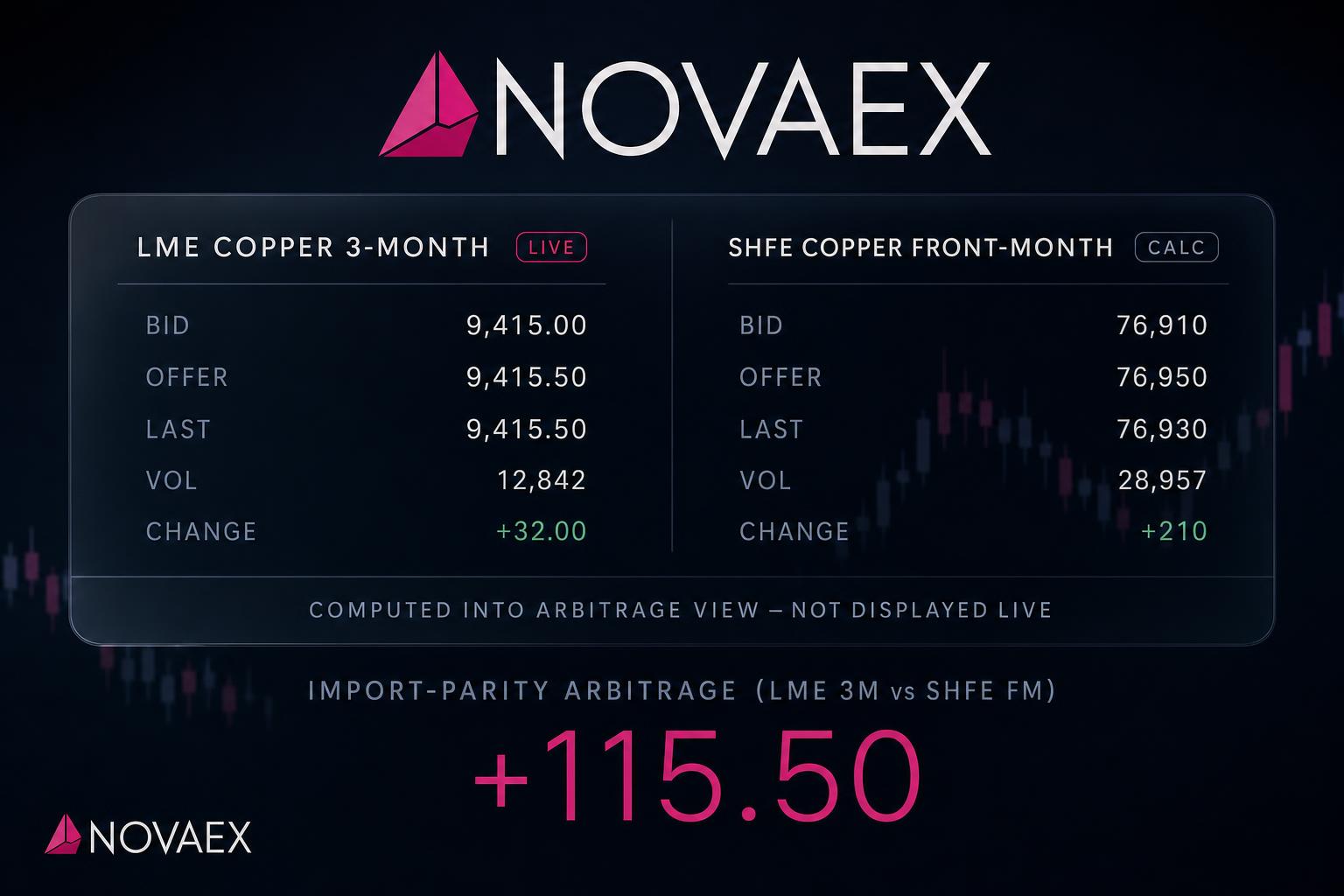
London shows the global paper price. Shanghai shows what China will pay for the metal itself. The gap between them, net of freight, duty, VAT and currency, is the import window — and it moves before the London desk opens.
Shanghai prices the copper China actually buys. London prices the copper the world trades. When the two disagree after freight, duty, VAT and currency are accounted for, the gap is the import window. It usually moves while London sleeps. LME and MCX live on screen; COMEX and SHFE computed into the arbitrage view.
Why does Shanghai price copper differently from London?
SHFE is a monthly yuan contract, deliverable into Chinese warehouses against domestic brands. LME is a dollar prompt-date system built around warrants and global delivery points. Different delivery, different currency, different hours. The two prices answer different questions.
The practical difference is timing. The SHFE close is on the record before the London desk is properly underway, so whatever Shanghai decided overnight sits there waiting while LME is still forming its view. A trader who reads only London starts the day one session behind.
What is the SHFE-LME arbitrage window?
The window compares the SHFE front-month price against the landed cost of LME metal: the LME price plus freight and premium, converted at the yuan rate, plus import duty and VAT. Practitioner references put refined-copper import duty around 1% with 13% VAT shaping the landed maths (SHFE copper reference). When SHFE sits above that landed cost, the window is open and importing pays. When it sits below, the window is shut.
Copper is the metal where this mechanism matters most. Fungible deliverable brands and bonded-warehouse stocks in Shanghai give the physical flow somewhere to go, which is why the LME's own education desk uses copper as its worked example of cross-market arbitrage. Aluminium barely arbs by comparison. The window is a copper instrument first.
What moves the window apart from the two prices?
Four costs decide whether a quoted spread is a tradable one: ocean freight and the physical premium, the yuan rate, duty and VAT, and financing across the voyage. A stronger dollar makes dollar-denominated LME metal dearer to yuan buyers and narrows the window without either exchange price moving. Tariff and customs friction does the same. Readers of the 2026 market have noted exactly this: spreads that look open on price alone closing once currency and trade costs are added (2026 arbitrage-gap analysis).
So never read the headline spread. Read the spread net of the four costs, and watch whether it holds across days rather than printing once.
What does the spread tell a hedger that LME alone does not?
It tells you whether Chinese physical buying is pulling metal in or pushing it away, while London still shows only the global paper price. An open window held for days against firm SHFE says domestic buyers are paying up. A shut window says they are not.
That reads directly onto the hedge. Copper hedged on LME while Shanghai pays a sustained premium leaves the physical leg priced somewhere the paper leg never visits. The spread is the early evidence of that mismatch, arriving before London opens, while there is still time to choose the venue.
What the spread is not
Treat the spread as a read-across for where to hedge, and size it honestly. Lifting the physical arbitrage needs onshore access, import licensing and quota that most desks outside China do not hold. For those desks the window describes someone else's physical option. The value to you is the directional read and the venue call, not the trade itself.
One precision about our own numbers. SHFE is computed into the arbitrage view, never presented as a displayed live feed. LME and MCX live on screen; COMEX and SHFE computed into the arbitrage view. The panel above carries that label, and so does this sentence.
How do you read it before the desk opens?
Four steps, in order:
Take the SHFE close and note its direction on the week, not just the day.
Set it against landed LME: price plus freight and premium, through the yuan rate, plus duty and VAT.
Ask whether the window is open or shut, and whether it has held that way for days.
Place the hedge where the metal will price. A window open for days argues for SHFE-linked coverage on China-bound tonnage. A shut one leaves LME the honest venue.
Read Shanghai first, then place the hedge where the metal will price.