Show me the working: what a board or auditor asks for, and what most desks can produce
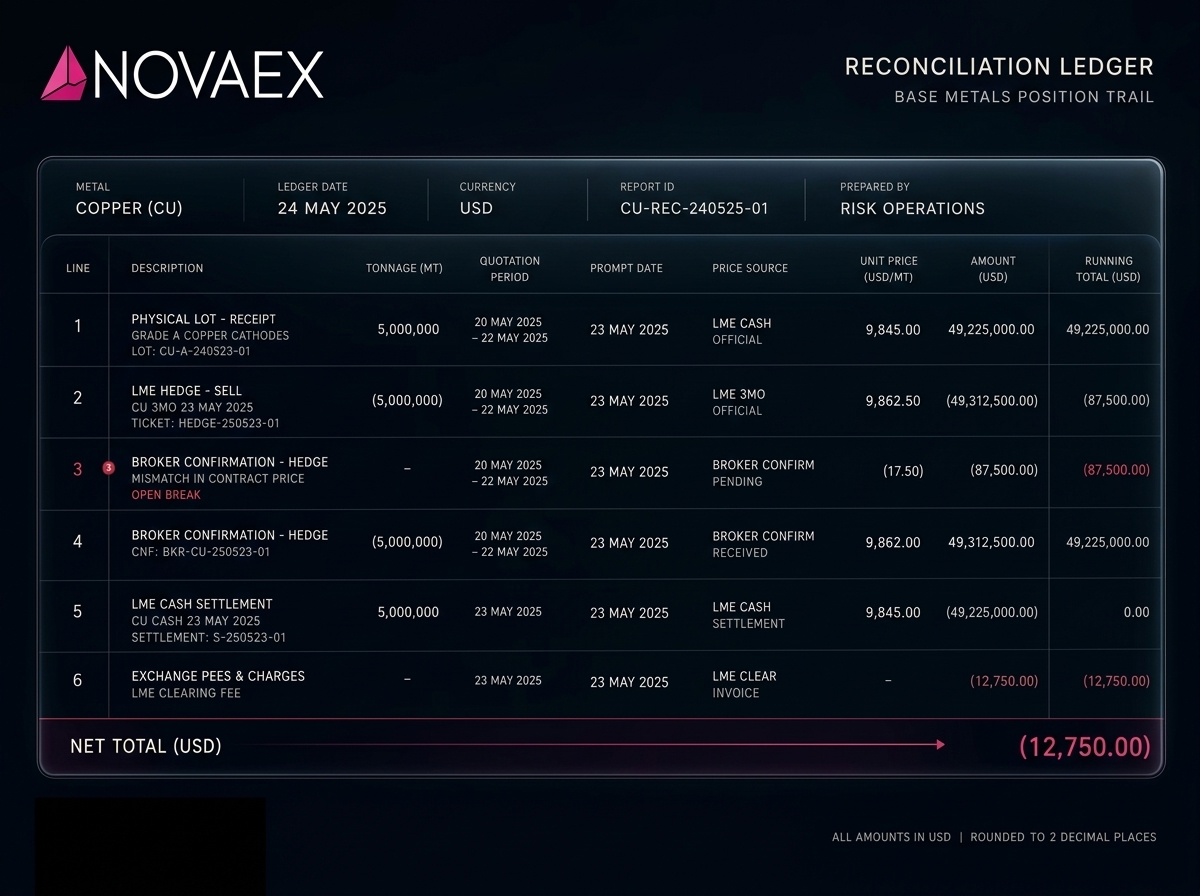
The board and the auditor ask the same question two ways. The answer is one artefact: a timestamped net with the trail attached.
The question lands at 14:20. A board member or an auditor says show me the working. The artefact they want is a net position as of a timestamp, with a line-level trail beneath every number. Each physical lot, each hedge and each broker confirmation sits on its own line with prompt date, quotation period and price source, and the running total ties straight to the net you put in front of them.
What does show me the working actually mean in the room?
It means prove the net position today, not the close position at month-end. The board wants exposure by metal and prompt, hedge coverage against policy, and the breaks still open. The auditor wants the evidence behind that same number, line by line, so each figure can be checked back to its source.
The two asks sound different. They resolve to one artefact. A producer's risk and treasury team lives between them, holding the physical and the financial position together under a board policy.
What does an auditor need to see under the number?
An auditor needs each position tied back to an outside source it can check. Position breaks work is defined as verifying that recorded positions match those held by external parties such as brokers and counterparties, with each break identified and resolved position breaks reconciliation.
Under IFRS 7, entities must disclose the nature and extent of risks from financial instruments, which is what the auditor tests against supporting evidence IFRS 7 disclosure overview). In practice that means fair value measures and evidence for the inputs used IFRS 7 quantitative disclosure requirements. No regulatory claim beyond that. The regime is named, and the evidence is the trail.
Why can most desks not produce it that afternoon?
Because the books live apart and only meet in a spreadsheet at month-end. The physical book sits in the CTRM or the ERP. The hedges sit with the broker under confirmations that arrive on their own schedule. Quotation periods mismatch between purchase and sale.
Someone squares it by hand. The founder of Novaex spent four years doing that reconciliation by hand on a base-metals desk. What forced the point was a counterparty that asked for substantially less than it was owed, and nobody caught it in time because the position could not be reconciled fast enough to check. The money was recoverable. The lesson held: you cannot defend a position you cannot see whole.
That is why the afternoon ask hurts. The number exists in three places. The proof that ties them does not exist yet.
What does a provable artefact look like, line by line?
It looks like a ledger you can read down without asking for a second file. One page, one timestamp, one net, and the working attached.
It carries an as-of timestamp with the price basis stated beside it. LME and MCX prices shown live on screen, with COMEX and SHFE computed into the arbitrage view rather than displayed. It shows the net by metal and prompt date. Then the lines: physical purchase with tonnage and quotation period, physical sale with tonnage and quotation period, hedge contract with venue and prompt, broker confirmation reference, price source and time, and a running total in the right column.
One line is flagged where physical and broker differ, with the age of the break and the owner. Nothing nets away. Nothing sits in a footnote.
Read that way, the artefact also calls the next decision. For copper due to price across the October quotation period, hold the cover on the LME October prompt through the 21 September expiry cutover, and square the flagged break before it rolls.
Can you produce it from your own stack before the desk opens?
Pull your net copper position as of 07:00 with that trail under it. Time the job from a blank screen to a page you would send to audit. Count the files you open, the confirmations you chase, and the lines you have to type by hand.
Most teams find the gap in that hour. The physical moves, the broker confirms later, and the quotation period sits between them.
Pull it before the desk opens on 18 September and time how long it takes.