Spreadsheet Risk in Commodity Trading: A Risk Vocabulary
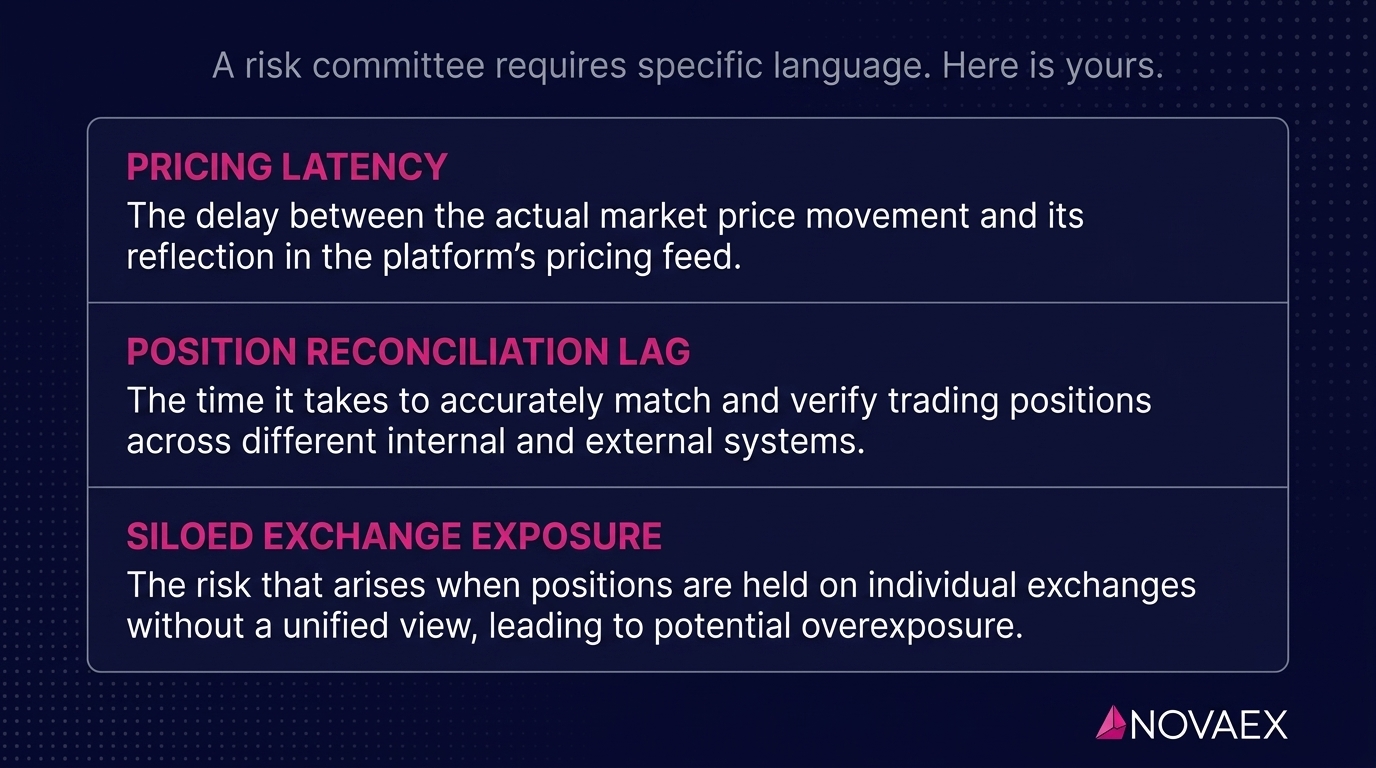
Spreadsheet risk in commodity trading is a category of operational exposure most metals traders recognize immediately, but few can define with sufficient precision to escalate. Seven operationally defined terms constitute the required vocabulary: version drift, formula fragility, single-thread dependency, reconciliation gap risk, latency opacity, override creep, and audit opacity. Each maps to a specific workflow failure mode and is ready for committee review.
If a position workbook returns an incorrect delta during a volatile LME session, or if forty minutes are lost reconciling two versions of a hedge sheet before a risk call, that is spreadsheet-dependent process risk (SDPR). Most trading desks lack the structured language to classify, report, or prevent these errors.
This guide defines each term, connects it to a specific failure mode, and structures it for risk escalation.
CTRM operational risk overview
Why Spreadsheet Risk in Commodity Trading Resists Escalation
Most trading desks operate with a shared, informal understanding that spreadsheets introduce risk. According to the European Spreadsheet Risks Interest Group (EUSPRIG), 88% of audited spreadsheets contain material errors. This figure has remained consistent across two decades of independent research. That statistic rarely appears in a risk committee deck.
The reason is language. "Our spreadsheets have errors" is not an actionable risk statement. It lacks a category, severity framework, and clear fix. Risk committees and trading desk heads respond to named, classified, quantified risk. Historically, SDPR has lacked a formal taxonomy in most commodity trading organizations.
What Is Spreadsheet-Dependent Process Risk?
Spreadsheet-dependent process risk (SDPR) is the category of operational risk that arises when critical trading, hedging, or position-management workflows are executed or maintained through manually operated spreadsheets rather than controlled system processes. SDPR goes beyond basic data-entry mistakes to affect the entire workflow.
Spreadsheet-dependent workflows can break without warning, propagate errors without audit trails, and fail under unfamiliar conditions.
According to a 2023 Gartner analysis, organizations relying on manual spreadsheet workflows for financial reporting experience on average 3.6 times more reconciliation incidents than those using integrated systems. In commodity trading, position accuracy functions as a critical risk control, making this differential significant.
operational risk in commodity trading
The Seven Terms: A Reference Vocabulary for SDPR
The table below defines the core vocabulary of spreadsheet-dependent process risk. Each term is operationally defined and connected to the failure mode it names. This reference functions as a standalone escalation aid: saveable, shareable, and applicable regardless of platform, desk structure, or commodity.
| Term | Operational Definition | Primary Failure Mode |
|---|---|---|
| Version Drift | Multiple copies of the same workbook circulate with divergent data | Position is reported differently by different team members in the same risk call |
| Formula Fragility | Spreadsheet logic produces incorrect results when exposed to inputs outside its design parameters | Pricing or delta calculation fails on unfamiliar contract structures |
| Single-Thread Dependency | A critical workflow relies on one person's undocumented knowledge of a workbook's logic | Desk cannot execute the process confidently when that individual is unavailable |
| Reconciliation Gap Risk | An uncontrolled exposure window exists between position entry and position verification | Errors compound undetected during the gap period |
| Latency Opacity | The age of data in a spreadsheet is unknown or cannot be trusted | Risk decisions are made on stale data without the data's age being apparent |
| Override Creep | Hardcoded values accumulate in formula cells over time without documentation | The workbook produces results no one can fully explain or reproduce |
| Audit Opacity | No traceable record exists of who changed a value, when, or what the prior value was | Post-incident investigation cannot reconstruct the calculation that produced an error |
Each of these terms describes a condition present on most trading desks operating with spreadsheet-dependent workflows. Precise naming allows teams to scope the condition, assign a severity, track it over time, and escalate it to secure a permanent fix.
Version Drift and Formula Fragility: The Two Most Common SDPR Events
What Is Version Drift in Trading Operations?
Version drift occurs when two or more copies of the same position workbook diverge through independent edits, email distribution, or unsynchronized local saves, resulting in team members reporting from different versions of the same data. In metals trading, version drift most commonly surfaces during morning risk calls when the trader's position differs from the risk manager's position and neither party can immediately determine which version is authoritative.
Version drift represents a structural failure of the workflow. Without a controlled master record, every copy holds equal claim to authority, and resolving any discrepancy requires manual reconciliation rather than an automated system check.
According to research by F1F9, 94% of large spreadsheet models contain at least one significant error, with version control failures cited as the most common root cause in financial services environments. spreadsheet error research financial services On a live trading desk, that failure carries a measurable cost: reconciliation time, decision latency, and unhedged exposure when the discrepancy surfaces mid-session.
How Does Formula Fragility Affect Position Accuracy?
Formula fragility describes the tendency of spreadsheet-based calculation logic to produce incorrect results when exposed to inputs outside the range the original builder anticipated. In base metals hedging, this surfaces most often when a desk adds a new instrument, exchange, or contract structure. An existing formula fails because its logic was hardcoded to a prior workflow state.
A fragile formula does not return an error message. It produces a plausible-looking number that may be wrong by a small margin or a large one, with no signal that the underlying logic has failed.
The correct operational risk classification for formula fragility is model risk, a category with a well-established Basel II/III framework that risk committees recognize. Classifying a formula failure as a model risk event changes the escalation process and opens the path to a formal solution.
model risk management framework commodity trading
Single-Thread Dependency: The Risk That Lives in One Person's Head
What Is Single-Thread Dependency Risk?
Single-thread dependency risk exists when a trading desk's ability to execute a critical process depends on one individual's knowledge of a workbook's logic, structure, or undocumented manual workarounds. If that individual is unavailable due to absence, rotation, or departure, the process cannot be executed confidently by anyone else on the desk.
This differs from conventional key-person risk. Key-person risk describes dependence on an individual's relationships or market judgment. Single-thread dependency describes dependence on an individual's undocumented technical knowledge of a workflow. The workbook may appear functional to any observer, because only one person knows which cells require a manual prompt-date override, which formulas require a sanity check before they can be trusted, and which outputs are approximations rather than calculations.
According to PwC's 2022 Global Risk Survey, 67% of commodity trading firms identified manual process concentration as a top-five operational risk, with desk-level workflow knowledge concentration cited as a primary contributing factor. operational risk commodity trading firms The risk committee implication is direct: single-thread dependency is a controls gap with a clear fix.
Reconciliation Gap Risk and Latency Opacity: Exposure You Cannot See
Reconciliation gap risk describes the exposure window that opens between the moment a position is entered into a spreadsheet and the moment it is verified by a second process or a second person. During that window, the position exists in a state of unconfirmed accuracy. Any error introduced during entry compounds without detection until the next reconciliation cycle.
In fast-moving LME markets, this window has direct P&L implications. A long position entered with the wrong lot count, or a hedge recorded against the wrong prompt date, may not surface until the next morning reconciliation. By that point, the market has moved and the error carries a realized cost.
How Does Latency Opacity Affect Risk Decisions?
Latency opacity is the condition in which the age of data in a spreadsheet is unknown or cannot be trusted. A risk manager reviewing a position sheet during a session may not know whether the LME settle prices reflect yesterday's close, last Friday's, or an intraday snapshot taken at an unrecorded time. When the spreadsheet is manually refreshed on an ad-hoc basis, the data timestamp is either absent or unreliable.
According to a 2022 survey by ION Group, over 60% of mid-market commodity trading firms still rely on manual data refresh cycles for at least one category of front-office pricing data. When that data feeds a position sheet, every risk metric derived from it inherits the latency of its least-current input.
A position that appears hedged may actually be unhedged if the hedge was sized against a price that no longer reflects the current market. This is a daily operational reality on any desk where pricing data flows through a manually refreshed spreadsheet.
real-time pricing data commodity trading
Override Creep and Audit Opacity: The Controls Failure No One Documents
Override creep is the gradual accumulation of hardcoded values within formula cells. These values are inserted to correct a mismatch, force a result, or bypass a broken formula, but are never removed or documented. Over time, a workbook that was originally formula-driven becomes partially formula-driven and partially hardcoded, with no clear or consistent boundary between the two layers.
These hardcoded values often become wrong or cease to be applicable at a future point, with no mechanism to detect the change. A workbook with undocumented overrides produces results that cannot be fully audited, reproduced, or defended under regulatory review.
How Do You Identify Audit Opacity in a Trading Workbook?
Audit opacity is present when a workbook cannot answer three basic questions: Who last changed this cell? When was it changed? What was the prior value? Standard spreadsheet applications do not maintain a cell-level audit trail by default. Without explicit version control or a controlled system of record, audit opacity is the default operational state of any spreadsheet used in a shared front-office workflow.
This has direct implications for incident investigation. When a pricing error, position discrepancy, or mark-to-market variance is reported, audit opacity means the root cause cannot be reconstructed from the workbook itself. Investigation depends entirely on the recollection of whoever last touched the file. This dependency fails at scale and fails under regulatory scrutiny.
According to Deloitte's 2023 Commodities Trading Operations Benchmark, firms with manual-spreadsheet-dependent position workflows reported average incident investigation times 4.2 times longer than firms using integrated CTRM platforms. This is a direct and quantifiable cost of audit opacity. [LINK: CTRM platform operational efficiency]
How to Escalate Spreadsheet Risk in Commodity Trading
The terms defined above must be translated into a structured escalation statement to drive committee-level action. The following four-step protocol applies to any SDPR escalation.
1. Classify the risk type using the vocabulary above. "We have a recurring version drift exposure on our LME copper position workbook" provides clear context for action.
2. Quantify the exposure window. How long has the condition existed? How many workflows does it affect? What is the estimated frequency of material error under current conditions? An order-of-magnitude estimate is more actionable than no estimate.
3. Assign a Basel operational risk subcategory. SDPR events most commonly map to Execution, Delivery and Process Management (EDPM) under the Basel III operational risk taxonomy, a category that risk committees and compliance functions recognize by name. Formula fragility may additionally qualify as model risk under SR 11-7 guidance. Applying established risk taxonomy immediately elevates the register of the escalation.
4. Propose a specific control. A risk committee cannot act on a problem without a proposed remedy. The control does not need to be a full platform migration. It can be a workflow change, a mandatory sign-off protocol, or a reconciliation checkpoint inserted at the gap. Specificity is required.
How Do You Present Spreadsheet Risk to a Trading Desk Head?
Present SDPR in the same format applied to any other operational risk: category, severity, frequency, exposure window, and proposed control. The communication format that generates action is specific and quantified. "We have a single-thread dependency on the LME copper hedge sheet, and that dependency is currently concentrated in one analyst who is scheduled to rotate in Q3" is a statement that supports a decision before the end of the week.
According to research published by the Basel Committee on Banking Supervision, operational risk events in trading operations are 2.3 times more likely to receive a formal action plan when presented with a named risk category and a quantified exposure window than when presented as general process concerns. Basel operational risk framework The vocabulary in this reference exists to close that gap.
From Vocabulary to Controls: What Naming These Risks Enables
Spreadsheets remain valuable tools for discrete analysis, scenario modeling, and ad-hoc calculation. The SDPR framework identifies when a spreadsheet has moved outside those parameters to become the system of record, the risk engine, the audit trail, and the position manager simultaneously.
At that point, it functions as an uncontrolled risk infrastructure presenting as a familiar file.
Four conditions signal that SDPR has reached committee-level severity on a given desk:
- Recurring version drift: Multiple team members regularly resolve position discrepancies through manual reconciliation.
- Structural single-thread dependency: A critical process relies entirely on one person's undocumented knowledge.
- Total audit opacity: No mechanism exists to reconstruct a calculation after the fact.
- Unquantified override creep: No one can state with confidence how many hardcoded values are active in production workbooks.
[LINK: commodity trading operational controls assessment]
Conclusion: Precise Language Is the First Line of Risk Control
Spreadsheet risk in commodity trading has historically lacked a precise enough name to consistently generate the escalation it warrants. The seven terms defined in this reference (version drift, formula fragility, single-thread dependency, reconciliation gap risk, latency opacity, override creep, and audit opacity) provide the operational vocabulary needed to classify, communicate, and escalate SDPR effectively.
The risk exists whether it is named or not. Naming it precisely transforms an operational frustration into a manageable control problem, establishing a clear case for infrastructure upgrades.
Three immediate actions for any metals trader or risk professional:
- Audit your most critical position workbook against the seven SDPR conditions in the reference table. Identify which conditions are present, at what frequency, and whether the failure mode has produced a measurable incident in the past 90 days.
- Document one specific SDPR event using the vocabulary and Basel EDPM classification above. This becomes the first entry in a formal risk register and the foundation of the next escalation.
- Draft a one-paragraph escalation statement using the four-step protocol from the previous section. Writing it with precision clarifies both the scope of the risk and the specificity of the required control.
CTRM platform evaluation guide metals trading risk management framework