The Analyst Hours Lost to Manual Price Table Maintenance
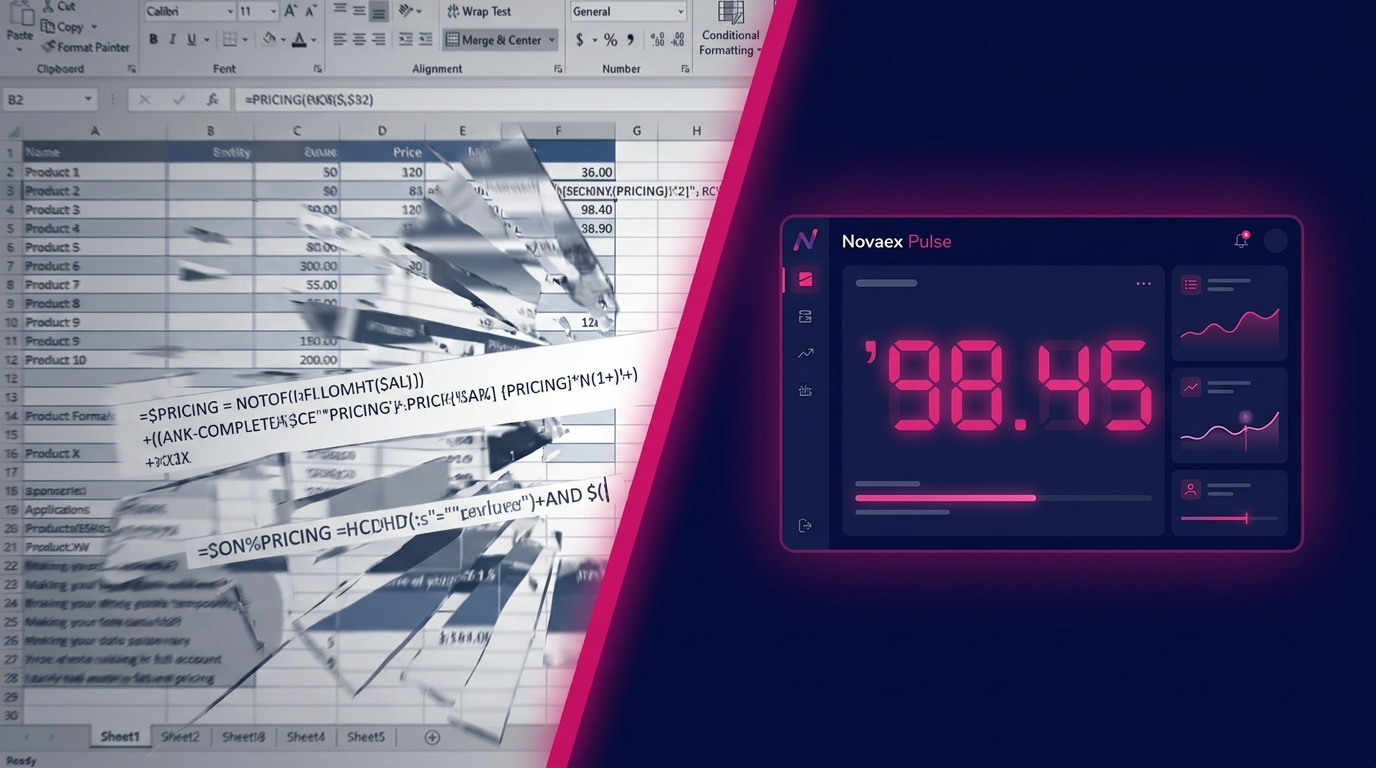
Manual price-table maintenance in metals trading consumes an estimated 6, 12 analyst hours per week per position, hours spent pulling LME settlements, constructing pricing-period averages, and reconciling counterparty invoices. A formula engine configured to specific contract terms eliminates this manual work, replacing it with a live calculation that runs continuously against your pricing logic.
This weekly drain creates massive inefficiency. Across a mid-market metals desk managing ten open physical positions, it represents 60, 120 analyst hours per month spent on deterministic arithmetic: applying known pricing logic to available market data. The logic does not change. The data arrives daily. The calculation is the same every settlement cycle.
Yet most trading teams are executing it manually because their platform does not hold their contract pricing terms in a structured, computable form.
According to the McKinsey Global Institute McKinsey Global Institute data worker productivity research, knowledge workers spend up to 40% of their productive time on data collection, validation, and manual entry tasks with no analytical content. In commodity trading operations, that proportion increases measurably during active settlement periods, when LME fixings, COMEX settlements, and MCX closes all land within hours of each other, compressing the available calculation window while increasing the volume of calculations required simultaneously.
This post quantifies what manual price-table maintenance actually costs your analysts. It then describes specifically how Novaex Pulse's formula engine is configured to your contract terms to make that workflow disappear.
Why Manual Price Table Maintenance Persists
Most CTRM platforms store contracts as documents. They capture the headline terms (commodity, quantity, counterparty) but they do not decompose the pricing clause into a live formula.
That structural gap forces the analyst to become the formula engine. When a settlement period arrives, someone on the desk has to pull the relevant exchange settlement price, identify the correct pricing period specified in that contract, apply the commercial premium or discount, cross-reference the result against the counterparty's provisional invoice, and reconcile any discrepancy before the payment date.
This arithmetic requires domain knowledge, access to multiple data sources, and careful attention. This complexity pushes the task onto a senior analyst's calendar rather than being delegated or eliminated.
Time Spent on Price Table Maintenance
Research from the International Swaps and Derivatives Association ISDA post-trade operations research estimates that manual reconciliation processes consume 25, 30% of operational staff time in commodity trading firms that have not systematized their post-trade workflows. For a three-analyst middle-office team, that is nearly one full-time equivalent devoted to tasks that are, at their core, formula lookups applied to arriving market data.
In a metals-specific context, the problem compounds. LME pricing is not a single settlement number. It involves the Official Settlement Price, the Closing Price, the Cash and Three-Month bids, and select pricing for specific tenor dates. Each physical contract may reference a different component across a different averaging window. An analyst managing five contracts across LME copper, zinc, and aluminum is running distinct lookup-and-calculation sequences for each one, every settlement cycle, without any system-level support.
The aggregate cost is invisible in any single week. Measured quarterly, across a mid-market desk managing ten or more open positions, it becomes a recoverable operational expense rather than a fixed cost of doing business.
The Four Manual Workflows Inside Every Price Table Update
Manual price-table maintenance involves four sequential workflows, each carrying independent error risk and time cost. Understanding the sequence is the first step to understanding where formula configuration reclaims the hours.
1. Data ingestion: Pulling settlement prices from exchange feeds, broker reports, or subscribed market-data services and entering them into a spreadsheet or the CTRM platform's price table by hand. According to Gartner's data quality research Gartner data quality and manual entry error rate, manual data entry carries an average error rate of 1, 3%. This might pass in low-stakes environments, but fails when the number becomes the basis for a multi-million-dollar cargo invoice.
2. Period construction: Building the pricing-period average. A contract specifying "the arithmetic mean of LME Official Settlement Prices for the five business days following the bill of lading date" requires the analyst to identify those exact five business days, pull each individual settlement, and calculate the average. This step alone typically consumes 15, 20 minutes per contract per pricing period.
3. Premium/discount application: Applying the commercial premium or discount negotiated in the physical contract (denominated in USD/MT, as a percentage of the base price, or as a spread to a secondary reference price) to arrive at the final contract price. That number lives in the contract PDF, remaining unreadable by the CTRM platform.
4. Counterparty verification: Comparing the internally calculated price to the price stated on the counterparty's provisional invoice or price notice. Discrepancies require a dispute workflow. Even when there is no discrepancy, confirming alignment consumes time, and when markets have moved sharply, both sides check their work more carefully than usual.
The Cost of Manual Price Verification
Oliver Wyman's operations research in commodity trading [LINK: Oliver Wyman commodity operations benchmark] estimates that post-trade operational errors cost mid-market firms an average of $250,000, $750,000 annually, accounting for dispute resolution, delayed payments, and reconciliation overhead. The error rate itself may be low, but the consequence of a single pricing error on a large physical cargo is disproportionate to the clerical time that caused it.
The opportunity cost carries far more consequence for most desks than the error rate. An analyst devoting three hours per settlement cycle to price-table reconciliation is not running sensitivity analysis on the hedge book, not providing live pricing intelligence to the commercial team, and not monitoring real-time position exposure when markets are moving. Those are the hours that carry the highest analytical value precisely when market conditions demand judgment.
Configuring a Formula Engine to Your Specific Contract Terms
A formula engine eliminates these manual workflows by holding contract pricing logic in a structured, computable form. The calculation runs against live market data immediately instead of waiting for analyst initiation.
Here is what contract-specific formula configuration looks like in practice.
Pricing basis configuration: The formula engine is configured with the exact reference price each contract specifies: LME Official Settlement for copper concentrate, COMEX nearby settlement for refined copper cathode, or MCX closing price for domestic India physical contracts. Each points to a specific price component from a specific exchange.
Period definition encoding: The pricing period ("5-day average post-BL," "M+1 average," "spot on invoice date") is encoded as a window function tied to the contract's shipment or delivery trigger date. When a bill of lading date is entered, the engine calculates the correct business-day window automatically and begins accumulating the relevant daily settlements without analyst initiation.
Premium/discount storage: The commercial premium or discount is stored as a contract-level field (like $45/MT over LME Official Settlement) and applied as part of the formula rather than added manually at reconciliation. If the premium is renegotiated for a subsequent shipment, it is updated in one field and all downstream calculations reflect the change immediately.
Provisional-to-final calculation: As daily settlements accumulate within the pricing period, the engine maintains a running provisional price. When the period closes, the final price is calculated and flagged for confirmation review, entirely skipping separate manual calculations, spreadsheets, or reconciliation cycles.
Configuring LME Pricing Formulas to Match Contract Terms
LME pricing formula configuration requires mapping three contract-specific variables into the engine: the price component (Official Settlement, Closing Price, Cash bid), the averaging period (number of business days, trigger event, applicable holiday calendar), and the premium or differential. When all three are encoded at contract creation, the formula engine calculates a live provisional price on any date within the pricing period without analyst input.
The output is available in real time. This configuration uses structured data entry at contract creation. It takes the exact information your analyst already uses and stores it in a computable form rather than a PDF attachment, bypassing the need for custom development or platform integration.
LME pricing components and settlement methodology
How Formula Configuration Changes the Counterparty Verification Workflow
Manual counterparty price verification exists because both sides are performing the same calculation independently and comparing results afterward. The calculation should always yield the same answer. It frequently differs because the inputs vary in ways neither party notices until the invoice arrives.
One side uses the LME Official Settlement. The other uses the Closing Price. One analyst includes a national holiday in the business-day count. The other uses a different regional holiday calendar. These are not systemic errors. They represent definitional ambiguities that a precisely configured formula engine eliminates by encoding the exact definition agreed upon in the physical contract.
According to Accenture's commodity operations benchmark Accenture commodity trading operations research, firms with structured pricing formula workflows reduce invoice discrepancy rates by 60, 70% compared to desks running manual price-table processes. That reduction translates directly into fewer dispute communications, fewer held payments, and fewer hours spent reopening positions that should have been closed at settlement.
Reducing Counterparty Verification Time
When your formula engine is configured to the same pricing definition your counterparty agreed to in the contract (same component, same period window, same business-day calendar), the provisional price your system calculates should match their invoice calculation exactly. Verification shifts from a manual cross-check requiring someone to re-run the numbers to a system-generated exception flag when a counterparty's stated price falls outside a defined tolerance band. Analyst time on verification drops from hours per cycle to minutes per exception.
The analyst's role in verification sharpens. They review flagged discrepancies that actually require judgment to resolve instead of running known calculations.
What the Analyst Hours Reclaimed Actually Look Like
The operational shift from manual price-table maintenance to formula-engine configuration is measurable in concrete recovered time.
Consider a metals trading desk managing 15 open physical contracts across copper, aluminum, and zinc (a realistic mid-market scenario). At an average of 90 minutes per contract per settlement cycle for the four manual workflows described above, the desk absorbs 22.5 analyst hours per settlement cycle on deterministic arithmetic.
With Pulse's formula engine configured to each contract's pricing terms, those 22.5 hours are replaced by:
- Contract creation (one-time): 20, 30 minutes per contract to encode pricing basis, period definition, and commercial premium
- Cycle exception review (recurring): 15, 30 minutes per settlement cycle to review engine-flagged discrepancies before releasing final prices
The Function of a Metals Trading Pricing Formula Engine
A metals trading pricing formula engine holds your contract pricing logic (reference price source, averaging window, commercial premium or discount) in a structured, computable form that calculates against live market data continuously. Rather than waiting for an analyst to pull settlements and run the calculation, the engine maintains a live provisional price throughout the pricing period and calculates the final price automatically when the period closes.
It eliminates the clerical workflow of applying pricing strategy to each settlement cycle while preserving the analyst's judgment. That reclaimed time does not dissolve into general overhead. It redirects to the analytical work a front-office metals desk requires: live position monitoring, hedge-effectiveness analysis, and pricing intelligence that supports the commercial team's negotiation of the next contract term.
Manual Price Table Maintenance as an Organizational Risk
There is a risk dimension to manual price-table maintenance that extends beyond analyst hours, and it compounds as desks grow.
When the pricing calculation lives in an analyst's spreadsheet rather than in a structured formula engine, the calculation lives in that analyst. When that analyst is on leave, managing a concurrent operational emergency, or has left the firm, the calculation has to be reconstructed from scratch. The probability of introducing an error during reconstruction is significantly higher than during routine execution.
According to PwC's operational risk research PwC commodity trading operational risk report, key-person dependency in manual data processes is cited as a top-five operational risk factor by commodity trading compliance teams. This is no theoretical concern. It remains a recurring incident pattern in firms lacking systematized pricing workflows, surfacing visibly during peak market volatility when analyst capacity runs low.
Formula configuration removes the key-person dependency structurally. The pricing logic is documented securely in a system accessible by any authorized analyst. It completely replaces fragile spreadsheets stored in personal drive folders. Any analyst with system access can review the running provisional price, check the period construction, and confirm the final calculation, because the logic is explicit, auditable, and independent of who originally built it.
The compliance benefit follows directly. An auditable formula engine produces a complete, timestamped record of every pricing calculation: the input data, the period window, the applied premium, and the final price. Manual spreadsheet reconciliation produces a result, often without a traceable audit trail of the inputs that generated it.
operational risk management in commodity trading firms
The Operational Standard Metals Desks Should Already Be Running
Solving manual price-table maintenance demands accurate configuration of existing contract information. This means storing the data your analysts use every settlement cycle in a computable form instead of a static PDF.
The operational standard is three steps executed at the right point in the contract lifecycle:
- At contract creation: Encode the pricing basis (reference price component, exchange, data source), the pricing period definition (window type, trigger event, applicable business-day calendar), and the commercial premium or discount into structured contract-level fields in Pulse.
- During the pricing period: Monitor the formula engine's running provisional price output rather than manually running the calculation. The engine accumulates daily settlements and updates the provisional price continuously, shifting the analyst's focus to monitoring.
- At period close: Review the system-calculated final price against the formula definition, confirm it is within expected parameters, and release for invoicing. The analyst focuses strictly on exception review.
Pulse's formula engine is built specifically for the pricing structures common to physical base metals contracts: LME averaging periods with official settlement or closing components, COMEX nearby-contract rolls for refined copper, MCX domestic pricing for India-delivery positions, and the premium and differential structures that govern concentrate, blister, and refined metal trades across counterparties with varying commercial terms. The configuration reflects the actual contract architecture of base metals trading. It actively avoids generalized commodity-pricing schemas adapted from energy or agricultural markets.
Novaex Pulse formula engine configuration
Reclaim the Hours and Redirect Them Where They Matter
Manual price-table maintenance has a precise and recoverable cost: approximately 90 minutes per contract per settlement cycle, multiplied by every open physical position on your desk. For a mid-market metals operation, that number accumulates into dozens of analyst hours per month. This figure grows proportionally with open position count and compounds in cost as it displaces higher-value analytical work.
The solution is configuring Novaex Pulse's formula engine to your specific contract terms: the pricing reference, the averaging window, the commercial premium. That configuration converts a recurring manual workflow into a live calculation that runs continuously against your market data. It transforms the analyst's role from formula executor to exception reviewer.
The three concrete next steps:
- Audit your current cycle time. For one full settlement cycle, track the actual hours each analyst spends on price-table maintenance across your open positions. The number is almost always larger than the intuitive estimate. Documenting it makes the recovery case irrefutable.
- Map your top five contracts to their pricing clauses. Identify the pricing basis, the period definition, and the premium for each. These are the precise inputs required for formula configuration in Pulse.
- Schedule a Pulse configuration walkthrough. See the formula engine configured live against one of your actual contract structures using your exact pricing terms and counterparties instead of a generic demonstration scenario.
The analyst hours currently consumed by price-table maintenance are the hours your desk should be deploying on work that requires trading judgment. A correctly configured formula engine provides an operationally available workflow correction. The desks that have implemented it have the recovered analyst capacity to demonstrate it.