The Breadth-vs-Depth Tradeoff in Base Metals Intelligence
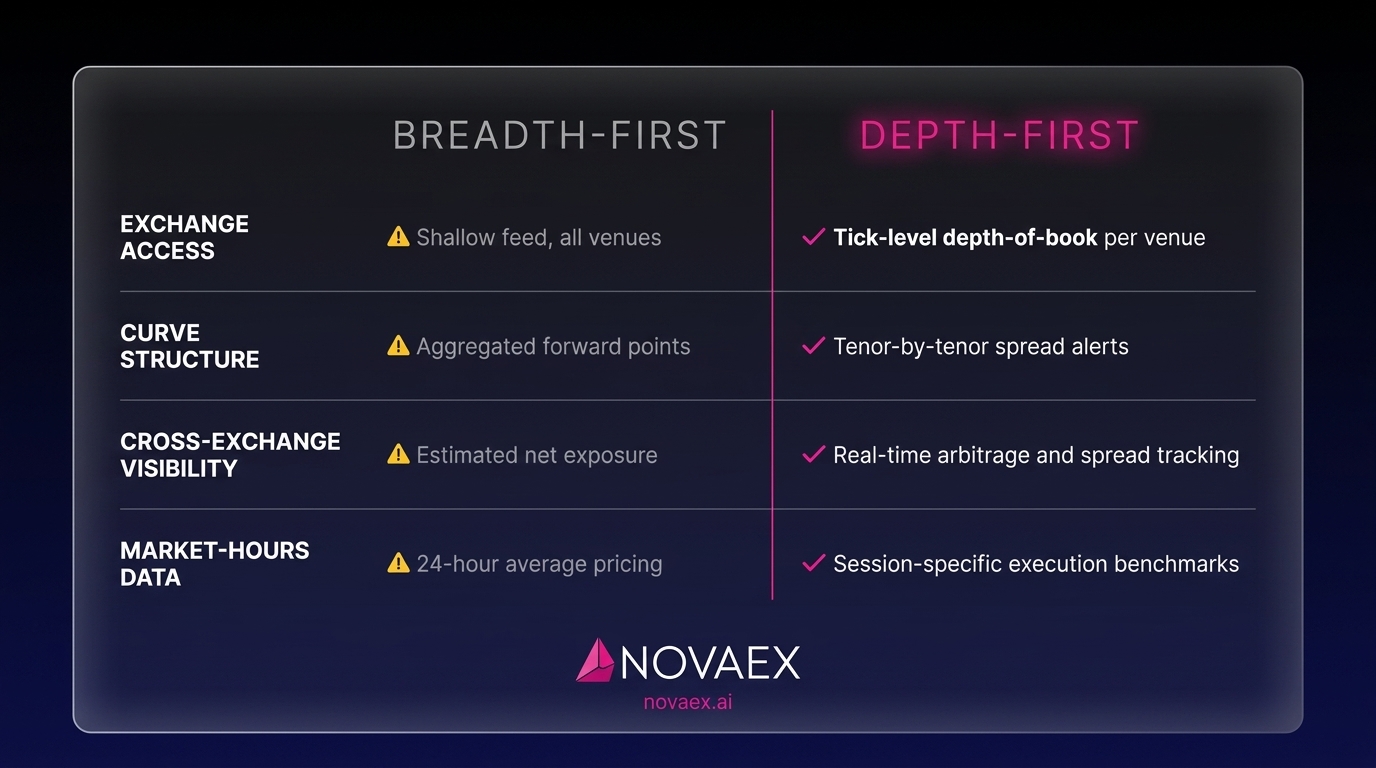
TL;DR: Base metals intelligence platforms divide into two architectures. Breadth-first systems spread coverage across many commodities and deliver shallow data for each. Depth-first platforms achieve complete understanding of individual markets before expanding coverage. For active metals traders, the architecture determines whether a platform supports live execution decisions or delivers descriptive data the trader must still interpret and act on.
Every metals trading desk has had the same internal conversation. The platform covers dozens of commodities. The data technically exists. But when copper prompt dates roll, when an intraday LME move triggers a margin call, or when a cross-venue basis spread opens faster than the feed refreshes, the system delivers a description of what happened.
Not what to do next.
That gap has a name. It is the breadth-vs-depth tradeoff, and it is the most consequential architecture decision in base metals intelligence, and one that most commodity trading stacks have incorporated into their default architecture without formal examination.
This post defines the tradeoff precisely, provides the operational framework to diagnose it in your current stack, and establishes the vocabulary to bring that diagnosis into your next internal platform conversation.
Why Breadth-First Architecture Dominates and Where It Fails
Multi-commodity platforms are built on a rational premise: commodity traders operate across asset classes, and a unified system reduces integration complexity and vendor overhead.
According to a 2023 survey by Coalition Greenwich, commodity trading desks cite data fragmentation across systems as their top operational bottleneck, above regulatory complexity and staffing constraints. The market responded with breadth: platforms that ingest pricing, position, and risk data across energy, metals, agricultural commodities, and freight in a single interface.
The commercial logic holds. The intelligence logic breaks down at execution speed.
The Difference Between Breadth-First and Depth-First Intelligence
Breadth-first architecture is designed to achieve consistent coverage across many commodity markets at an acceptable data depth for each. The architecture prioritizes integration scale: how many markets the system covers over intelligence quality within any single market.
Depth-first intelligence is designed to achieve complete, workflow-grade understanding of a specific commodity market before expanding coverage. The true standard requires the system to understand the market well enough to support an active execution decision in real time.
This distinction creates measurable differences at the workflow level, which is precisely where base metals traders operate.
Why Multi-Commodity Platforms Struggle With Base Metals Data
Base metals carry structural complexity that generic commodity architecture does not accommodate well. The London Metal Exchange prompt date system (with daily delivery dates extending three months forward, then weekly, then monthly) generates a carry structure unlike agricultural or energy futures calendars.
According to LME market statistics, average daily notional volume across base metals contracts exceeded $52 billion in 2023. That volume moves through a prompt structure requiring real-time carry cost calculation, warehouse warrant tracking, and cross-venue basis management across LME, COMEX, MCX, and SHFE simultaneously.
Breadth-first systems were not designed to understand the LME prompt calendar natively. They were designed to store dates and prices. The difference between storing and understanding is precisely where execution support breaks down.
The Depth-First Intelligence Standard, Defined
Depth-first intelligence represents an architectural commitment that determines what the system is built to know before it is built to show.
The depth-first standard applies a single test to every data field, every workflow module, and every alert the system generates: does this output support an active trading decision, or does it describe conditions the trader must still interpret?
Descriptive intelligence tells a copper trader that the 3-month LME contract moved 1.2% in the last hour. Execution-grade intelligence tells that trader what their net delta is across all open legs, what the prompt-adjusted carry cost of holding the position through the roll looks like, and what the cross-venue basis to COMEX is doing simultaneously.
According to Oliver Wyman's 2022 Commodity Trading Outlook, firms that achieve integrated position-and-risk visibility at the front-office level reduce manual reconciliation time by an average of 34%. In active metals markets, that time determines whether a desk acts on a signal or documents why the window closed.
Depth-First Intelligence in LME Hedging Workflows
For LME hedging workflows, depth-first intelligence means the system natively understands the prompt date structure, calculates live carry costs without manual input, and surfaces physical-versus-paper position netting in a single view rather than requiring the trader to reconcile across modules.
In practice: when the 3-month spread narrows unexpectedly, a depth-first platform surfaces the carry implication for any open forward position automatically. A breadth-first system logs the spread movement. The trader calculates the carry implication in a spreadsheet.
That spreadsheet step carries direct and measurable cost. According to a 2023 EY report on commodity trading operations, front-office traders at mid-market firms spend an average of 2.1 hours per day on manual data reconciliation tasks that exist specifically because their platforms do not natively integrate position and market intelligence. In a market moving at LME speed, 2.1 hours is not recoverable.
The Diagnostic Framework: Six Base Metals Trading Workflows Compared
The framework below is designed as a standalone diagnostic artifact. Each row represents a named workflow decision that occurs on an active base metals desk. The contrast is between what a breadth-first architecture delivers and what a depth-first intelligence standard requires.
Use this to assess your current platform. Use it to structure your next internal conversation about what your stack is built to do.
base metals platform evaluation criteria for front-office traders
Base Metals Intelligence Architecture: Workflow Diagnostic
| Trading Workflow Decision | Breadth-First Architecture | Depth-First Intelligence Standard |
|---|---|---|
| LME Prompt Date Roll | Generic date field stored; carry calculation performed manually by trader or in spreadsheet | Native prompt calendar with live carry cost calculated automatically and embedded in position view |
| Physical vs. Paper Position Netting | Physical inventory and derivative legs held in separate modules; reconciliation requires manual export and matching | Unified position view nets physical and paper legs in real time; net exposure surfaced at the contract level |
| Cross-Venue Spread Management (LME / COMEX / SHFE) | Price feeds from multiple venues displayed separately; basis spread requires manual calculation and venue adjustment | Real-time venue-adjusted spread with pre-calculated basis; cross-exchange arbitrage signals surfaced automatically |
| Intraday Margin Call Response | Alert triggered on threshold breach; trader must reconstruct net delta, affected positions, and funding requirement manually | Alert includes net delta across all affected legs, required funding amount, specific lots at risk, and prompt date exposure |
| Warehouse Warrant Tracking | Not natively supported or handled via external module requiring separate login and manual reconciliation | Warrant positions integrated with physical inventory; delivery risk flagged against open forward commitments |
| Cross-Metal Correlation Hedge Ratio | Correlation analysis requires data export to external tool; hedge ratio calculated offline and applied manually | Live correlation matrix with suggested hedge ratio output; updated continuously as the underlying price relationship shifts |
Every row above represents a decision that occurs on a real metals desk. The breadth-first column reflects what traders at those desks are working with on platforms built for broad coverage. The depth-first column reflects the intelligence standard, not as a feature wish list, but as the baseline for execution support.
How Data Fragmentation Affects Metals Trading Decisions
Data fragmentation shifts the trader's focus from decision-making to data assembly. When position data, market data, and risk analytics live in separate modules (or separate systems entirely), the trader becomes an integrator before becoming an analyst.
According to Accenture's 2023 Trading Operations Report, commodity desks with fragmented data architectures make time-sensitive decisions an average of 47% slower than desks with integrated intelligence environments. In base metals, where intraday volatility can move a copper position by six figures in under two hours, that latency is not operational friction. It creates financial exposure.
Fragmentation degrades both speed and decision quality. A trader assembling a position picture from three sources is verifying that data is correct. That is a different cognitive activity than applying judgment to a market signal.
LME prompt date structure and carry cost calculation explained
Why Base Metals Intelligence Demands Its Own Architecture
Base metals represent a distinct trading environment with structural characteristics that require purpose-built intelligence design.
The LME operates on a daily prompt system with near-continuous delivery dates for the first three months. COMEX copper runs a monthly contract cycle with different delivery specifications. MCX operates in Indian rupees with its own margin framework. SHFE carries bonded and domestic warehouse distinctions that affect the deliverable basis in ways that shift with Chinese regulatory posture.
A trader managing exposure across all four venues is not managing "metals prices." They are managing four distinct liquidity pools, four margin frameworks, and four delivery mechanisms simultaneously, with basis relationships between them that shift continuously and asymmetrically.
According to the World Bank Commodity Markets Outlook, base metals price volatility averaged 22% annually over the 2020 to 2023 period, which is above energy commodity volatility for the same period. This volatility concentrates in specific prompt dates, specific venue spreads, and specific physical delivery windows.
Breadth-first architecture treats those concentrations as edge cases. Depth-first intelligence is built around them.
Evaluating Commodity Intelligence Coverage Versus Depth
Instead of asking how many commodities a platform covers, traders should ask if it understands their active markets well enough to support an execution decision without requiring supplementation.
The diagnostic remains operational rather than feature-based. Run your three most time-sensitive workflow decisions through the platform during a live market session. Measure what the platform produces versus what you need to act. The gap between those two outputs is the depth the framework is designed to measure, and it is the number that matters in a platform evaluation.
commodity trading risk management best practices for base metals desks
The Operational Cost of Breadth-First Base Metals Intelligence
The breadth-vs-depth tradeoff carries a direct operational cost that is rarely calculated explicitly but accumulates continuously across every trading session.
The cost appears in three measurable forms.
1. Latency cost. The time between a market signal and an informed response increases with every manual reconciliation step the platform requires. According to a 2022 McKinsey analysis of commodity trading operations, each manual data assembly step in a front-office workflow adds an average of 4, 7 minutes of latency per decision cycle. At ten decision cycles per session, that is 40, 70 minutes of systematic lag every day.
2. Attention cost. When a platform requires the trader to verify data integrity before acting, it is consuming the trader's highest-value resource: judgment. Attention applied to reconciliation is not available for market interpretation. This is not a soft cost. It causes a direct reduction in the quality of decisions made under time pressure.
3. Risk cost. Incomplete position visibility at the moment of a market move creates exposure the trader cannot see. According to the Bank for International Settlements 2023 Quarterly Review, commodity price gaps (defined as intraday moves exceeding 2%) occurred in base metals markets on an average of 31 trading days in 2022. Each of those 31 days was a moment where incomplete position intelligence translated directly into unquantified risk.
While absent from platform invoices, these three costs show up directly on a trading P&L, which is precisely why they are so consistently underweighted in platform evaluation cycles.
Applying the Depth-First Standard to Your Current Stack
With the tradeoff defined and the diagnostic framework established, the next step is applying both to your current intelligence environment with enough precision to produce a clear internal recommendation.
A structured diagnostic follows three steps.
Step 1: Identify your three highest-frequency, highest-latency workflow decisions.
These are the decisions that occur most often and require the most manual supplementation. For most active metals desks, they cluster around prompt management, cross-venue basis, and intraday margin response, precisely the rows in the diagnostic table above.
Step 2: For each decision, document what your current platform produces versus what you need to act.
Specificity matters here. Not "the data is incomplete" but "the platform produces a spot price; I need a prompt-adjusted carry cost and a net delta across all open legs." That level of specificity is what makes the diagnosis useful in an internal conversation rather than a qualitative observation.
Step 3: Calculate the aggregate latency and attention cost.
Using conservative estimates (the lower bound of McKinsey's 4-minute-per-cycle figure) to calculate the accumulated time cost per session, per week, per quarter. Convert that time to opportunity cost at your desk's average decision value. The result is the operational cost the framework measures, stated in terms your organization can evaluate against a platform investment.
According to a 2023 survey by the International Swaps and Derivatives Association, 67% of commodity trading professionals report that their primary platform does not fully support their most time-sensitive workflow decisions. This tradeoff represents the industry norm.
Novaex depth-first base metals intelligence platform overview
Conclusion: Name the Tradeoff, Change the Conversation
The breadth-vs-depth tradeoff in base metals intelligence functions as an architecture decision with quantifiable operational consequences. It is a decision that has been running inside most commodity trading stacks without a precise name or a shared diagnostic vocabulary.
The framework above provides both. Breadth-first architecture versus the depth-first intelligence standard serve as structural descriptions of what a platform is built to know, and what it is therefore able to deliver at the moment execution decisions are made.
How to evaluate your current platform:
- Run the diagnostic table against your current platform. For each of the six workflow decisions listed above, document what your system produces versus what you need to act. The gap is the depth the framework is designed to measure, stated in operational terms.
- Build the cost case. Use the latency, attention, and risk cost framework to calculate what the gap costs your desk per quarter. In most cases, that number exceeds the platform subscription it is being compared against.
- Bring the vocabulary into your next internal conversation. "Our platform is breadth-first" is a complete and precise diagnosis. It names the tradeoff, implies the standard, and gives your organization a testable criterion to evaluate against.