The LME Rollover Cost Spreadsheets Cannot Calculate
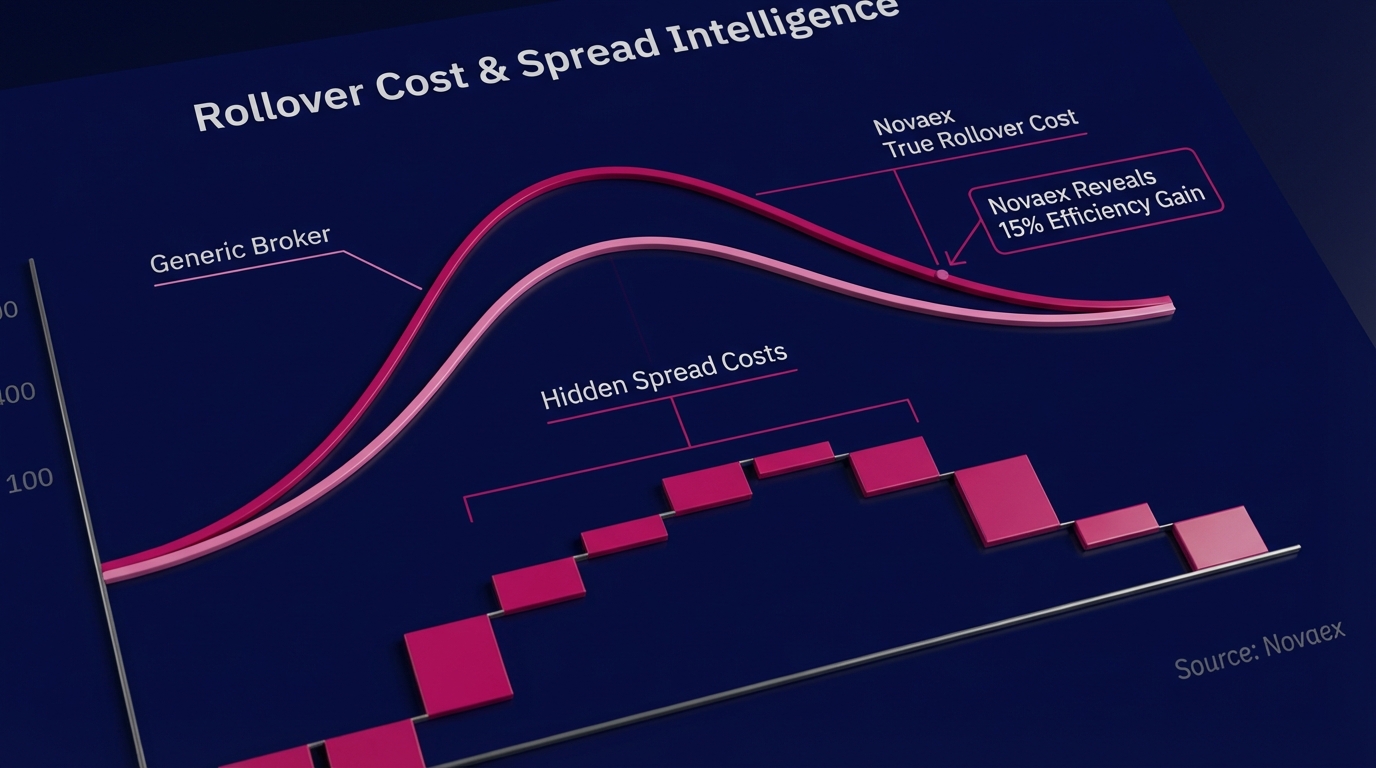
Spreadsheets cannot produce accurate LME rollover costs because the required data does not exist in any cell. Without live bid/ask depth and broker-accurate inter-month spread differentials, every rollover estimate is a structured approximation. If someone in your network manages metals exposure through spreadsheets, this post identifies precisely what is missing and documents why no formula update resolves it.
What LME Rollover Cost Actually Measures
Rollover cost is the total expense of moving an open metals position from one prompt date to a later one. While that framing is straightforward, the underlying mechanics are complex.
The cost has three components: the calendar spread differential between the two prompt dates, the bid/ask spread paid on both legs of the carry trade, and any broker commission or execution slippage applied at the moment of the roll. Each component fluctuates constantly.
The Mechanics of Rollover Cost
Rollover cost in metals trading is the net expense of closing a near-dated position and reopening it at a further prompt date to maintain continuous exposure. On the LME, this involves executing a spread trade (simultaneously selling one prompt date and buying another) with the total cost determined by the live carry structure plus execution spread on both legs. According to the London Metal Exchange, copper and aluminum prompt dates extend as far as 63 months forward, meaning rollover strategy is a persistent cost driver across the full life of any hedge.
The carry structure itself changes minute to minute. A position rolled at 09:30 London time can cost materially more or less than the same roll executed at 12:00. According to LME Ring data, bid/ask spreads on nearby copper spread trades can widen from under $0.50/t to over $4/t during illiquid windows or physical delivery tightness events, a variance that no daily settlement figure captures.
This variability is precisely why static spreadsheet formulas are structurally insufficient. A formula only calculates against provided numbers, missing real-time execution values.
The Structural Spreadsheet Gap in Rollover Cost Calculation
The most common spreadsheet approach to LME rollover cost involves pulling a daily settlement price for two prompt dates and computing the difference. This method completely misses two of the three cost components described above.
Settlement prices are end-of-day official closes. They reflect the Ring close or the electronic midpoint instead of the executable spread available during the trading session when the actual roll occurs. A trader executing a carry in live market conditions encounters a bid/ask spread on each leg rather than a settlement midpoint. Those are structurally different numbers.
Spreadsheet Limitations with Forward Spreads
Spreadsheets cannot calculate LME forward spreads accurately because they depend on settlement prices that are end-of-day approximations instead of live executable rates. The spread a trader actually pays includes bid/ask costs on both the near and far leg simultaneously, which settlement data does not capture and cannot be inferred from it. According to a 2023 report by CTRM Center, over 62% of mid-market commodity firms still use spreadsheets as their primary hedge management tool, meaning the majority of mid-market hedgers are estimating rollover exposure against data that structurally understates real execution cost.
Beyond the settlement price problem, spreadsheet infrastructure cannot interpolate broker-accurate forward curve points for non-standard prompt dates. The LME publishes daily pricing for three-month contracts, but positions aligned to physical delivery windows frequently fall on dates that are not published. Accurately pricing those points requires a model that accounts for full curve shape, seasonal carry factors, and current physical tightness, rather than linear interpolation between two adjacent settlement cells.
The gap is structural. Adding more data columns or refreshing the feed daily does not resolve it. The underlying data structure is wrong for the task.
Live Bid/Ask Depth: The Data Spreadsheets Cannot Replicate
Live bid/ask depth refers to the full order book at each prompt date: the volume available to buy, the volume available to sell, and the price increments at which that volume sits. This data determines two things that directly affect LME rollover cost: whether a roll can be executed at the quoted spread, and how execution size affects the realized cost.
A quoted spread of $2/t on a 500-lot copper roll tells you nothing about whether 500 lots can actually be executed at that level. If the book at that price is thin, execution pushes the effective spread wider as each successive lot clears at a less favorable price. A spreadsheet has no mechanism to represent this, holding a single number instead of a distribution.
The Role of Bid/Ask Spreads in LME Trading
The bid/ask spread in LME trading is the difference between the highest price a buyer will pay and the lowest price a seller will accept at any given prompt date or spread combination. For carry trades, the mechanism used to roll positions, the bid/ask applies simultaneously to both legs, compounding the execution cost. According to risk analytics research cited by OpenLink, bid/ask spreads on LME three-month copper range from $0.50/t in liquid sessions to more than $5/t during physical delivery squeezes or significant macro events, a tenfold variance that no daily settlement figure reflects.
This variance carries direct P&L consequences. A metals manufacturer hedging 1,000 tonnes monthly with a $3/t bid/ask spread overshoot across both legs of the roll faces $6,000 in untracked execution cost per roll cycle. Annualized across monthly rolls, that is $72,000 in hedging cost that the spreadsheet model does not see because it lacks the necessary data feed.
The absence of bid/ask depth from spreadsheet infrastructure means rollover cost estimates derived from settlement prices systematically understate actual hedging cost in every roll cycle, by a margin that scales directly with position size.
How Spread Intelligence Changes the LME Rollover Cost Equation
Spread intelligence, in the context of LME rollover cost, means access to live inter-month spread differentials at broker-accurate precision instead of end-of-day settlements or generic forward curve extrapolations built on published date ranges. It means knowing the executable carry before committing to the roll.
Broker-accurate forward curve interpolation accounts for the shape of the carry across the full curve, the prevailing tightness or backwardation at specific prompt dates, and the differential between cash and forward pricing that reflects real physical market conditions. According to research by Oliver Wyman, commodity firms operating with real-time market data infrastructure spend 38% less time on position reconciliation than counterparts relying on manual processes, a figure that reflects what happens when the model matches reality rather than approximating it.
The Impact of Inter-Month Spread Differentials
Inter-month spread differentials affect hedging costs by determining the actual carry a trader pays or receives when rolling a position from one prompt date to another. In contango, rolling a long position costs the positive carry. When backwardation tightens sharply, as it does during physical supply disruption events, rolling can become significantly more expensive or, in extreme cases, executable only at spreads far wider than any settlement-based model anticipated. According to LME market data, copper inter-month spreads have swung from mild contango to acute backwardation within single trading sessions during documented supply disruption events, with spreads moving $15-$25/t intraday.
A spreadsheet model holding a fixed carry assumption, even one updated from yesterday's settlement, cannot detect this shift in real time. A trader managing a 2,000-tonne copper hedge with a $20/t intraday carry move against their roll timing faces a $40,000 cost variance that never appears in their P&L attribution model because the model never had the data to flag it.
Spread intelligence surfaces that number before the decision is made. That is the operational distinction that matters for any colleague still estimating rollover cost from settlement differentials.
The Base Metals Breadth Indicator: One Field Spreadsheets Cannot Build
The Base Metals Breadth indicator is a concrete example of a data field that spreadsheet infrastructure cannot replicate because it requires simultaneous, live aggregation of price momentum, volume, and directional participation across multiple LME metals at the same time.
Breadth indicators measure how many instruments within a category are moving in the same direction at a given moment. For base metals, a breadth reading showing that copper, aluminum, zinc, and nickel are all strengthening simultaneously carries materially different risk implications than copper rising in isolation. The former signals macro demand or a dollar-driven move. The latter may signal a supply event specific to copper. The hedging response to each scenario is different.
A manufacturer with simultaneous exposure to copper and aluminum needs to know whether the move is correlated or idiosyncratic before making a roll decision. A spreadsheet can display two price columns side by side. It cannot compute, in real time, whether those two instruments are participating in a common directional signal or diverging for instrument-specific reasons.
According to a 2022 Accenture survey of commodity trading operations, 73% of respondents identified data fragmentation as their top operational risk. commodity trading data fragmentation risk The Base Metals Breadth indicator addresses that fragmentation directly. It is a synthesized signal rather than a raw data field. Synthesized signals require infrastructure that observes multiple live data streams simultaneously and applies logic across them in real time. That is not a task spreadsheet architecture was designed to perform.
The same structural constraint applies to the correlation matrix available within Novaex's free intelligence tier. Novaex base metals correlation matrix Correlation between copper and aluminum changes across macro regimes, physical delivery windows, and dollar cycle phases. A static spreadsheet matrix, even one updated weekly from historical data, captures a lagging relationship rather than a live one. Rollover decisions made against a stale correlation assumption carry basis risk that the model cannot identify, let alone flag.
The Workflow Cost of Missing Rollover Intelligence
The data limitations described above translate directly into a workflow gap with compounding financial consequences. The operational pattern is consistent.
A metals trader at a manufacturing firm is managing a rolling three-month copper hedge. On the morning of a roll, they open their spreadsheet, check the carry from yesterday's settlement, and confirm the roll appears cost-efficient at the modeled level. They execute through their broker. The actual spread they transact differs from the model by $3.50/t, within normal bid/ask variance but entirely invisible in the spreadsheet. The cost hits the hedge account. The P&L attribution shows the hedge performing as expected.
It is only performing as modeled, which yields a different result.
Over twelve months, that firm accumulates rollover execution variance that the model cannot surface and cannot attribute. This variance is directional: execution costs are consistently higher than settlement-derived estimates because settlement prices consistently understate live spread costs by the full bid/ask component. According to analysis published by Risk.net, basis risk (the gap between the price assumed in a hedge model and the price at which execution actually occurs) accounts for an estimated 15-30% of realized hedging losses in physical commodity positions. basis risk commodity hedging
The spreadsheet generates a systematic blind spot in this context. The workflow gap is specific: without rollover cost intelligence derived from live bid/ask data and broker-accurate spread interpolation, there is no point in the execution workflow where the user knows the true cost of the hedge they just executed. They know the modeled cost. The model and the market are operating on different data.
Sharing This Analysis with Spreadsheet-Dependent Colleagues
For anyone in your network managing metals exposure through spreadsheets (a manufacturer with copper or aluminum procurement exposure, a physical trader rolling LME positions monthly, a risk manager estimating carry costs from settlement screens) the analysis above addresses the relevant structural question directly.
The primary issue is that the spreadsheet model cannot observe rollover cost, and the preceding analysis documents precisely why.
The structural limitations are concrete and non-negotiable:
- No live bid/ask depth: settlement prices structurally understate execution cost on every roll, by the full bid/ask component on both legs.
- No broker-accurate forward curve interpolation: non-standard prompt dates are approximated from published settlements instead of being calculated against live curve shape and physical tightness.
- No real-time spread differential tracking: inter-month carry moves intraday and the spreadsheet model misses every move that occurs between refreshes.
- No synthesized cross-metal signals: Base Metals Breadth and live correlation intelligence require real-time multi-stream aggregation that spreadsheet architecture cannot perform.
The free tier is specifically designed to give a spreadsheet-dependent operator access to the data they currently cannot generate (rollover-relevant spread intelligence, Base Metals Breadth signals, and forward curve data interpolated against real broker quotes) without displacing any existing workflow. The entry point is the intelligence itself.
According to the CTRM Center's 2023 industry survey, firms that integrated real-time market data into their hedge management workflows reduced untracked hedging variance by an average of 34% within six months of adoption. Since the tier is free, the true cost of remaining in spreadsheet infrastructure is the rollover variance accumulating invisibly, in every roll cycle, every month, at a rate that scales directly with position size.
The practical recommendation: forward this analysis, direct the recipient to the free tier, and point specifically to the forward curve and spread intelligence features. The structural case is documented above.
The Rollover Cost Is There. The Spreadsheet Just Cannot See It.
Spreadsheets are capable tools for many analytical tasks. They are the wrong infrastructure for LME rollover cost intelligence due to structural limitations. The three core gaps (no live bid/ask depth, no broker-accurate forward curve interpolation, no real-time inter-month spread differential tracking) are not addressable with better formulas or more frequent data refreshes. They are architectural constraints that define what the tool can and cannot do.
The Base Metals Breadth indicator and live correlation matrix represent the same constraint from a different angle: synthesized, multi-stream signals require infrastructure designed to synthesize multiple live streams. A spreadsheet column cannot provide this infrastructure.
Three steps to act on this now:
- Identify one contact managing metals exposure through spreadsheets: a manufacturer with copper or aluminum hedging exposure, or a physical trader rolling LME positions on a regular cycle.
- Forward this analysis directly as the opening message in the recommendation conversation. The structural argument is documented throughout.
- Direct them to the Novaex free tier Novaex free intelligence tier signup, specifically the forward curve and spread intelligence features, which are accessible without a paid subscription and address the rollover cost gap immediately.