The Reconciliation Breaks No Metals Integration Can Prevent
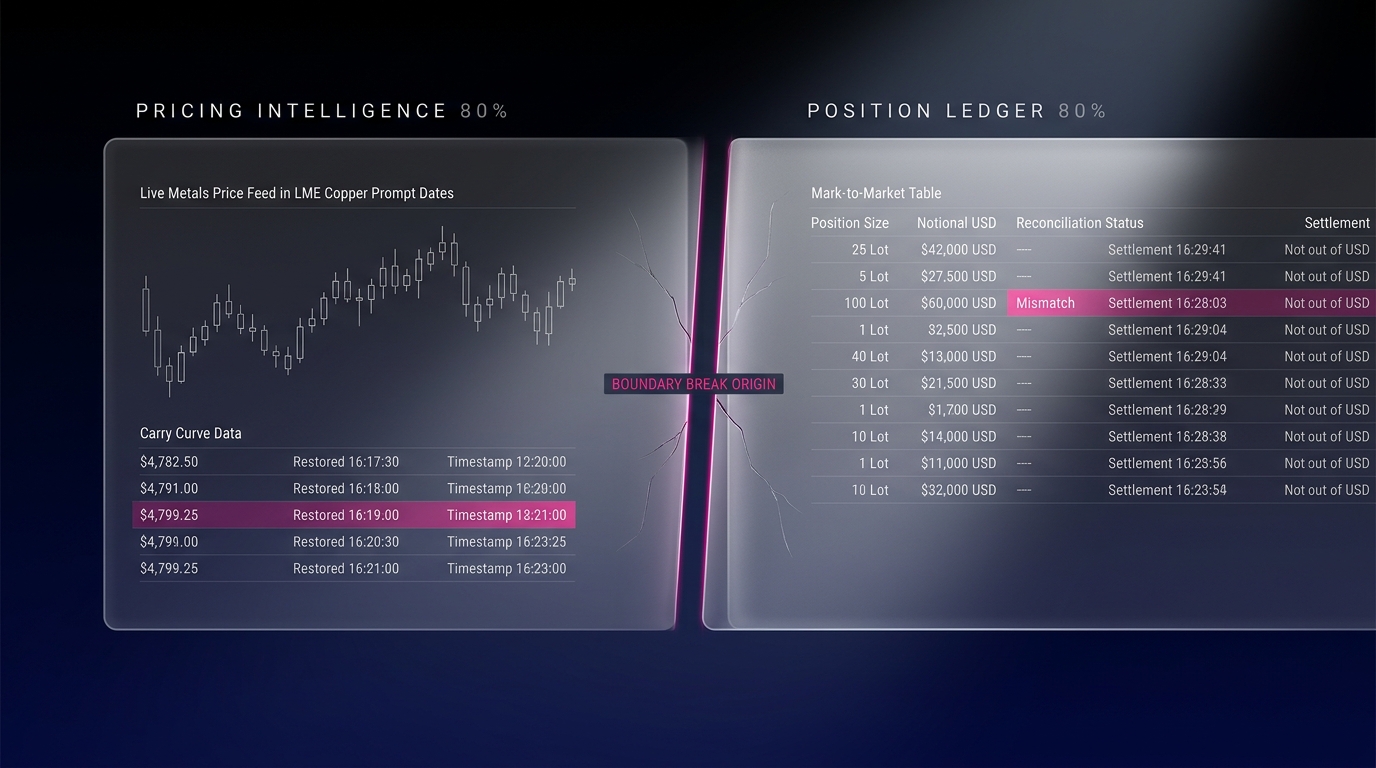
Best-of-breed metals stacks cannot eliminate a specific category of metals reconciliation breaks. Integration cannot fix it. When pricing intelligence and position management operate in separate systems, a structural boundary exists between them. That boundary is the origin point of a break class that no API eliminates. Integration relocates the seam.
It does not close it.
The best-of-breed approach is defensible on its face. Select the most capable pricing intelligence tool, connect it to the most capable position management system, and build an integration layer between them. On paper, coverage is complete. In practice, the space between those two systems functions as a fault line: structurally present, load-bearing in ways that remain invisible until a break surfaces at precisely the wrong moment.
While best-of-breed architecture has broad utility, it contains a specific structural condition that makes one class of metals reconciliation break impossible to prevent from outside the boundary. This establishes why that boundary carries greater consequence in base metals than in almost any other commodity class.
What Makes Metals Reconciliation Breaks Different
What is a reconciliation break in commodity trading?
A reconciliation break in commodity trading occurs when the position recorded in a risk or trading system does not match the position expected from executed trades and market data. In base metals, breaks carry amplified risk because prices move continuously across multiple venues (LME, COMEX, MCX, and SHFE). A position discrepancy that persists for even a few minutes can translate into material P&L error.
Breaks are not created equal. Some originate from data entry errors: wrong lot size, transposed contract code, incorrect prompt date. These are detectable, correctable, and largely preventable through standard validation logic.
A second category originates at the boundary between systems, stemming from timing and semantic differences between how one system records an event and how another interprets it. According to industry analysis from Commodity Technology Advisory LLC CTRM operations benchmarking, reconciliation exceptions requiring manual investigation consume an estimated 15 to 20% of middle-office capacity in commodity trading operations, with that figure scaling upward in multi-vendor environments.
Most stack evaluations focus on data coverage: does the pricing tool carry LME prompt structure? Does the position system support SHFE warrant accounting? These are answerable questions. The boundary break question is structurally harder to examine because it requires modeling what happens between systems rather than inside them.
The Architecture of a Best-of-Breed Metals Stack
A standard best-of-breed metals stack operates across three layers: a market data and pricing intelligence platform, a position management and risk system, and an integration layer (typically API-based or file-exchange-based) bridging the two.
Each component can be excellent at its designated function. A specialized metals pricing tool can deliver granular LME prompt structure, real-time basis data, and curve modeling with high accuracy. A dedicated CTRM platform can handle physical and financial position netting, exposure aggregation, and mark-to-market calculation with precision.
According to a 2023 survey by Commodity Technology Advisory LLC CTRM market landscape report, more than 60% of mid-market commodity trading organizations operate with at least two separate vendor systems for market data and position management, making best-of-breed the dominant operational pattern, not the exception.
The assumption embedded in this architecture is that a sufficiently fast, sufficiently well-designed integration layer will make the boundary between the two systems functionally invisible. This assumption is testable. In metals, under specific and reproducible conditions, it fails.
Can API integration eliminate the gap between pricing and position data?
API integration can reduce latency between pricing updates and position revaluation, but it cannot eliminate the semantic boundary between two independently designed systems. The gap is fundamentally a definitional problem. When the pricing tool and the position system use different internal representations of the same instrument (different day-count conventions, different prompt-date roll logic, different treatment of LME kerb versus ring prices), the integration layer translates between them. Translation introduces the structural possibility of mismatch.
A metals-specific illustration: LME copper trades in 25-metric-tonne lots with specific prompt dates. The carry structure between prompts is live-traded and changes intraday. If the pricing tool computes carry using one interpolation method and the position system uses another (both valid, both documented), their outputs for the same physical trade will diverge. The integration layer passes data correctly. The break still occurs.
The Boundary Problem: Where Metals Reconciliation Breaks Originate
In a best-of-breed stack, the boundary between pricing intelligence and position management is a permanent architectural feature rather than a temporary defect. Every price event must cross that boundary to affect the position ledger. Every crossing is a translation step: a point at which the originating system's representation of an event is interpreted by the receiving system's logic.
The true fault line lies in the gap between two independently designed semantic models.
Why do real-time pricing signals create reconciliation errors?
Real-time pricing signals create reconciliation errors when the receiving position system processes them in a different temporal or semantic context than the one in which they were generated. An LME closing price carries specific meaning: it is the official price for a specific prompt date, recorded at a specific time under specific venue rules. If the position system interprets the timestamp using a different timezone convention, or processes the price in a batch cycle that runs 90 seconds after receipt, its mark-to-market calculation will diverge from the pricing tool's output for that window.
In a slow-moving market, this divergence may fall within acceptable tolerance. In a fast market, precisely when position visibility matters most, a 90-second lag against a 30-point copper move produces a position error that requires manual investigation.
According to the Bank for International Settlements BIS commodity market structure paper, base metals markets on the LME average intraday price ranges of 1.5 to 2.5% under normal conditions, with ranges exceeding 4% during supply disruption or macroeconomic shock. A 90-second translation lag during a 4% intraday move in a 100-lot copper book represents a severe decision-quality failure rather than a minor reconciliation nuisance.
Can the integration layer be engineered to prevent boundary breaks?
The integration layer can be made faster, more fault-tolerant, and better monitored. These improvements are substantive and worth pursuing. But engineering the integration layer to higher standards does not change the fundamental condition: two separately designed systems retain two separately designed semantic models. Engineering effort moves the seam and improves translation quality, but the seam remains.
Beyond integration engineering, architectural topology dictates that when two systems must share a common understanding of "LME copper price at 3-month prompt on a given date," that shared understanding must be constructed, maintained, and versioned across both systems independently. Any divergence, however small or infrequent, produces a break category built into the architecture.
Why Metals Complexity Widens the Fault Line
The boundary problem exists in any best-of-breed financial stack. It is not unique to metals. What is specific to metals is the density and precision of the semantic surface that must cross the boundary cleanly on every cycle.
Base metals carry instrument characteristics that amplify boundary risk. LME contracts trade daily prompt dates for the first three months, weekly thereafter, and monthly beyond that. Carries between prompts are live-traded, not derived from a static formula. Basis risk between LME, COMEX, and SHFE is material and must be tracked in real time. Warrant positions, physical metal location, and financing costs interact with paper positions in ways that demand consistent semantic treatment across pricing and ledger functions simultaneously.
According to the London Metal Exchange LME market statistics, average daily volume across base metal contracts has exceeded 600,000 lots in recent years, representing over $40 billion in daily notional exposure. This is a market with continuous, granular price discovery across multiple instruments and venues. These are precisely the conditions under which semantic boundary mismatches compound into consequential position errors.
How do LME carries and basis affect reconciliation accuracy?
LME carries and basis data are especially sensitive to boundary mismatches because they are computed quantities (derived from multiple underlying price points) rather than single observed prices. When the pricing tool computes carry using live bid-ask midpoints and the position system computes it using settlement prices from the prior close, they are not measuring the same quantity. Both computations may be internally consistent. Their outputs will diverge. That divergence produces a mark-to-market difference that requires explanation and reconciliation.
Basis between LME and COMEX copper introduces a second dimension. A trader running a cross-venue hedge (long LME, short COMEX) requires both sides of the basis marked from consistent price sources at consistent timestamps. In a best-of-breed stack, each side of the hedge may be marked from whichever system is most authoritative for that venue. If those systems use different close times (LME ring close versus COMEX settlement), the basis mark will not be internally consistent. The break is not an error. It is the predictable output of two correct systems measuring at different moments.
What an Integrated Signal-Plus-Ledger Architecture Actually Changes
An integrated signal-plus-ledger architecture, where pricing intelligence and position management share a single semantic model and a single data layer, does not eliminate all metals reconciliation breaks. Data entry errors still occur. Execution errors still occur. But the specific category of break that originates at the boundary between separate systems ceases to exist, because the boundary no longer exists.
When the pricing signal and the position ledger operate within the same system, they share the same timestamp logic, the same instrument definitions, the same prompt-date conventions, and the same interpolation rules. An LME copper price does not travel across a boundary and undergo reinterpretation. It is recorded once, within one semantic model, and both pricing functions and ledger functions operate on the same underlying record.
This represents a fundamental structural difference. Integration can make a best-of-breed stack faster. It cannot make it architecturally unified.
What is a signal-plus-ledger architecture in CTRM?
A signal-plus-ledger architecture is a CTRM design in which market pricing data (signals) and position accounting records (the ledger) are managed within a single unified system, sharing one data model. Pricing updates do not require transmission to a separate position system; they are already available to the ledger function because both operate on the same underlying data. This eliminates the translation step where boundary breaks originate.
While a unified dashboard can display data from separate systems, true integration requires storing and computing data in one place. If the carry calculation for a position mark occurs in the pricing tool and the carry calculation for the ledger entry occurs in the position system, the two computations can diverge even when both are individually correct. When both computations occur within a single system, using a single algorithm on a single dataset, divergence is eliminated by design.
According to McKinsey & Company research on commodity trading technology modernization McKinsey commodity operations report, organizations operating integrated commodity management platforms report 30 to 40% lower middle-office reconciliation effort compared to multi-vendor stacks. This reduction is attributable primarily to the elimination of inter-system translation errors, rather than a decrease in trade volume or complexity.
The Hidden Cost of Living with Boundary Breaks
The direct cost of boundary breaks is middle-office reconciliation time. The indirect cost is decision quality under pressure. That second cost compounds.
Front-office metals traders make hedging and position management decisions using the mark-to-market visible in their position system. When that mark is stale, even by 90 seconds in a fast market, the decision inputs are incorrect. The trader does not necessarily know the mark is stale. The system presents a number. The number gets used.
A 2022 analysis by the International Organisation of Securities Commissions IOSCO commodity market surveillance report noted that real-time position visibility is a critical control for managing commodity price risk, and that gaps between market price and internal mark exceeding defined thresholds must be flagged and investigated. For organizations operating best-of-breed stacks, those gaps function as structural outputs of the architecture during high-volatility periods.
The second hidden cost is operational confidence. When traders know that marks may not reflect current prices during fast markets, they compensate behaviorally: consulting external screens, running shadow calculations, deferring decisions until the system catches up. These workarounds are rational responses to a documented architectural limitation.
According to Accenture research on commodity trading operations efficiency Accenture commodity operations survey, traders in organizations with fragmented data environments spend an estimated 25 to 35% of their analysis time on data validation and reconciliation rather than market analysis and decision-making. That allocation points to an architecture problem.
The same study noted that high-performing commodity trading organizations are three times more likely to operate integrated position and risk platforms than their median-performing peers. This correlation holds after controlling for trade volume and product complexity.
Building on Solid Ground: The Depth-First Case
While best-of-breed stacks do not fail universally, they have a structural inability to eliminate one specific break category. That category carries disproportionate impact in base metals because of the semantic density of LME, COMEX, SHFE, and MCX instruments.
The depth-first response to this problem is to build an architecture that addresses base metals with the specificity the market demands. That means treating LME prompt structure, COMEX settlement conventions, SHFE warrant accounting, and MCX basis as core design requirements, rather than edge cases managed by a translation layer between two systems built for generic commodity coverage.
A platform built with a single semantic model covering pricing signals and position ledger together does not ask traders to trust a boundary they cannot see. It eliminates the boundary. The metals reconciliation breaks that were structural outputs of a fragmented architecture do not appear.
For front-office traders running positions across LME, COMEX, and SHFE, the operational outcome is position visibility that supports real-time trading decisions, without the shadow calculations and manual checks that compensate for an architecture not built to handle what base metals actually require.
The critical question for any metals stack is whether the architecture requires a boundary to exist at all. Where that boundary exists, the breaks that live within it function as a design output. They will surface at precisely the moments when accurate position data carries the most consequence.
Review the Novaex platform overview to see an integrated signal-plus-ledger architecture in practice. Novaex eliminates boundary breaks by design because it is built from the ground up for LME, COMEX, MCX, and SHFE.