The Silent Hedge Ratio Gap Settlement Prices Create
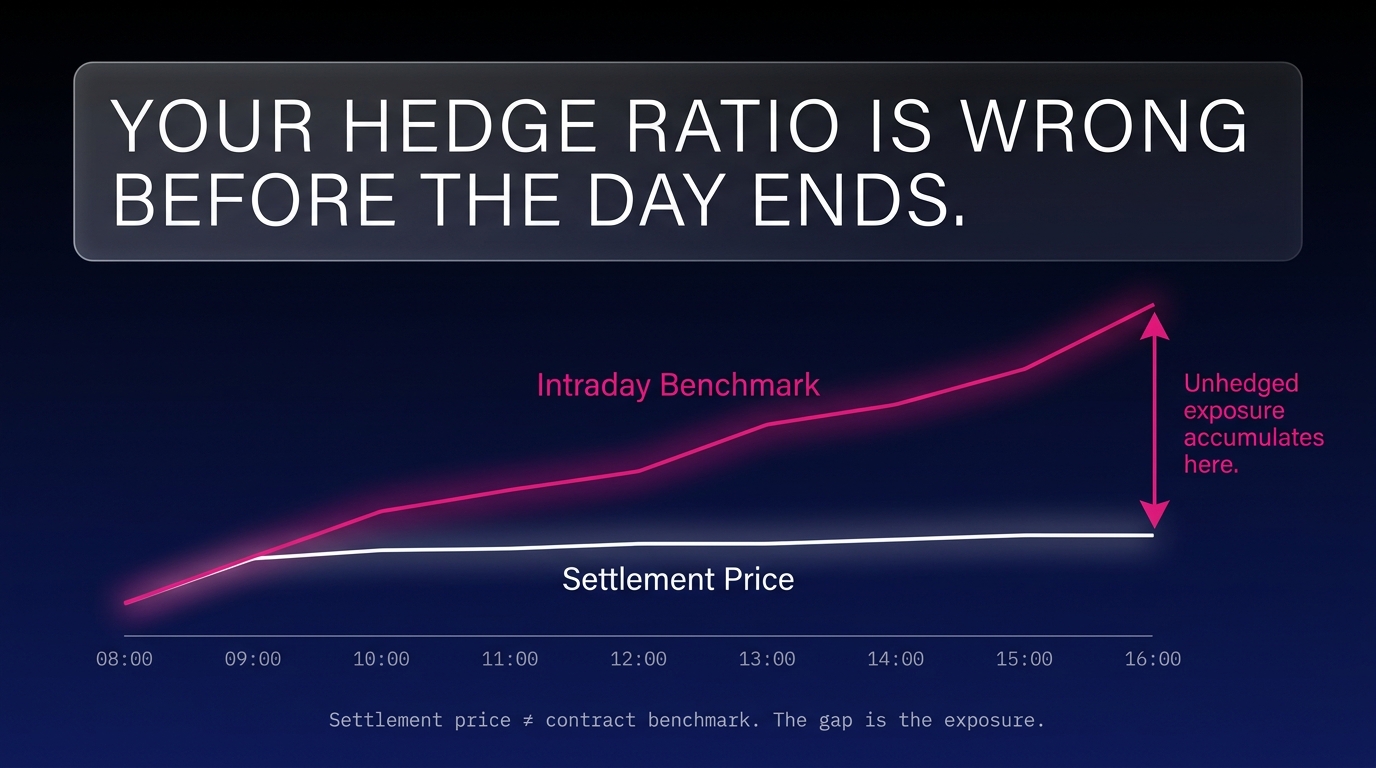
When hedge ratios are calculated using end-of-day LME settlement prices rather than the intraday benchmark at which a physical contract was priced, partial exposure accumulates without detection. No alert fires. No flag appears on the position screen. The gap widens and compounds with every contract added to the book.
That structural invisibility is what distinguishes this problem from recoverable execution errors.
For front-office metals traders managing physical positions against exchange-traded hedges, the working assumption is that a hedged position is flat. Flatness, however, depends entirely on which price was used to calculate the hedge ratio. When that price does not match the actual transaction benchmark (and in physical base metals trading, it rarely does), the hedge ratio is structurally incorrect before trading begins.
Industry risk management research consistently identifies price timing discrepancies as a systematically underreported source of unexplained P&L variance in physical trading books. commodity risk management P&L variance research The problem is purely architectural.
The Disconnect Between Benchmark and Settlement Prices
Physical metals contracts (whether copper cathode, aluminum ingot, or zinc slab) are priced against a benchmark. That benchmark is typically the LME cash price, a three-month forward, or a monthly average tied to a specified time window within the trading day. The LME official cash settlement price is published at a specific moment during the Ring session: the afternoon official prices are declared between approximately 12:30 and 13:00 London time.
Physical trades are agreed throughout the entire trading day. A copper forward-sale priced at the London morning ring captures a number that is structurally distinct from that afternoon's official settlement.
Benchmark Prices vs. Settlement Prices
A benchmark price is the specific price point at which a physical commodity contract is valued, fixed at the time of trade or by a pre-agreed formula referencing a specific session window. A settlement price is the official closing price published by an exchange at the end of its daily pricing session. The two are structurally different mechanisms and will rarely produce the same number.
In active LME copper trading, the spread between morning and afternoon official prices regularly exceeds $20/mt. On a high-volatility session, that gap can exceed $60/mt. LME official price structure and session mechanics This difference is the mechanical source of the hedge ratio error, not noise or an edge case.
The distinction matters because most hedge management platforms treat settlement prices as a universal reference. They apply a single end-of-day number to every physical contract in the book, regardless of when, or against which benchmark, those contracts were actually priced. The result is a systematic miscalculation that is invisible to every standard position report the system produces.
The Copper Benchmark Gap: $9,240 vs. $9,198
Consider a standard physical copper transaction.
A trader sells 250 mt of copper cathode, priced at the LME cash price at the time of the morning ring: $9,240/mt. The sale is agreed, confirmed, and booked. The hedge (a short futures position on the LME) is entered immediately after execution. This is the correct operational sequence.
The hedge management system calculates the hedge ratio at end-of-day using the LME official cash settlement price: $9,198/mt.
The delta is $42/mt.
On 250 mt, that is a $10,500 valuation gap embedded in the hedge ratio calculation. The system reports the position as fully hedged. It is not. The physical leg was sold at $9,240. The hedge is sized to a notional position valued at $9,198. The trader carries a net long position of $10,500 of unrecognized copper exposure (approximately 1.14 mt of unhedged metal) without a single position alert having fired. physical commodity hedging best practices
Exposure at Scale
On a single 250 mt parcel, a $42/mt discrepancy generates $10,500 of unhedged exposure. Scale that to a book running ten simultaneous contracts (a modest physical trading position by most standards) and the silent accumulation reaches $105,000. LME volatility data shows copper price moves averaging 1.2 to 1.8% per day in active markets, meaning unrecognized exposure of this magnitude faces daily mark-to-market swings of $1,260 to $1,890 without any corresponding hedge cover.
This is a structural position, not a rounding error.
The more active the trading book, the faster the gap accumulates. In trending copper markets, where morning and afternoon ring prices consistently diverge in the same direction across multiple sessions, the unrecognized exposure does not oscillate around zero. It builds directionally. A book running 20 contracts per week can accumulate six figures of unrecognized directional exposure within a single month of normal activity.
End-of-Day Settlement Tools and the Hedge Ratio Gap
This error is architectural rather than operational.
Most CTRM and ETRM platforms calculate mark-to-market valuations, hedge ratios, and position reports using end-of-day settlement prices. This approach is operationally convenient. Settlement prices are clean, official, arrive at a consistent time, and integrate directly with exchange clearing and margin workflows. For many use cases, they are entirely appropriate.
Physical metals hedging is not one of those use cases.
The Mechanics of Partial Hedge Exposure
End-of-day settlement prices create partial hedge exposure because physical contracts are priced at specific intraday benchmarks that do not align with the settlement window. When a hedge management system applies settlement prices to calculate the hedge ratio, it recalculates the required hedge based on a price that was never used in the actual transaction. The ratio drifts from the true hedged quantity without any visible position change triggering a review.
The system's internal logic is fully consistent. Its output is structurally incorrect.
Industry surveys of commodity risk management practices indicate that a significant majority of mid-market physical commodity trading firms rely on end-of-day price sources as their primary hedge valuation input. commodity risk management survey data The operational convenience of settlement prices carries an exposure cost that most firms have never systematically measured because the tools used to measure it share the same flaw as the positions they evaluate. The measurement instrument and the position it assesses are miscalibrated in the same direction.
This circularity allows the problem to persist.
The Silent Accumulation of the Hedge Ratio Gap
Most risk exposures have a trigger event. A limit breach fires an alert. A counterparty default triggers margin calls. A price spike activates stop-loss logic. Operational failures generate exception reports that route to compliance. The hedge ratio gap has none of these characteristics.
The exposure accumulates because there is no moment at which the system recognizes a discrepancy. From the platform's internal perspective, everything is functioning correctly. The physical position is booked. The hedge is entered. End-of-day reconciliation matches lot counts, commodities, and tenors. Every operational check passes cleanly. The gap exists in the space between what the system calculates and what actually occurred at the moment of the physical trade.
Detection Challenges
Partial hedge exposure from settlement price lag is difficult to detect because it does not create a position mismatch in the traditional sense: the hedge lot count is correct, the commodity and tenor match, and the system reports the position as flat. The error resides in the valuation layer: the price used to size the hedge differs from the price at which the physical was transacted. Without benchmark-level price attribution at the individual contract level, no standard position report surfaces this discrepancy.
Consider a trading book running 15, 20 physical copper contracts per week. Each carries a benchmark-to-settlement gap that varies by session volatility and market conditions. Over a month of active trading, that unrecognized exposure does not cancel. It accumulates directionally based on whether intraday benchmarks consistently price above or below settlement (a pattern that holds for weeks at a time in trending markets). The book carries a systematic directional bias that has never appeared in any position report and has never been intentionally established as a trading view.
Base metals trading infrastructure research consistently identifies benchmark timing errors among the most prevalent sources of unexplained P&L variance in physical copper and aluminum books, precisely because they remain invisible to the standard reporting architecture that most firms have deployed. base metals trading infrastructure and P&L attribution The exposure is real. The reporting system has no mechanism to surface it.
The Operational Consequence of a Widening Hedge Ratio Gap
The consequence arrives in the P&L.
When copper moves $50/mt over two trading days (a routine event in active markets, not an exceptional one), a book carrying $105,000 of unrecognized net long exposure absorbs $21,000 of unhedged loss on an adverse move. That loss does not appear in the position report as hedge failure. It appears as P&L variance requiring post-hoc explanation, without access to the granular benchmark data that would account for it.
During forensic review, the position is reported as flat while the P&L says otherwise. The reconciliation process begins, and the answer, days or weeks later, is that the hedge ratios were calculated against the wrong prices from the beginning of the affected period.
CME Group's published risk management guidelines for commodity hedging state that the accuracy of hedge ratio calculation is directly dependent on the price source applied, with intraday benchmark attribution explicitly recommended for physical contracts priced outside the settlement window. CME commodity hedging risk management guidelines The recommendation exists because the problem is well understood at the exchange level. It is far less consistently addressed at the platform level where physical books are managed day-to-day.
Operational Risks
An incorrect hedge ratio creates three compounding operational risks. First, unrecognized P&L exposure that accumulates daily without triggering any position alert or breaching any risk threshold, because the system characterizes the position as flat. Second, inaccurate risk reporting to management and compliance: the position is formally reported as fully hedged when it is not, which misrepresents both the risk profile and the capital efficiency of the book. Third, distorted hedging decisions: when traders adjust hedges based on positions that are already miscalculated, each subsequent correction introduces additional error rather than resolving the original discrepancy.
The longer the gap goes undetected, the more embedded the miscalculation becomes across an active book.
Requirements for Accurate Hedge Ratio Calculation
Correcting the hedge ratio gap requires solving the architectural problem, not adjusting the trading workflow.
The solution is price-source attribution at the contract level. When a physical trade is booked, the benchmark (the specific price, the specific time window, and the specific exchange session) must be captured and used as the hedge ratio reference for the life of that contract. Settlement prices have a defined and legitimate role in end-of-day clearing reconciliation and exchange margin calculations. They do not belong in hedge ratio calculation for intraday-benchmarked physical contracts. intraday benchmark pricing methodology for base metals
Novaex is built on this distinction. The platform captures benchmark-level price attribution at the point of trade booking. It records the specific session, time window, and exchange reference for each physical contract, applying that captured benchmark as the hedge ratio reference throughout the contract's life. Position management logic applies the correct price source to each contract individually, not a single daily reference applied uniformly across a book containing contracts priced against different benchmark windows. This is the architectural standard that physical metals hedging accuracy requires.
This requires intraday price data at the benchmark level across LME, COMEX, MCX, and SHFE sessions, and position management logic that preserves the distinction between benchmark-priced and settlement-priced contracts from booking through close.
Data Requirements for Accurate Calculation
Accurate hedge ratio calculation for physical metals requires intraday benchmark price data at the specific session, time window, and exchange referenced in each individual physical contract. For LME-priced copper, this means capturing the official cash price at the morning or afternoon ring, not the end-of-day settlement. LME official documentation specifies seven distinct official prices per session per metal: cash buyer, cash seller, cash mean, three-month buyer, three-month seller, three-month mean, and the official settlement price. Each represents a different moment and a different market mechanism. Applying the wrong one is not a minor calibration issue. It is a different number, applied to the wrong position, producing a hedge ratio that does not reflect the actual transaction.
The gap between a fully hedged book and a structurally exposed one is not visible in the lot count or the position summary. It is visible only in the price source. Platforms built without this architectural distinction cannot surface it.
Conclusion
The hedge ratio gap created by settlement price lag is structural, silent, and systematic. It accumulates without triggering any alert, appears in no standard position report, and surfaces only when unexplained P&L variance forces a forensic review of positions the system reported as flat.
For physical metals traders, the operational implication is direct: a book reported as hedged may be carrying growing directional exposure that compounds with every session. The magnitude of that exposure scales with market volatility, contract frequency, and the consistency of benchmark-to-settlement divergence, all of which are elevated in active base metals trading environments.
Three verifications every metals trading operation should complete before the next session:
- Identify the price source used for hedge ratio calculation in your current platform. If the answer is end-of-day settlement, the gap already exists in your book.
- Audit the spread between physical transaction benchmarks and settlement prices across your last 30 trading days. Quantify the exposure delta on each contract individually.
- Determine whether your position reports distinguish benchmark-priced contracts from settlement-priced contracts, or whether both are reported against a single daily reference that treats every physical trade as if it priced at the close.