Tin and lead: how to hedge thin liquidity without widening your basis
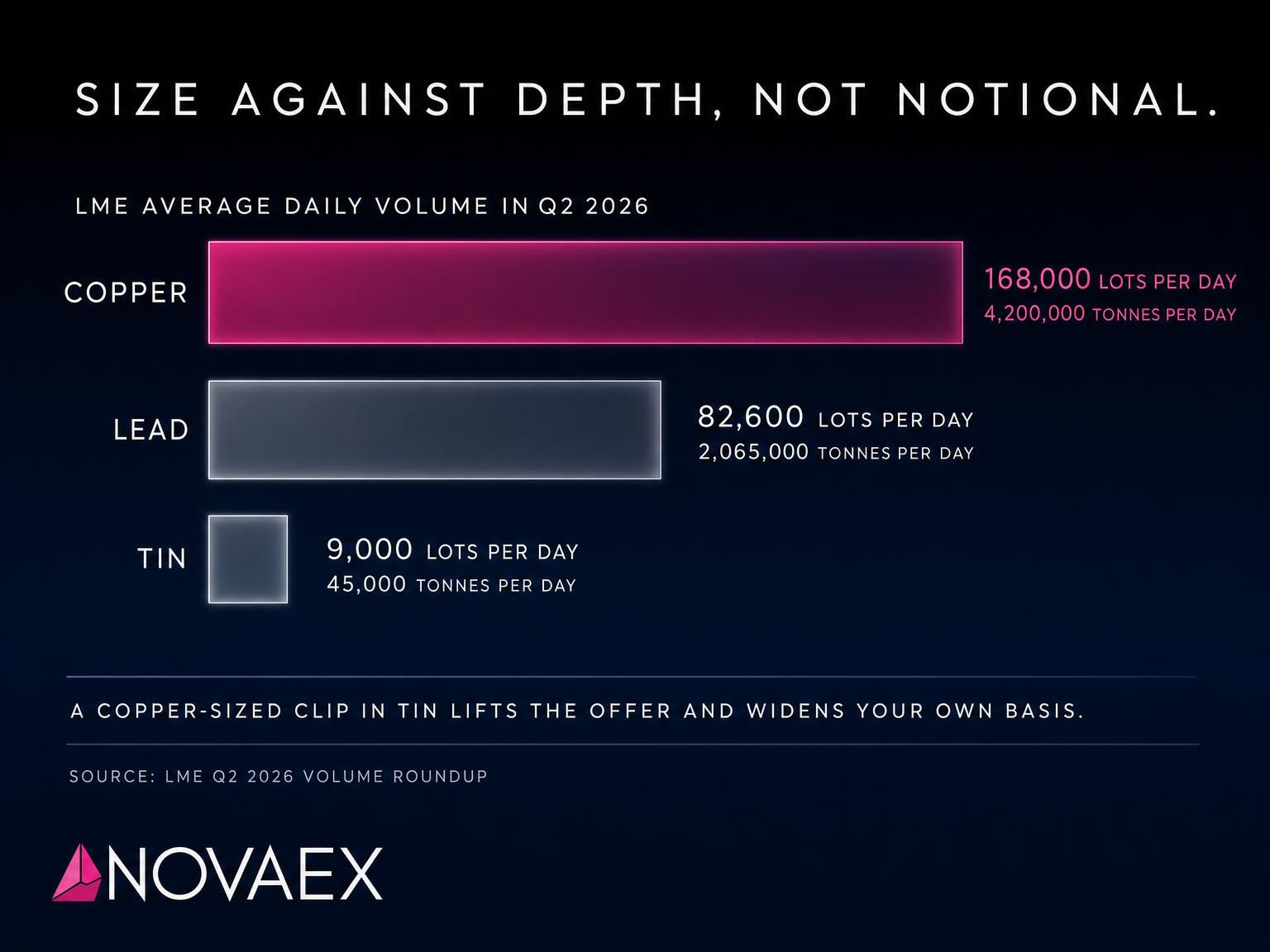
Copper absorbs a desk-sized order. Tin reads it before it prints. The sizing rule that keeps the hedge from moving its own basis.
Size tin and lead hedges against visible depth, not notional. In Q2 2026 the LME averaged 168,000 copper lots a day against 9,000 in tin and 82,600 in lead, per the LME Q2 2026 volume roundup. A copper-sized clip in tin lifts the offer and widens your own basis, so split the order, work it across prompts, and check depth before you deal.
Why does a copper-sized hedge move the price in tin and lead?
Because the book behind the price is a fraction of copper's. Copper absorbs a desk-sized clip without noticing. Tin notices yours.
The tonnage makes it concrete. Copper at 168,000 lots x 25 tonnes a lot is 4,200,000 tonnes crossing the exchange in the day. Tin at 9,000 lots x 5 tonnes a lot is 45,000 tonnes. Lead sits between the two: 82,600 lots x 25 tonnes a lot is 2,065,000 tonnes, roughly half of copper's depth in tonnage terms.
When your order is a visible share of the day's depth, the market reads it before it prints. The offer steps away, the quote widens, and the hedge fills against a basis you moved yourself. That slippage is not a market call gone wrong. It is the hedge.
What does a moved basis cost you?
Every step the offer takes away from you is paid on every tonne in the clip. On a 25-tonne lead lot, a quote that walks a few dollars while you deal multiplies across the whole lot before the fill is done. Nobody sends a bill for it. It sits inside the fill price, which is why it survives every post-trade review that only checks whether the hedge was placed.
What is the depth-first sizing rule?
Cut the order into clips that each sit inside what is showing, and work them one at a time. Before every clip, read the bid and offer depth at your prompt date. If the clip would take most of what is there, halve it. Depth sets the size. Notional does not get a vote.
This inverts the copper habit. On copper the desk sizes from exposure: so many tonnes to cover, so many lots dealt. In tin and lead the binding constraint is the other side of the screen. A 20-lot tin clip sounds small until it meets a morning book showing single lots on the offer. The rule keeps every fill inside the market as it stands, instead of inside the market as your spreadsheet assumes.
How do you work the order across the session?
Spread clips across prompts and across the trading day, and pause when the spread answers back. If the bid-offer widens after your first clip, that is the book telling you it needs time to refill. Step away, let other flow arrive, and re-cut the next clip against fresh depth.
Keep each clip to its own prompt date where the physical allows it. Stacking every lot onto the same prompt concentrates your footprint exactly where the book is thinnest. And deal inside the liquid hours. A thin book at the edges of the day is thinner still, and the basis paid for finishing early is rarely worth it.
When do you leave part of it unhedged?
When the depth will not take the full clip without moving against you. A partial hedge held at a clean level beats a full hedge that cost you the basis to complete. Carry the residual into the next session and work it the same way.
This is the judgement the desk earns its keep on. Covering the last few lots at any price feels like discipline and prices like the opposite. Name the level where dealing stops helping, write it down before the desk opens, and hold it when the screen tempts you past it.
Can tin and lead be hedged on the LME at all?
Yes. Both trade as physically settled LME futures with global reference prices: tin in 5-tonne lots and lead in 25-tonne lots, with monthly prompt dates out the curve. The contracts are standard. Only the depth is unusual.
Size the next tin clip against the book, not the spreadsheet.