US refined copper duty from 1 January 2027: three scenarios for your book
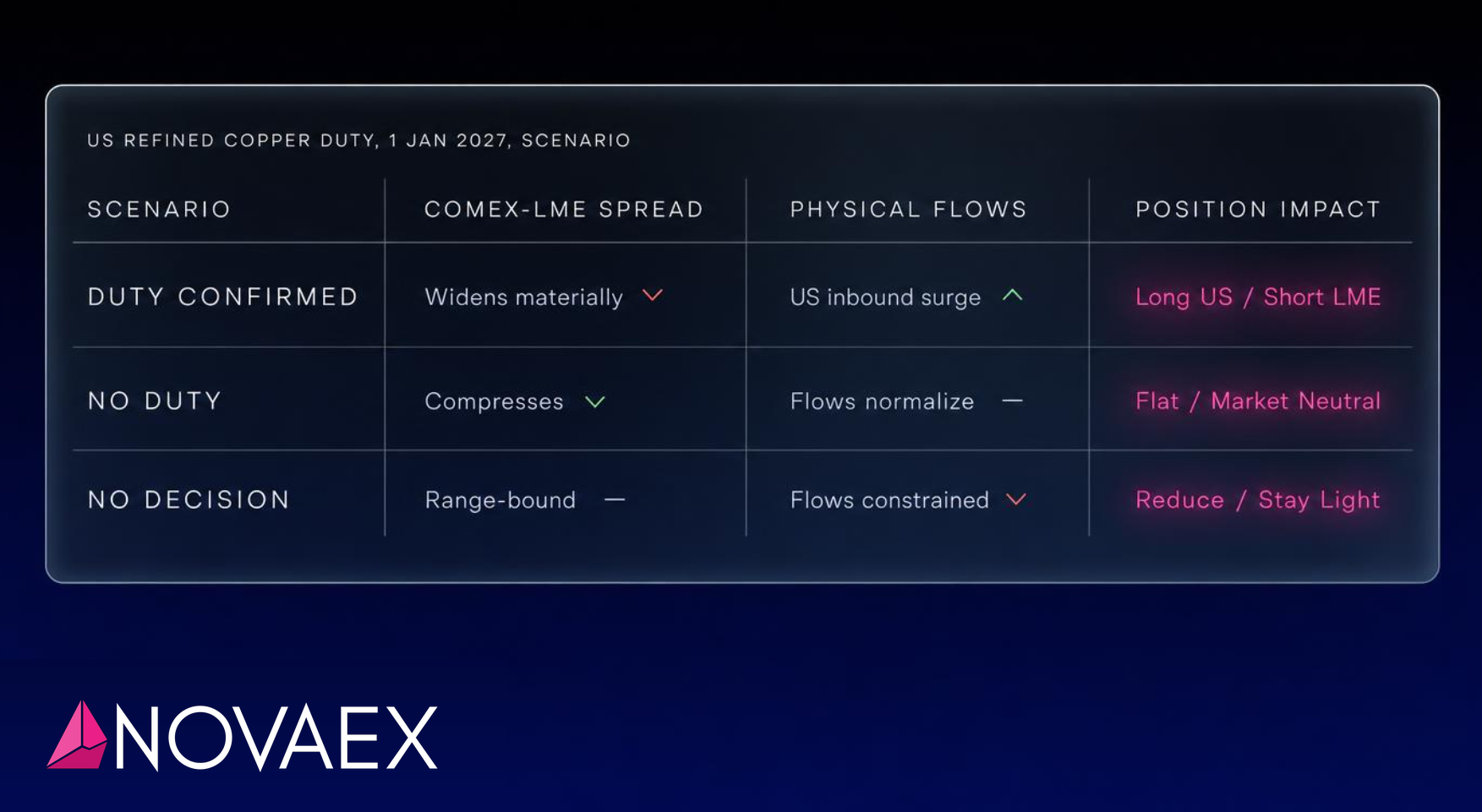
No decision has been verified. Here is what each outcome would do to the COMEX–LME spread, physical flows and your position, so the table is ready before the news is.
No decision on a US duty on refined copper has been verified. The 30 July 2025 proclamation asked Commerce to report on a possible 15% duty from 1 January 2027, and as of 23 November we found no approval. Three outcomes are live, and each moves the COMEX–LME spread, physical flows and your position differently.
What is known about a US refined copper duty from 1 January 2027?
Very little is decided. Proclamation 10962, signed 30 July 2025, put a 50% tariff on semi-finished copper products and copper-intensive derivatives from 1 August 2025. Refined copper was left out. The proclamation asked the Commerce Secretary to update the President by 30 June 2026 so he could decide whether a phased duty on refined copper, 15% from 1 January 2027 and 30% from 1 January 2028, is warranted.
Commerce delivered that update, but the decision has not followed. The ICAA weekly brief of 12 November says the recommended tariff "has still not been approved". It also notes that Democrats won both chambers on 3 November, which Saxo Bank reads as lowering the odds, and that Deutsche Bank cautions Section 232 tariffs remain within the President's power, so the risk is reduced, not removed. In mid-October, Kitco reported analysts suggesting the January date could pass without a decision.
We searched for a November announcement on 23 November and found none. Nothing here is a prediction. Check the day's news before you act on any row below.
What does each outcome do to the position?
The table is built for a book that holds US-warehoused metal, prices sales off COMEX, or hedges on LME against physical that ends up in the US. The directions follow how the market has been reading each case, not forecasts of size.
Scenario COMEX–LME spread Physical flows Position impact
Duty confirmed (15% from 1 Jan 2027) Premium rebuilds toward the cost of the duty Imports pulled into the US ahead of the date; ex-US supply tighter Long US-priced metal gains; ex-US physical priced off LME plus a wider premium
No duty (rejected or lapses) Stays at or below parity; arbitrage stays closed US-held metal has no tariff reason to stay; some already booked toward China Anything bought for the premium marks down; sales off COMEX earn no premium over LME cost
No decision by 1 Jan Trades on the odds, moves on each headline Flows stall between the two cases Basis risk carried unhedged, repriced on news
The second row is already the market's lean. The ICAA brief has COMEX at a premium of more than US$700/t in August, US$200–250/t a fortnight before 12 November, and about US$25/t below LME three-month on 11 November. Crux Investor, citing SMM, put the spread near parity on 18 November.
How do you read which way the market is leaning?
Watch the cross-exchange spread. It is the market's running price on the duty. When the premium of COMEX over LME falls, the market is pricing a lower chance of the duty. When it rebuilds, the opposite.
Pulse computes that cross-exchange arbitrage per metal. LME and MCX prices are live on screen; COMEX is computed into the arbitrage view and not displayed as a live price. The spread is the number to put beside each row of your own table.
Physical flows sit next to it. Crux Investor reports a record China import premium of US$360/t on 18 November, and the ICAA brief puts COMEX stocks at a record of about 732,000 t. Metal sits in the US while the premium builds elsewhere, which is why a no-duty outcome moves flows as well as price.
What does it look like on a realistic book?
Take a hypothetical merchant desk with 2,000 t of cathode in a US warehouse, bought on LME-linked terms. A January sale to a US consumer is priced off COMEX. The LME hedge covers the flat price and leaves the COMEX–LME spread open.
Every US$100/t move in the spread is US$200,000 on that tonnage: 2,000 t × US$100. If the duty is confirmed and the premium rebuilds, the sale prices above the LME-linked cost. If there is no duty and COMEX sits where it did on 11 November, about US$25/t below LME three-month, the sale prices US$50,000 below it on the spread alone, before freight and warehouse costs.
The hedge did what it was for and the position still moved. Defending the hedge means knowing how much of the book sits outside it, per outcome.
What should you check before 1 January?
Four things, in this order:
The day's news on the proclamation, since nothing here is decided.
The COMEX–LME spread, as the market's read on the odds.
Your tonnes in the US, priced off COMEX, and hedged on LME.
The gap between the last two. That is your spread exposure.
Pick two or three rows of the table and fill in the left-hand side from your own books. The table then says what each outcome does to that gap.
Where do you see this on your own book?
Ledger reconciles physical, hedge and broker books into one position, with the trail behind each figure, so the gap above is a reconciled number and not a month-end estimate. Pulse supplies the spread. LME and MCX pricing is on live prices
Seeing it run on your own book is a call away.