What time of day is your daily MTM actually struck?
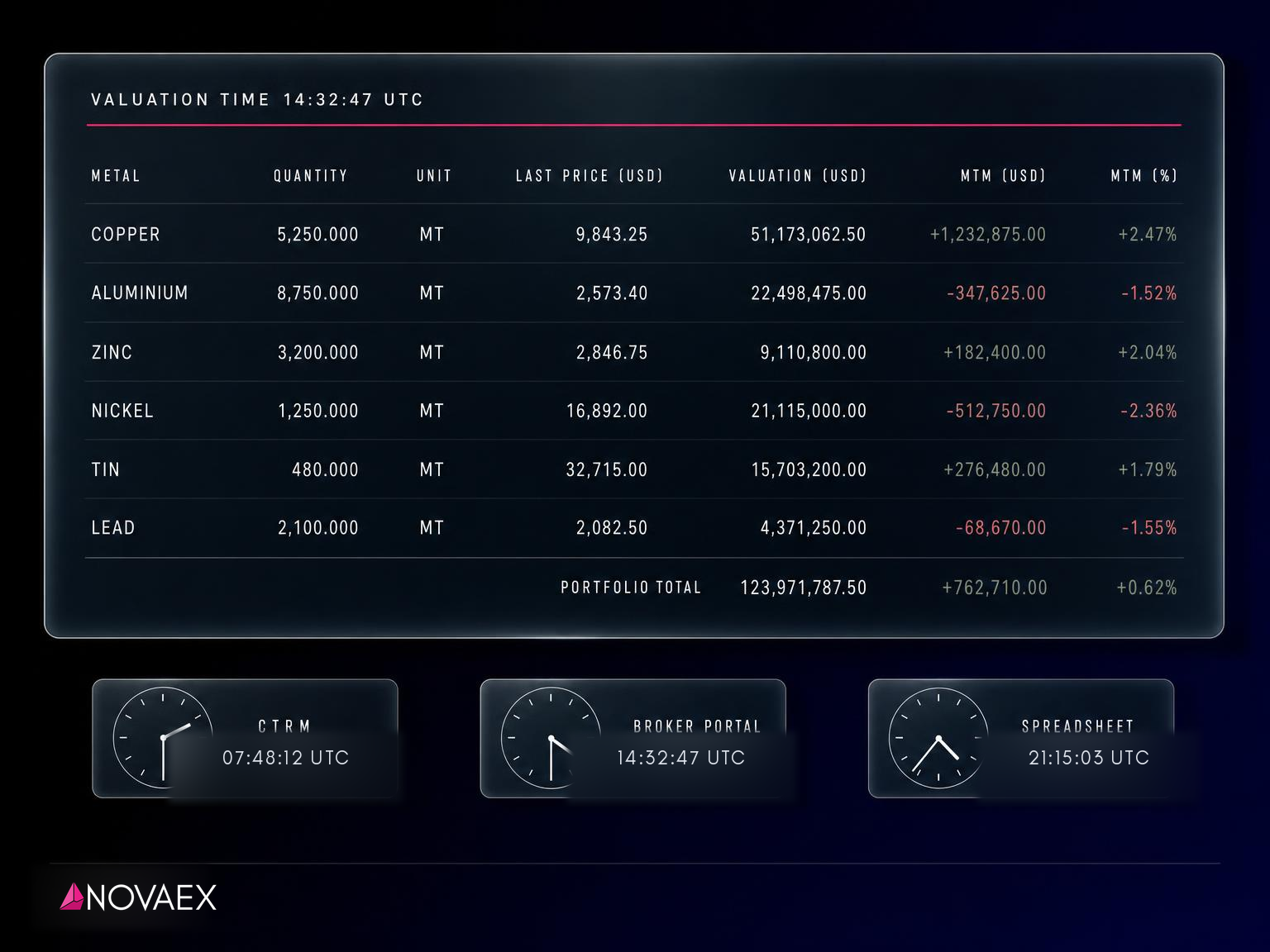
Your CTRM, your broker portal and your spreadsheet each strike their valuation at a different hour. One published clock turns three closes into a number you can prove.
A defensible daily MTM names its valuation clock: one timestamp, one price source per leg, applied the same way each day. Where the CTRM, the broker portal and the spreadsheet each strike at a different hour, the blended total is three closes added together, and nobody can prove it.
Most desks do not have an MTM problem. They have three MTMs, each correct inside its own system. The CTRM revalues the physical book at its own close, often the LME official prices carried overnight. The broker portal revalues the hedges at settlement, on the broker's own cut-off. The spreadsheet that holds the parcels the CTRM never modelled revalues whenever someone opens it, at whatever price was pasted in. Add the three and the total moves with the hour it was assembled, not with the market.
Why do the CTRM, the broker portal and the spreadsheet disagree?
Each source strikes its valuation at a different time, off a different price, for a different book. The CTRM prices open physical against the forward curve at its close. The broker marks the hedge book at the settlement price for the clearing cut-off. The spreadsheet prices the leftover parcels at the last price anyone typed in.
None of those is wrong on its own terms. The error enters when the three are totalled as though they share a clock. A morning CTRM export plus an afternoon broker statement plus a spreadsheet priced yesterday is not a daily MTM. It is a composite of three days' thinking with one date stamped on it. The board reads it as a number. Audit will read it as three.
Which clock sets the timestamp?
The exchange settlement for the quotation period sets it, and one source owns each leg. Physical legs take the LME official and forward curve for their period, with LME and MCX live on screen and COMEX and SHFE computed into the arbitrage view. Hedge legs take the broker settlement for the same cut-off. The spreadsheet takes the same curve at the same hour or it stops contributing to the total.
Fix the order this way. The quotation period on each parcel names the price. The valuation clock names the hour that price is taken. The source hierarchy names who supplies it: exchange curve for physical exposure, broker settlement for cleared hedges, spreadsheet only where it is re-priced at the same clock. Where two sources cover the same leg, the broker settlement wins for the hedged leg and the exchange curve wins for the physical leg. Write that down once and the argument about whose export is right ends.
The practical point is narrow. Pick one cut-off the desk can actually meet, after the LME official prices are out and before the broker statement lands, and hold every source to it. A clock nobody can meet moves by itself each day, which is how the timestamp drifts back into three closes.
How do you strike one MTM across all three?
The same four passes each day, in the same order, against the same clock.
First, freeze positions per source at the cut-off. CTRM physical by parcel and quotation period. Broker hedges by contract and prompt date. Spreadsheet parcels listed separately, with their period stated. Anything booked after the cut-off belongs to tomorrow.
Second, re-price each leg at the clock. Physical at the exchange curve for its period. Hedges at the broker settlement. Spreadsheet parcels at the same curve, looked up fresh, not carried from yesterday's paste. A leg without a period gets one before it gets a price.
Third, total by period before totalling across the book. October physical against October hedges, November against November. Netting across periods hides the basis the desk is actually carrying, and it flatters the MTM on exactly the days the curve moves.
Fourth, attach the trail line by line. Parcel, period, price taken, source, hour. The trail is what turns the total from a figure into a position the desk can prove, because anyone checking it can see which price was taken for which parcel and when.
This runs over the CTRM, the broker portal and the spreadsheet already in place. Nothing gets replaced. The change is the discipline: one clock, one price per leg, one order of operations, every day.
What should you publish to the desk?
A short valuation note the whole desk can recite. The cut-off hour. The price source for each leg. The owner of each export. The place the trail lives.
Keep it to four lines. Valuation struck at a named hour each day. Physical at the LME curve for the stated period. Hedges at the broker settlement for the same cut-off. Breaks listed with owner and close time, carried into tomorrow where still open. Pin it where the desk assembles the number and date each change to it.
A risk owner who can say those four lines has answered the question this piece opened with. One who cannot is still adding three closes together.
Pick your valuation clock and publish it before the next close.