What Your Metals Trading Platform Gap Means This September
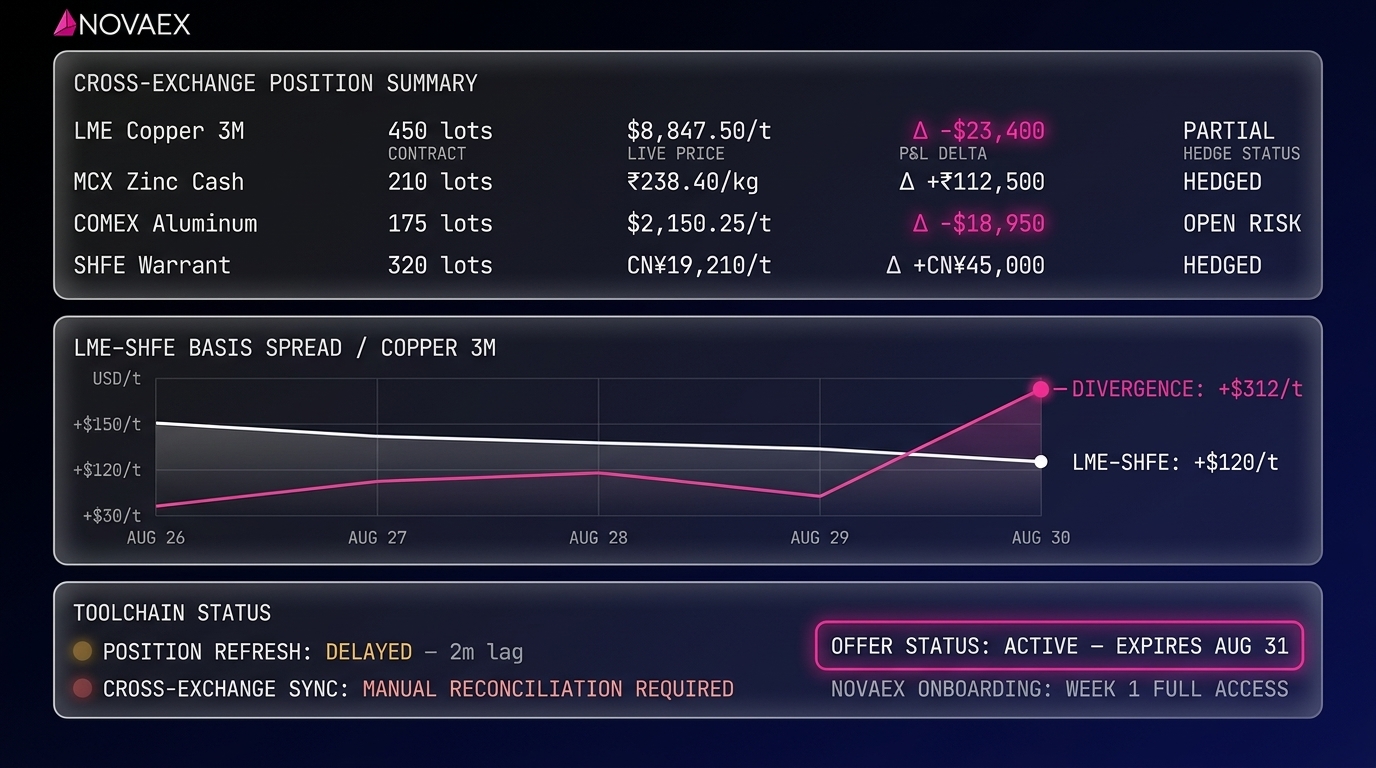
The metals trader reading this post has already made the diagnosis. The platform lags when the market moves fastest. The position data requires manual reconciliation. The workaround spreadsheet exists because the toolchain does not close the gap on its own.
TL;DR: A metals trader who has identified toolchain inadequacies (fragmented position data, delayed visibility, manual workarounds during peak volatility) faces one operational decision before August 31st: act on that diagnosis or carry it, unchanged, into the Q4 trading calendar that will most expose it.
This post focuses on alignment between the assessment a professional has already made and the decision that follows from it.
The Diagnosis You've Already Made About Your Metals Trading Platform
Most metals trading desks arrive at the same conclusion through different routes. Some reach it during an LME session when their metals trading platform's position refresh lags the market by two minutes and those two minutes define the quality of the hedge. Others reach it after a manual reconciliation burns the first three hours of a session when LME and SHFE positions should have been visible in a single view from the open.
A few reach it looking at a risk report that shows gross exposure across copper, aluminum, and zinc, but cannot explain why the numbers moved between yesterday's close and this morning's open.
The conclusion, in each case, is the same: the toolchain was not built for what the job actually requires.
Why Do Metals Traders Rely on Manual Workarounds?
Manual workarounds in metals trading exist because platforms fail to close the gap between data and decision. According to a 2023 report by Commodity Technology Advisory, over 60% of commodity trading firms cite data integration gaps as their primary operational risk. This is a direct result of the infrastructure they chose to run on.
The workaround serves as evidence that the platform has transferred its structural problem to the trader. Every spreadsheet built to compensate for delayed position data documents a platform capability gap. This is a burden the trader has absorbed into their workflow in the absence of a native resolution.
Manual workarounds tend to stick around for a specific reason. Traders build them because they work well enough to prevent catastrophe. And "well enough to prevent catastrophe" quietly becomes the operating standard when no immediate alternative is visible.
Traders reading this post in late August usually do so because the workaround is still running, and they have accumulated sufficient evidence to know it should not have to.
What Manual Workarounds Are Actually Costing Your Trading Desk
The financial cost of a manual workaround is difficult to quantify in isolation, which is why it rarely appears in a technology ROI calculation. The operational cost is easier to measure and more actionable.
A metals desk running simultaneous positions across LME, COMEX, and SHFE requires position visibility that refreshes in near-real time. According to research published by the International Organization of Securities Commissions, latency in cross-market position reporting creates compounding risk in correlated commodity markets, an effect particularly pronounced in base metals where LME prompt structures and SHFE warrant positions interact within the same trading session IOSCO market data report.
When a trader builds a manual bridge between two systems that do not communicate natively, they are simply absorbing the problem, converting a platform deficiency into a personal workflow obligation that drains mental energy better directed at the market.
What Does Data Fragmentation Cost a Trading Desk?
Data fragmentation costs a trading desk the one resource it cannot recover: decision time during peak volatility. A 2022 study by McKinsey & Company on commodity trading operations found that fragmented data environments extended average trade decision cycles by 23% (measured under normal market conditions, not stress periods) McKinsey commodity trading operations.
In practice, a copper desk watching an LME three-month spread move 40 basis points cannot act with the same precision as a desk with unified position, pricing, and risk data in a single view. Traders operating on fragmented data suffer because their tools make speed structurally unavailable to them.
The cost is the cumulative drag on decision quality across an entire quarter. This is the compounding effect of executing every hedge, every position adjustment, and every risk assessment against information that is incomplete by design.
commodity trading decision latency
How Data Fragmentation Rewrites the Q4 Metals Trading Calendar
September 1st marks the start of Q4 preparation. This timeline brings measurable consequences for base metals desks.
The base metals market enters its most consequential trading period of the year as industrial demand forecasts from manufacturers become clear, LME warehouse stock movements begin signaling supply chain positioning, and SHFE activity from Chinese industrial buyers creates cross-market pressure that requires active, informed hedging. According to London Metal Exchange data, average daily trading volumes in base metals rise approximately 18% in Q4 compared to Q3, with copper and aluminum leading the increase LME volume statistics.
The highest performing desks in Q4 are the ones whose infrastructure allows them to act on their fundamental views without friction. A fragmented toolchain becomes even more consequential in Q4 because the moments when platform limitations matter most arrive more frequently.
How Does Delayed Position Visibility Affect Hedging Decisions?
Delayed position visibility affects hedging decisions by forcing traders to hedge against a position snapshot rather than a live position. According to the Risk Management Association's 2023 Commodity Risk Survey, firms with real-time position data execute hedges with 31% lower basis risk compared to firms relying on end-of-day or materially delayed position feeds RMA commodity risk survey.
The practical implication is precise: hedging with stale data creates a structural error baked into the hedge itself. The hedge is correct for the position the trader believed they held, not the position they actually held at execution. That error is invisible until it resolves in the market (sometimes in the trader's favor, sometimes not).
Across a Q4 metals trading calendar, that structural error compounds across every hedge execution that relied on incomplete position information. The aggregate is a systematic drag attributable to platform design rather than market judgment.
base metals hedging best practices
What a Depth-First Metals Trading Platform Actually Changes
The depth-first approach to commodity intelligence begins from a different premise than the multi-commodity platforms most base metals desks currently run on. Instead of building horizontal coverage across every commodity category and delivering undifferentiated intelligence in each, a depth-first metals trading platform commits to knowing a single category completely before expanding further.
For base metals, complete means integrated coverage of LME prompt structures, MCX cash pricing, COMEX warehouse stock dynamics, and SHFE warrant movements. Instead of separate data feeds requiring manual reconciliation, this requires a unified analytical layer that a trader can interrogate without switching systems or building bridges between sources.
According to a 2023 Accenture report on commodity data infrastructure, traders operating on unified data platforms reported a 40% reduction in time-to-decision during high-volatility periods compared to peers on fragmented systems Accenture commodity data report. This is a massive shift: the difference between a platform that delivers intelligence and one that delivers inputs the trader must convert into intelligence themselves.
What Should a Base Metals Trading Platform Include?
A base metals trading platform should include real-time position management, cross-exchange pricing intelligence across LME, MCX, COMEX, and SHFE, integrated risk analytics, and physical workflow support, all accessible within a single interface without requiring manual data transfer between systems. Research from Gartner's 2023 CTRM Market Guide indicates that platforms requiring more than two system integrations for standard trade workflow completion create statistically significant increases in operational error rates Gartner CTRM guide.
The operational definition of completeness is whether a trader can move from market signal to hedged position without leaving the platform to retrieve information from a secondary source. Measured against that standard, most platforms covering base metals fall short. Genuine depth in base metals requires understanding how LME warrant dynamics, SHFE positioning, and COMEX inventory interact within the same session.
A depth-first platform changes the job description of the trader by removing the integration burden (the mental overhead of reconciling data from disparate sources) and returning that energy to where it belongs: reading the market and making decisions.
The September Decision
The evidence presented in this post supports a specific operational conclusion.
A metals trader who has identified the toolchain gap (who has watched their platform lag during an LME session, built the workaround spreadsheet, and executed a hedge against a position they were not certain was accurate) faces a specific decision before September begins: address the gap before Q4 amplifies it, or carry it forward into the quarter that will most expose it.
According to the Association for Financial Professionals' 2023 Risk Technology Survey, 74% of commodity trading professionals who identified operational toolchain inadequacies in Q3 but deferred technology changes to the following year reported that the same inadequacies directly affected their Q4 performance outcomes AFP risk technology survey. The finding reflects a straightforward dynamic: known infrastructure limitations produce predictable performance impacts when the trading conditions that stress them arrive on schedule.
When Is the Right Time to Upgrade a CTRM Platform?
The right time to upgrade a CTRM platform is before the period that will most expose its limitations. For most base metals desks, that period is Q4, when volume increases, volatility is structural rather than episodic, and the operational premium on accurate, real-time position data is at its annual peak.
A 2022 Deloitte survey on trading technology transitions found that firms implementing new CTRM capabilities at the start of Q4, rather than mid-quarter, reported 28% smoother adoption curves and meaningfully better performance outcomes in the first 60 days of use Deloitte trading technology transitions.
September 1st is a natural reset point. Teams are reorienting from summer trading rhythms. Forward position books are being restructured for Q4 inventory and demand cycles. The trading calendar is being mapped. A platform transition at this juncture integrates into existing workflow restructuring rather than interrupting an active campaign. A trader who enters September with the same toolchain is making an active choice, one that takes effect by default if the August window closes without a decision.
CTRM platform implementation timeline
What August 31st Represents as a Decision Point
A deadline attached to a technology decision can feel promotional, but August 31st represents a structural reality. It marks the last practical opportunity to make a decision before the conditions that made it relevant arrive in full force.
According to Commodity Technology Advisory's annual CTRM spending report, organizations that planned and initiated focused CTRM deployments in Q3 reported average time-to-full-functionality of 4.2 weeks for scoped implementations, meaning a decision made in late August produces a functional platform by mid-September, before the Q4 calendar reaches peak activity CTRM implementation timeline data.
The structural fact, stated once: Novaex subscriptions initiated before August 31st begin onboarding immediately, with full platform access (integrated position management, cross-exchange pricing intelligence, and risk analytics) available within the first implementation week.
That is the offer. It appears once in this post because it needs to appear once. The operational decision it enables is what the post has addressed from the first paragraph.
Infrastructure Readiness Is a Pre-Quarter Decision
The data on this point is consistent across sources.
According to a 2023 Oliver Wyman report on trading desk performance, the single largest predictor of Q4 performance improvement in commodity trading was infrastructure readiness entering the quarter Oliver Wyman trading performance report. Infrastructure readiness is the outcome of a decision made before the quarter begins, when the implementation window is still open.
The highest performing traders in Q4 are the ones who recognized the toolchain problem and acted before September made the gap consequential.
Three concrete steps for the trader who has made the diagnosis:
- Map current toolchain gaps against Q4 workflow requirements. Document what you are compensating for manually: position refresh rate, cross-exchange pricing integration, risk analytics access during active sessions. The manual workaround you have normalized is the gap you are carrying into Q4.
- Identify the specific Q4 moments when those gaps will be most consequential. Peak LME volatility windows. SHFE warrant reporting periods. COMEX inventory release dates. These are the moments your toolchain will be tested, and they arrive on a known schedule.
- Make the decision that the diagnosis already points to. The analysis is complete. The remaining question is operational: whether to enter Q4 with the infrastructure the work actually requires.
August 31st is the boundary of the implementation window: the point after which a pre-Q4 deployment is no longer viable on the timelines the data supports.
Traders who enter Q4 with adequate infrastructure made that outcome possible by acting before the quarter arrived, while the window to act was still open.
That window closes August 31st.