Where do we actually stand? A three-book check after LME Week
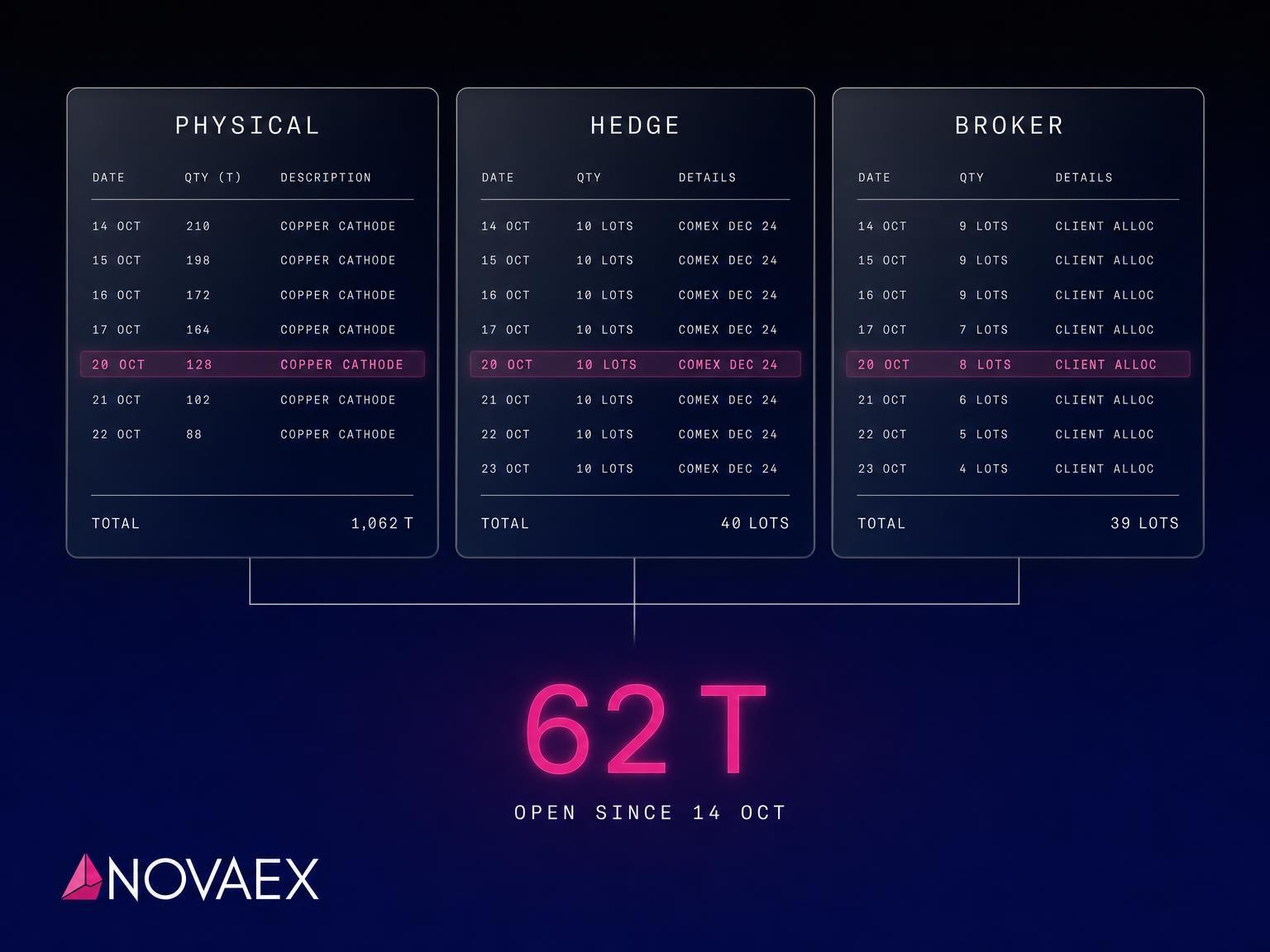
A line-by-line reconciliation across physical, hedge and broker books, for risk owners who want the number this week and not at month-end.
You stand where your physical, hedge and broker books agree, and after a volatile fortnight they rarely do. Run one check this week: match tonnage, quotation period and price basis across all three, explain every difference, and flag whatever stays open. Month-end is too late to find it.
What has moved since LME Week, and why does it widen the gap between books?
Copper premiums, the curve and nickel's price basis have all shifted since LME Week. Each move reaches the physical, hedge and broker books on a different schedule, so the same tonne can carry three different prices by Friday. The wider the move, the bigger the gap that month-end inherits.
Three-month LME copper closed at $14,364 per tonne on 21 October, down 0.4% on the day from a three-week high of $14,700 on 14 October, while LME stocks rose by 11,475 t, according to ScrapMonster's report of the Mining.com story. The same report has Codelco offering European customers 2027 copper at a record $350 per tonne premium over LME. Nickel rose 4.1% that day to $16,310 on expectations of Indonesian output cuts, which remain under discussion and are not confirmed.
Underneath, Fastmarkets wrote on 14 October that US tariff uncertainty pulled metal into the US, drained LME stocks and pushed nearby spreads into steep backwardation over the summer. By 2 November, LME official prices in KME's table had copper at $14,380 and nickel at $15,260.
A fortnight like that leaves a book with a new premium, a different curve and a nickel price on a basis the contract may not use. None of the three books refreshes at the same time.
Where does drift creep into the three books?
Three places, in this order: quotation periods that no longer line up, broker confirmations that arrive after the physical book has moved, and premium and basis that one book carries and the others never see.
Quotation periods that no longer match
A physical cargo delivered in October usually prices on the November average. The hedge against it was struck on a date. In a backwardated curve, an averaged price and a dated price differ by the shape of the curve, and nobody made an error.
The LME's own hedging guide makes the underlying point: the reference price and the timing on the physical and financial sides have to line up, or basis risk walks in. Check each physical line's quotation period against the date or averaging the hedge was struck on.
Broker confirmations that lag the physical book
The broker statement is the external record, and it trails. A lot traded late in the session confirms the next morning, an amendment arrives a day behind, and the physical book has already moved. The gap is usually one lot and usually harmless, which is why it gets waved through.
It stops being harmless when it sits on top of another gap. A lagging confirmation is a pending item with a date on it. It is never a rounding.
Premium and basis not carried
The hedge and broker books speak flat LME price. The physical book speaks LME plus a premium, and in nickel a price basis as well. A book that carries tonnes without the premium agrees on tonnes and is wrong on margin.
Codelco's record $350 per tonne for 2027 European copper is paid on top of LME, so it lives in the physical book alone. The nickel figures above show the same trap: $16,310 on 21 October was a three-month price, and $15,260 on 2 November is an LME official price. A contract priced on one and hedged on the other carries the gap between them.
What does a worked three-book reconciliation look like?
Match tonnage book to book, explain each difference with a dated reason, then price what remains. The result is one line you can state: how many tonnes are open, since when, and what a move costs. Here is that check on an illustrative copper book as at 4 November. The tonnages are made up for the example, and the price is the 2 November LME official figure above.
Line Physical book Hedge book Broker statement
Copper cathode, tonnes 1,062 t delivered, November average QP 1,000 t sold (40 lots) 975 t confirmed (39 lots)
Last change Parcel added by amendment, 14 Oct Lot 40 executed late, 3 Nov Statement as at close, 3 Nov
Physical to hedge: 62 t apart. The trail shows a second 62 t parcel added to the contract by amendment on 14 October. The CTRM took it, the hedge was never resized, and the invoice priced 1,000 t. That is the open line: 62 t, open since 14 October, priced short.
Hedge to broker: 25 t apart. One lot was executed late on 3 November and the confirmation is due this morning. It is explained, dated and pending, so it stays a pending item.
Carry the price. At $14,380, 62 t is $891,560 of outright price exposure, and each $100 per tonne move is $6,200. If the broker never confirms lot 40, the open amount is 87 t (62 t plus 25 t).
The position you can prove today reads: 62 t open since 14 October, 25 t pending confirmation, priced at the 2 November official. Month-end would have shown the same 62 t, weeks later and a lot of November's price movement further on.
How do you run this check on the systems you already have?
Ledger reconciles the physical, hedge and broker books into one position, over the CTRM, ERP and broker systems already in place. The trail behind each figure is available line by line, and it goes live in weeks. The check above becomes something you open each morning rather than build each month.
Every line carries an audit trail, role-based access and AES encryption, and Novaex is built to SOC 2 Type 2 readiness, so the person asking for the number can see who changed what and when. Reconciling shows the 62 t. Closing it is still a hedging decision, and the exposure stays on the book until someone acts. You can see how the same position reads for finance on the page, and how Ledger sits over your stack on the Ledger page.
Run copper first, then nickel, where the basis will take a second pass. If it would help to see it run on your own book, that is a call away.