Why Cross-Exchange Reconciliation Fails in Metals Trading
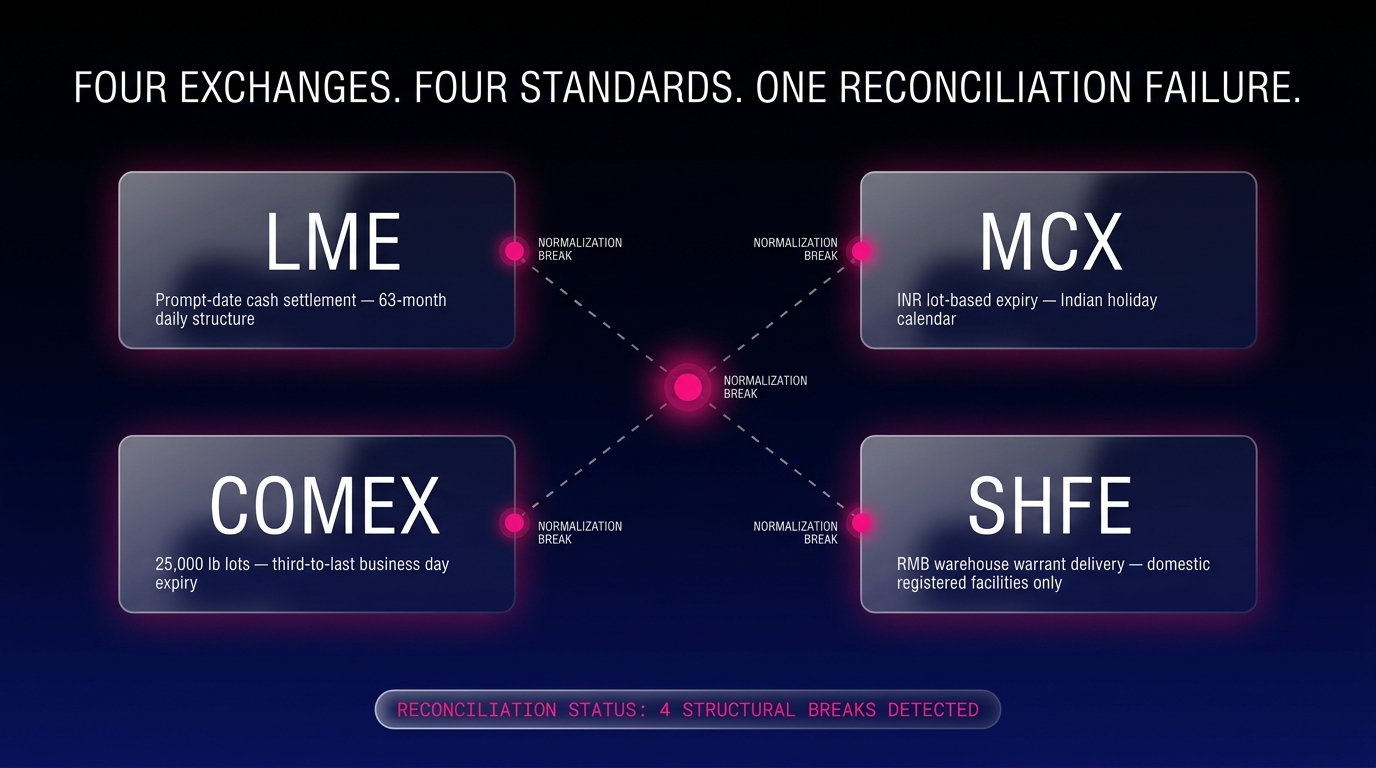
Cross-exchange reconciliation failures are not workflow problems. They are structural outputs of a specific architectural decision: applying a single normalization layer to exchanges that operate on fundamentally different native conventions. The failure begins in data ingestion, not in the reconciliation step itself.
When LME prompt-date cash settlement, MCX INR lot-based expiry calendars, COMEX basis lot sizing, and SHFE warehouse warrant standards are routed through one generalized normalization schema, position data arrives at the reconciliation engine already corrupted. No reconciliation logic can repair data that was compromised before it entered the system.
This is an engineering problem with a traceable root cause. Here is exactly where and why the corruption begins.
The Structural Problem with Cross-Exchange Data Normalization
Most commodity platforms covering multiple exchanges made an early architectural choice: build a single, generalized data layer that translates exchange-specific conventions into a common internal format. This approach, known as breadth-first architecture, prioritizes exchange coverage over exchange precision.
Defining Breadth-First Platforms in Commodity Trading
A breadth-first platform is one designed to cover as many exchanges as possible through a generalized normalization schema. It applies the same ingestion logic to every exchange it supports, trading precise representation of each exchange's native conventions for broad market coverage. In metals trading, this means LME, MCX, COMEX, and SHFE positions are all processed through the same schema. This single schema is designed to accommodate any exchange and is therefore optimized for none.
The commercial rationale is straightforward: broader exchange coverage expands addressable market reach. The technical assumption is not sound. LME, MCX, COMEX, and SHFE do not share a common data architecture that can be reasonably abstracted. They operate on categorically different settlement mechanisms, lot conventions, currency denominators, and physical delivery frameworks.
Abstracting them into a single normalization schema does not simplify those differences. It misrepresents them.
According to a 2023 operational survey by Accenture Accenture commodity trading operations research, over 62% of unresolved position breaks in multi-exchange metals portfolios trace to data translation errors introduced during normalization, not to reconciliation matching failures. The reconciliation engine is identifying real discrepancies. The discrepancies were created by the platform's own ingestion layer.
LME Prompt-Date Structure: Where Cross-Exchange Reconciliation First Breaks
The London Metal Exchange operates on a prompt-date settlement model with no direct equivalent on any other major metals exchange. Every LME trade settles on a specific prompt date: the date on which delivery or cash settlement is due. These prompt dates are individual trading days, not standardized monthly expiries, and they extend daily for the first three months, then weekly to six months, then monthly out to 63 months.
A single copper book can carry dozens of active prompt dates simultaneously, each representing a distinct settlement obligation with its own mark-to-market profile and cash flow timing.
Structural Differences in Settlement Conventions
LME uses prompt-date daily cash settlement extending to 63 months, with positions distributed across individual trading days. COMEX uses standardized monthly expiry settling on the third-to-last business day of the delivery month, with physical delivery in 25,000-pound lots priced in USD per pound. MCX uses INR-denominated contracts with 1 MT lot sizes, expiring on the last working day of the contract month adjusted for Indian market holidays. SHFE uses RMB-denominated contracts with 5 MT lots and delivery via registered warehouse warrants at approved domestic Chinese facilities. These are not variations of a single model. They are four distinct financial architectures built on incompatible structural premises.
A normalization schema that maps LME prompt dates to monthly expiry buckets (the convention used by the other three exchanges) introduces structural error on every position settled on a non-month-end prompt date. The settlement date is wrong. The cash flow timing is wrong. The delta to the 3-month benchmark is wrong.
According to LME published clearing data LME annual statistics report, the exchange clears approximately 150,000 copper lots per day, with positions distributed across dozens of concurrent prompt dates. A normalization error affecting even a small percentage of those positions produces reconciliation breaks that are mathematically guaranteed, not statistically likely, but certain.
Every misassigned prompt date is a break waiting to be logged.
MCX: Currency Denomination, Lot Sizing, and Calendar Fragmentation
The Multi Commodity Exchange of India introduces three normalization challenges that interact to compound error. Each is independent. In a live book, they stack.
The Impact of Data Normalization on Position Reconciliation
Data normalization translates raw exchange data into a platform's internal format. When normalization applies incorrect conversion rules (wrong lot multipliers, misaligned expiry dates, approximate currency denominators), the internal position record diverges from the actual position held at the exchange. Reconciliation compares the platform's internal record against exchange-confirmed positions and correctly identifies a discrepancy. What reconciliation cannot identify is that the discrepancy originated two steps earlier, inside the normalization pipeline. The engine raises a break. A trader investigates. The position at the exchange is correct. The error exists only inside the platform.
First: currency denomination. MCX copper is priced in INR per kilogram. A normalization layer that converts to USD at an ingestion-time spot rate introduces FX basis error into every position record. That error compounds whenever exchange rates shift between position entry and reconciliation run, which in active trading means continuously and often materially.
Second: lot size multiplier. MCX copper lots are 1 MT per lot, a fraction of COMEX's ~11.34 MT and SHFE's 5 MT. According to MCX published contract specifications MCX copper futures contract specifications, the standard lot is 1,000 kilograms with a price quotation in INR per kilogram. Position counts that appear correct at the MCX level produce incorrect notional values at the platform level when the conversion multiplier is wrong or inconsistently applied across sessions.
Third: calendar-based expiry. MCX follows Indian market holidays not observed by LME, COMEX, or SHFE. Contracts expire on the last working day of the delivery month, adjusted for Indian public holidays that affect expiry dates in approximately four to six contract months per year. A normalization schema applying standard business day conventions will misassign expiry dates for every affected month.
These three errors are independent. In a cross-exchange book that includes MCX positions, they stack. A single MCX lot can carry three simultaneous normalization errors: currency basis, lot multiplier, and expiry date. Each surfaces as a separate reconciliation break.
COMEX Basis Lot Sizing and Settlement Mechanics
COMEX copper contracts, cleared through CME Group, specify 25,000 pounds per lot. This is a unit that does not convert to metric tonnes without a 2.20462 multiplier. For cross-exchange position management, this conversion must be applied at the lot level with exact precision, not at the portfolio level where rounding errors accumulate undetected.
According to CME Group contract specifications CME Group COMEX copper futures specifications, COMEX copper is priced in USD per pound and settles on the third-to-last business day of the delivery month, with physical delivery at CME-approved US warehouses. Delivery receipts denominate physical copper in 25,000-pound units throughout the delivery workflow.
A normalization layer converting COMEX positions to metric tonnes at the portfolio level introduces rounding error per lot. Across a 500-lot position, lot-level rounding errors aggregate into a position discrepancy of several tenths of a tonne. That figure exceeds a typical break threshold, but falls short of the magnitude that would suggest a genuine position error. The result is a reconciliation break that consumes analyst time but traces to no actual discrepancy at the exchange level.
The second COMEX normalization failure is settlement date mapping. COMEX's third-to-last business day expiry does not align with LME prompt-date schedules or SHFE delivery periods. A cross-exchange book carrying simultaneous COMEX and LME positions in copper requires fully independent settlement date logic for each exchange. A shared schema approximating both to a common calendar simultaneously generates two classes of settlement date error, one for each exchange whose native calendar was overridden.
SHFE Warehouse Warrants: A Delivery Architecture With No Parallel
The Shanghai Futures Exchange introduces a normalization problem with no analog on any other exchange in this group: warehouse warrant-based delivery.
SHFE copper contracts settle via registered warehouse warrants. These are exchange-registered instruments representing specific quantities of physical copper at specific SHFE-approved domestic facilities. Each warrant carries an identification number, a registered owner, a storage location, and a physical specification. According to SHFE published contract rules SHFE copper futures contract specifications, standard copper lot size is 5 MT, denominated in RMB per MT, with delivery available only through SHFE-registered Chinese warehouses.
A long position at SHFE expiry does not represent a generic physical copper entitlement. It represents an obligation to receive specific warrants, denominated in RMB, deliverable from approved domestic facilities. This is a legally and operationally distinct instrument from a generic long physical copper exposure.
A normalization schema that maps SHFE delivery positions to a generic physical delivery category strips out warrant-level specificity entirely. The platform record shows long physical copper exposure. The actual position is an RMB-denominated warrant obligation tied to registered domestic inventory. These are not the same instrument, and risk models built on the platform record are not modeling the actual exposure.
According to SHFE market data SHFE copper open interest statistics, copper futures open interest on the exchange regularly exceeds 500,000 lots, representing 2.5 million metric tonnes of notional copper exposure. The scale means that normalization errors affecting SHFE positions are not edge cases in a minor market. They affect material notional values in the world's largest copper futures market by open interest.
Why Breadth-First Platforms Are Architecturally Incapable of Solving Cross-Exchange Reconciliation
The normalization failures documented in the preceding sections do not result from misconfigured mapping rules or outdated schemas. They result from an architectural decision that cannot be corrected through reconfiguration or schema updates.
The Root Cause of Cross-Exchange Reconciliation Failures
Cross-exchange reconciliation fails when the data being reconciled was corrupted during normalization. Each exchange publishes position data in its native format. A generalized normalization layer translates that data into approximations: LME prompt dates become monthly buckets, MCX INR lots become approximate USD MT equivalents, and SHFE warrant positions become generic physical exposures. The reconciliation engine then compares these approximations against exchange-confirmed positions. The math does not close because the platform's records do not accurately represent what the exchanges report. The failure is not in the comparison step. It is in the translation that preceded it.
A breadth-first platform's normalization schema is designed to be exchange-agnostic. That is its core function. It processes LME data with the same logic it applies to COMEX data, and COMEX data with the same logic it applies to MCX data. This is not a bug. It is the feature that makes it commercially viable to support dozens of exchanges without writing separate ingestion logic for each one.
The consequence is that exchange-specific precision is architecturally excluded, not merely unconfigured. You cannot add "respect LME prompt-date structure" as a configuration option to a schema built to abstract all settlement dates into monthly buckets. You cannot add "preserve SHFE warrant specificity" to a delivery model that maps all physical positions to a generic exposure category. Resolving either limitation requires replacing the schema, not patching it.
This is foundational architectural debt. Unlike code-level technical debt, which can be addressed through refactoring, architectural debt at the data model level requires foundational redesign. A breadth-first platform cannot reconcile cross-exchange metals positions accurately because accurate reconciliation requires exchange-native data handling that directly contradicts the platform's core design premise.
Fixing Cross-Exchange Reconciliation Errors in Metals Trading
Fixing cross-exchange reconciliation errors requires rebuilding the normalization layer, not reconfiguring the reconciliation engine. Each exchange must have its own ingestion pipeline that understands and preserves that exchange's native conventions: LME prompt dates stored as prompt dates, MCX INR positions stored in INR with exact lot multipliers and calendar-aware expiry logic, COMEX lots converted at the lot level with full pound-to-tonne precision, and SHFE warrant positions preserved as warrant-level instruments denominated in RMB. Currency conversion and date normalization for cross-exchange analytics must occur explicitly at the analytics layer (not silently during ingestion) so that position data remains at native precision when reconciliation is performed. This architecture requires depth-first data engineering: exchange-specific pipelines built from the ground up for each exchange covered.
According to Gartner research on CTRM platform operations Gartner CTRM market analysis, firms using generalist multi-exchange commodity platforms report spending an average of 18 to 22 hours per week on manual reconciliation corrections for cross-exchange positions. Every hour spent closing normalization-generated breaks is an hour during which risk models are running on corrupted inputs, and hedging decisions are being made against a book that does not accurately reflect actual exchange obligations.
The operational cost is real. The risk cost is larger and less visible.
The Architecture Cross-Exchange Reconciliation Requires and Where to Find It
Accurate cross-exchange reconciliation in a multi-exchange metals book is an engineering outcome, not a configurable feature. It is the result of building a data architecture that preserves exchange-native precision from ingestion through position record through risk calculation without loss of specificity at any layer.
That architecture has four non-negotiable requirements:
- Exchange-native ingestion pipelines. Each exchange must have its own data ingestion logic built around that exchange's published conventions. LME prompt dates are stored as prompt dates. MCX INR positions are stored in INR with correct lot multipliers and Indian holiday-adjusted calendars. COMEX lots are converted at the lot level with full pound-to-tonne precision. SHFE positions are stored as warrant-level instruments in RMB.
- Separation of normalization from the data layer. Translation for cross-exchange analytics must occur at the analytics layer. This must happen explicitly, auditably, and on demand, not silently during ingestion. The data layer preserves native precision. The analytics layer performs explicit conversions when cross-exchange comparison is required. Reconciliation operates against native-precision data.
- Per-exchange calendar-aware settlement date logic. Settlement date rules must be implemented independently for each exchange using its published holiday calendar and expiry schedule. MCX Indian market holidays are registered as explicit exceptions. COMEX third-to-last business day expiry is calculated independently from LME prompt-date schedules. Calendar logic is not shared.
- Denomination preservation across the position lifecycle. MCX INR and SHFE RMB positions carry their native currency and the FX rate recorded at entry through their full lifecycle. Currency conversion for reporting occurs explicitly at the reporting layer, with the original denomination and entry rate preserved and auditable.
Novaex was built on exactly this architecture. Designed specifically for base metals trading across LME, MCX, COMEX, and SHFE, Novaex implements independent, exchange-native ingestion pipelines for each of the four exchanges analyzed here, preserving LME prompt-date structure, MCX INR lot calendars with Indian holiday adjustments, COMEX lot-level pound-to-tonne conversion, and SHFE warehouse warrant specificity through the full data lifecycle. Normalization for cross-exchange analytics occurs at the analytics layer, explicitly and auditably, leaving position data at native precision when reconciliation is performed.
The distinction is not a feature comparison. It is a categorically different approach to the underlying engineering problem, one built on the architecture that accurate cross-exchange reconciliation actually requires.
Novaex platform technical overview Schedule a technical demonstration with the Novaex team