Why Depth Makes a Base Metals Trading Platform Irreplaceable
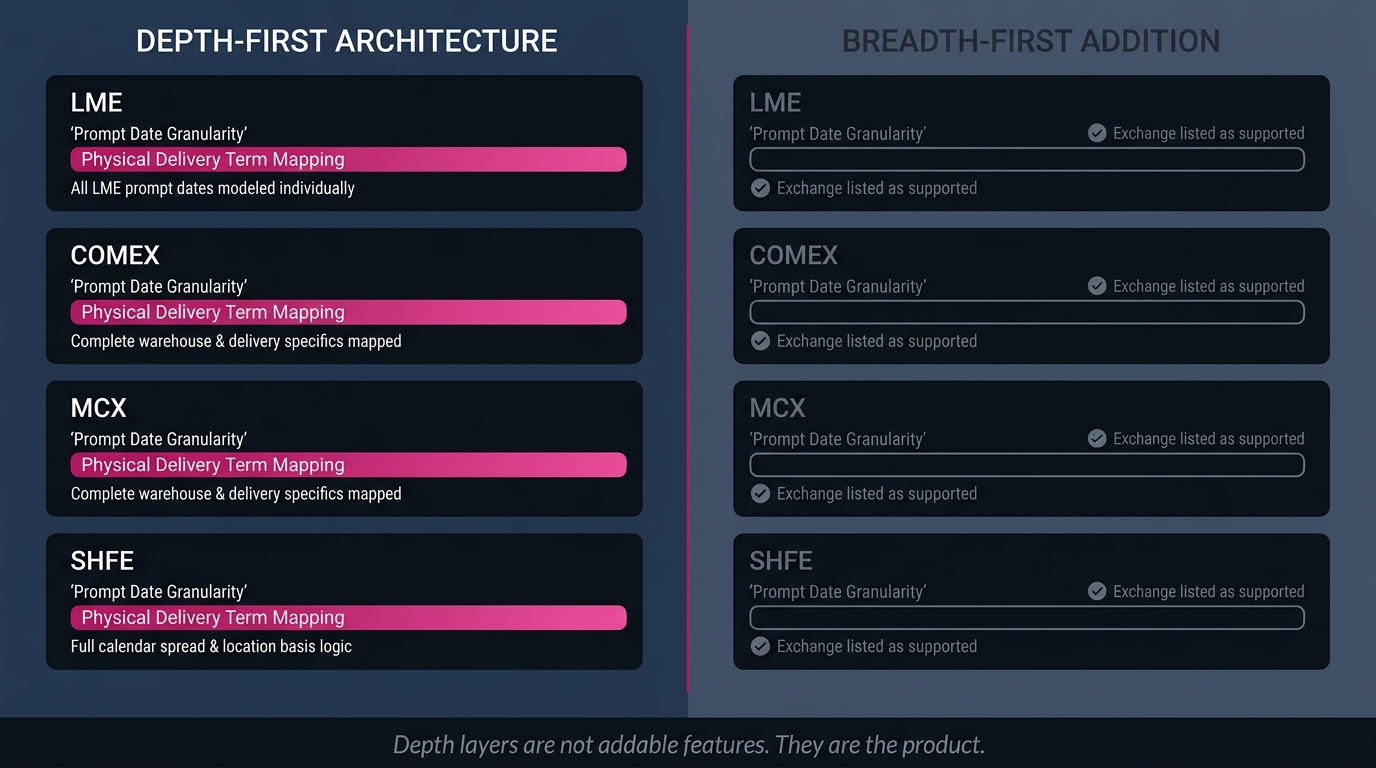
TL;DR: A base metals trading platform built depth-first (mastering LME prompt date structures, COMEX EFP workflows, MCX rupee-denominated risk, and SHFE's restricted-access architecture before expanding) establishes an execution standard that breadth-first competitors cannot close by adding metals as a commodity category. The replication cost is measured in years of live market exposure rather than budget allocation.
A front-office copper trader managing positions across London, New York, Mumbai, and Shanghai operates across four completely different markets. Each exchange operates with a distinct contract architecture, settlement logic, delivery mechanism, and data structure that demands modeling on its own terms.
A base metals trading platform that treats those exchanges as variations on a generic commodity theme introduces systemic risk at precisely the moments when accuracy is most critical: when markets move fast, positions are large, and manual reconciliation is not operationally viable.
According to the London Metal Exchange, daily notional turnover in base metals contracts regularly exceeds $50 billion. Position errors caused by platform data gaps at that scale translate directly into execution losses rather than accounting adjustments.
The defining capability of any metals platform is what it covers on LME, COMEX, MCX, and SHFE, and whether that coverage was built from the ground up for metals or retrofitted from a multi-commodity framework. Those two architectures produce fundamentally different outcomes under live trading conditions.
What Exchange Depth Means for a Base Metals Trading Platform
Defining Exchange Depth
Exchange depth requires the platform to model every structural feature of a contract exactly as the exchange defines it, without simplified approximations. For a base metals trading platform, depth means LME carry dates calculated on the exchange's actual prompt date calendar, COMEX option delta computed against exchange settlement rules, MCX P&L reported in INR with accurate cross-rate conversion, and SHFE warrant positions tracked through the exchange's physical delivery system. Approximations in any of these dimensions produce errors that compound in proportion to position size.
The distinction matters at the data model layer before it matters anywhere else. A platform designed to cover the broadest possible commodity universe must accommodate the most general case at its core. Metals require the most specific case, particularly on the LME. These two design goals are in structural conflict.
A platform that models LME copper as a standard monthly future (the most common simplification used by multi-commodity systems) will misrepresent carry exposures on any day that is not a standard monthly prompt date. Because the LME allows delivery on any business day within the spot month, this error affects operations on most trading days.
According to a 2023 survey by Coalition Greenwich, 67% of commodity trading firms identified data fragmentation across exchanges as the primary driver of manual reconciliation work in their front offices. That reconciliation burden exists because the platforms generating it are not deep enough to eliminate it at the source.
The LME: Where a Depth-First Metals Architecture Begins
LME's Date Structure Architecture
LME's date structure requires a platform to store, calculate, and expose positions at the individual prompt date level instead of the contract month level. A platform that aggregates LME positions to monthly buckets cannot accurately calculate tom/next carries, backwardation exposure, or the true cost of rolling a physical hedge. These calculations occur on every trading day for any firm running a physical metals book alongside a futures hedge.
Building this correctly means the database schema, position aggregation logic, P&L attribution engine, and risk reporting layer all treat prompt-date granularity as a fundamental requirement from day one.
Rebuilding a monthly-bucket data model to accommodate this after the fact requires replacing core data structures while preserving all existing functionality for every other commodity on the platform. According to Gartner's enterprise software migration benchmarks, core data model refactoring in production trading systems takes between 18 and 36 months with a high probability of regression in adjacent modules.
Beyond prompt dates, comprehensive LME depth requires three additional capabilities that multi-commodity platforms consistently fail to deliver:
- Ring and Kerb pricing differentiation: Official Ring prices and Kerb prices are distinct benchmark references used for different hedging and physical pricing purposes. Conflating them produces incorrect P&L for firms whose physical contracts reference one and not the other.
- LME Warrant management: Physical delivery on the LME involves warrants; documents of title for metal stored in LME-approved warehouses. A platform that tracks paper positions but cannot reconcile them against warrant holdings presents an incomplete view of physical exposure.
- Monthly averaging structures: Many physical offtake contracts reference monthly average LME prices. Computing those averages accurately requires prompt-date granularity throughout the month rather than an end-of-month approximation.
COMEX and MCX: Where Breadth-First Platforms Break Down
The Breadth-First Coverage Gap
Breadth-first platforms cannot simply add metals coverage because metals require rebuilding core platform components rather than installing a new module. COMEX copper's EFP mechanism, MCX's INR denomination, and LME's prompt date structure each demand changes at the data model layer. A platform designed for breadth has already committed those layers to supporting the widest possible commodity set (which means the most general case). Metals require the most specific case. Adding specificity to a generalized core requires reconsidering fundamental architectural decisions.
COMEX presents a different set of depth requirements from the LME. The most operationally significant is the Exchange for Physical (EFP) transaction. This mechanism allows a trader to exchange a COMEX futures position for a physical transaction at a negotiated basis. EFPs are standard practice in the North American copper market and are used routinely to manage the transition between financial and physical book positions.
According to CME Group data, EFP volume in COMEX copper regularly accounts for 15, 25% of total open interest adjustments in active contract months. A platform that cannot capture EFP entries as a native transaction type will misstate a trader's net futures exposure versus their physical book on any day an EFP is executed. For an active physical desk, this occurs on most days.
MCX introduces a different dimension: currency-denominated risk management embedded within position accounting. MCX is India's primary commodity derivatives exchange, and its metals contracts are denominated in Indian rupees. For a firm hedging both LME and MCX copper exposure, P&L is a function of both the metals price move and the USD/INR exchange rate simultaneously.
According to the Multi Commodity Exchange of India, MCX handles over 85% of India's commodity futures volume by value. A base metals trading platform serving any firm with Indian physical exposure cannot treat MCX as optional coverage.
Comprehensive MCX depth requires:
- Real-time INR/USD conversion embedded directly in the position and P&L engine rather than applied externally as a post-calculation adjustment
- MCX contract specifications including lot sizes and delivery units that differ structurally from LME and COMEX equivalents
- Indian session integration covering MCX's morning and evening sessions and the distinct price discovery dynamics of each
- MCX-LME basis tracking for desks managing cross-exchange hedging programs where the domestic Indian price premium or discount to LME is a live risk variable
SHFE: The Coverage Gap That Reveals the Full Replication Cost
SHFE-Specific Data Requirements
Traders need RMB-denominated P&L calculations, SHFE warrant tracking for physical delivery positions, Chinese national holiday calendar integration for accurate carry date calculations, and live SHFE-LME premium/discount monitoring as a risk metric. Generic platforms typically provide SHFE price data as a feed without modeling the contract structure, delivery mechanism, or currency dynamics that cause SHFE positions to behave differently from LME or COMEX equivalents under the same market conditions.
The Shanghai Futures Exchange is the largest base metals futures market by volume for copper, aluminum, and zinc. According to SHFE annual reports, the exchange regularly records copper futures volumes exceeding 60 million lots per year, reflecting the scale of Chinese domestic hedging activity.
For a non-Chinese firm, SHFE depth means something operationally precise: the ability to model SHFE positions in RMB, convert them to a reporting currency with accurate cross-rates applied at the correct point in the calculation chain, and track the SHFE-LME spread as a live risk metric, rather than a reference number retrieved separately. The SHFE-LME copper premium is one of the most closely monitored arbitrage signals in global metals trading. A platform that provides SHFE prices without modeling the spread relationship delivers a data fragment rather than a risk picture.
SHFE's physical delivery system compounds the requirement. SHFE warrants (functionally analogous to LME warrants but operating within Chinese regulatory and logistics frameworks) require dedicated tracking logic. A firm carrying SHFE warrant positions on a platform that cannot reconcile them against futures exposure is managing a gap that can only be filled by manual spreadsheet work.
According to the International Copper Study Group, over 50% of global refined copper consumption occurs in China. A base metals trading platform that treats SHFE as an optional coverage tier is deprioritizing the world's largest metals market.
Depth on SHFE additionally requires:
- Night session coverage that overlaps with LME and COMEX hours, creating simultaneous cross-exchange exposure that must be visible in a single consolidated position view
- Chinese national holiday calendar integrated into carry date calculations, because SHFE closure periods create carry gaps that affect any position bridging those dates
- Foreign access structure modeling that accurately represents the constraints on non-Chinese participant exposure, ensuring the platform does not overstate theoretical positions that cannot be executed
The Replication Barrier: A Structural Timeline
The Multi-Exchange Development Timeline
Building accurate multi-exchange metals coverage (LME prompt dates, COMEX EFP logic, MCX currency integration, SHFE warrant tracking, and consolidated cross-exchange risk aggregation) takes four to six years of iteration against live trading data. The volume of real trading scenarios that must be encountered, diagnosed, and resolved before the model reaches production reliability sets this timeline. Budget accelerates staffing. It does not accelerate exposure to the complexities that only surface in live markets under real conditions.
The replication cost for a breadth-first competitor is a sequential series of constraints that cannot be fully parallelized:
| Phase | Work Required | Estimated Duration |
|---|---|---|
| Data model refactoring | LME prompt date granularity at core schema level | 18, 36 months |
| Exchange connectivity rebuild | LME, COMEX, MCX, SHFE at contract-spec level | 12, 18 months per exchange |
| Live trading validation | Sufficient market conditions to reach accuracy | 24, 36 months minimum |
| Regulatory alignment | FCA, CFTC, SEBI, CSRC per jurisdiction | 6, 12 months per jurisdiction |
| Total sequential minimum | | 7, 9 years |
These phases are not independent. Data model decisions constrain exchange connectivity design. Exchange connectivity determines what live trading validation is possible. Validation surfaces errors that require data model revisions, returning work to phase one.
According to Forrester Research analysis of financial software platform migrations, the average cost of rebuilding a core data model in a production trading system exceeds $15 million when accounting for development, testing, regression management, and market risk during the transition period. CTRM platform migration cost analysis
The economic case for replication does not close. By the time a breadth-first competitor completes the rebuild, the depth-first platform has continued iterating on live trading data throughout the competitor's construction period. The accuracy gap does not narrow during that time. It compounds.
How a Depth-First Base Metals Trading Platform Compounds Execution Advantage
The practical value of depth is not visible in a feature comparison matrix. It becomes visible in specific, recurring trading conditions: a copper trader running a large forward book when the market moves into backwardation; a metals desk managing cross-exchange hedges when INR moves sharply against the dollar; a risk manager producing an end-of-day exposure report that must consolidate LME, COMEX, MCX, and SHFE positions without a single manual adjustment.
In each of these scenarios, a platform with genuine depth produces accurate outputs automatically. A platform with approximated depth requires the trader to identify the error, understand its source, and correct it manually at the exact moment when the market is moving and every second of attention has measurable cost.
According to a 2022 Oliver Wyman study on commodity trading operations efficiency, manual reconciliation in front offices using multi-commodity platforms not purpose-built for their primary market costs an average of 2.3 hours per trader per day. At a conservative senior-trader compensation level, that reconciliation cost exceeds $150,000 per desk per year before accounting for the trading opportunities missed during the reconciliation window. commodity trading operations efficiency benchmarks
Depth also compounds through analytics quality in a way that breadth cannot replicate. An accurate position model produces accurate risk analytics. Accurate risk analytics support more effective hedging decisions. More effective hedging decisions, applied consistently over months and years, produce measurably higher hedge effectiveness ratios. A 2021 study by the Energy Risk Professionals Association found that firms using purpose-built exchange-specific platforms achieved hedge effectiveness scores averaging 12 percentage points higher than firms using generalized multi-commodity systems for the same underlying exposure.
A breadth-first platform that closes the feature gap in year five does not recover the analytical compounding that a depth-first desk accumulated in years one through four. That compounding occurred in real markets, on real positions, producing real hedging outcomes. It cannot be retroactively replicated.
Evaluating Your Base Metals Trading Platform: The Right Questions
Evaluating a base metals trading platform on feature breadth alone misses the structural question. The relevant question is: at what layer does this platform's model of each exchange shift from precise representation to workable approximation?
That question has verifiable, binary answers for each exchange:
- LME: Does the platform store and calculate positions at individual prompt date granularity, or does it aggregate to contract months?
- COMEX: Are EFP transactions a native first-class entry type, or does the desk record them as workaround entries?
- MCX: Is INR-denominated P&L calculated inside the position engine, or converted from an external source after the fact?
- SHFE: Does the platform track SHFE warrants as a live position type, or does it provide SHFE prices without modeling physical delivery?
A front-office metals operation currently managing cross-exchange position visibility through spreadsheet exports and manual consolidation faces a fundamental platform depth problem. Adding workflow tools to an insufficiently deep platform produces more sophisticated manual workarounds rather than accurate automation.
According to a 2023 Accenture survey of commodity trading technology investment, 71% of trading firms reported that their primary CTRM pain point was inaccurate outputs from features that nominally existed rather than missing features. commodity trading technology investment survey The distinction between a feature that exists and a feature that produces accurate results under live trading conditions is precisely what exchange depth determines.
The execution barrier created by genuine depth across LME, COMEX, MCX, and SHFE is an architectural fact with a measurable replication cost and a documented multi-year timeline. Organizations evaluating their current base metals trading platform should evaluate how a platform covers these four exchanges, and how long the team building it has been resolving errors in live markets.
The depth-first standard for base metals trading is defined by what the platform gets right at the level of prompt dates, EFP logic, INR denomination, and SHFE warrant tracking. Each of those dimensions has a specific, testable answer. None can be approximated without a direct and traceable cost to trading accuracy.
Three immediate steps for trading operations and technology teams:
- Audit your LME prompt date model: Request a tom/next carry report for your current book. If it requires manual adjustment before it reflects actual exposure, the data model is approximate.
- Test your COMEX EFP workflow: Ask your platform team to show the native EFP entry screen. If it does not exist as a distinct transaction type, your futures-versus-physical reconciliation is being handled manually.
- Run a cross-exchange P&L test: Request a consolidated P&L report that includes MCX INR conversion and SHFE-LME basis in a single output. If it requires spreadsheet assembly, the platform has not solved the depth problem.