Why Did the COMEX–LME Copper Premium Collapse? Two Readings for a Hedging Desk
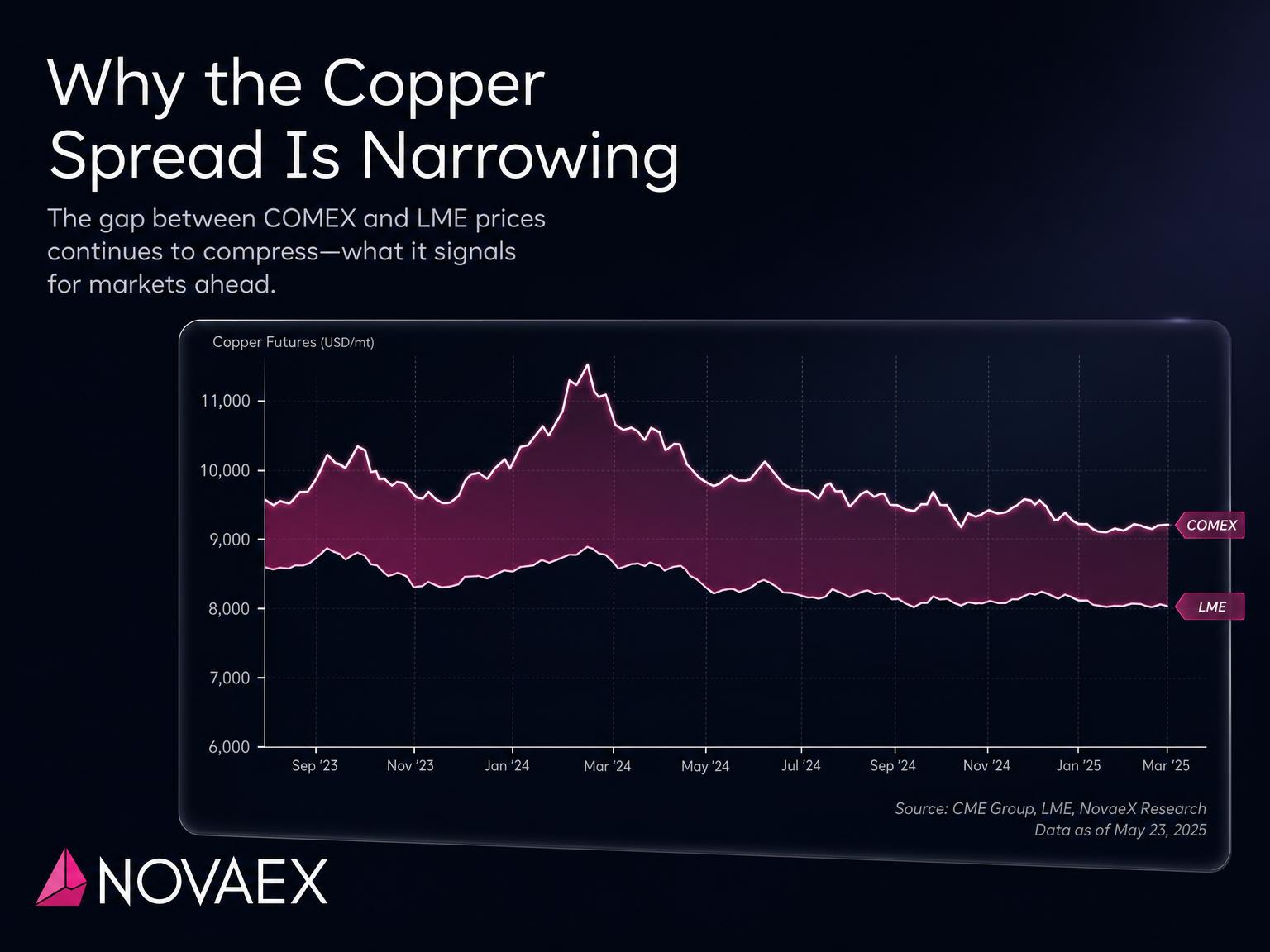
The spread fell from $783/t on 25 August to $62/t on 15 September. A tariff repricing and a physical shift both fit the data, and they pull a cross-venue hedge in different directions.
The COMEX–LME copper premium collapsed after 10 September, when the White House said no refined-copper tariff decision had been made. Two readings fit the data: the market stopped pricing a tariff, or the physical pull of metal into the US stalled. They disagree on whether the premium returns, which is what a cross-venue hedge depends on.
What happened to the COMEX–LME copper premium?
The gap between COMEX and LME copper fell about 92% in three weeks. FT Mercati, citing SunSirs, puts it at $783/t on 25 August and $62/t on 15 September. At the end of July it stood near $420/t, roughly eight times its 20-year average.
The table sets out the prints we can source. They are not one clean series, because each source measures the gap its own way (more on that below).
Date COMEX–LME gap Source and working
End-July about $420/t ICA Australia weekly brief
25 Aug $783/t SunSirs via FT Mercati
15 Sep $62/t SunSirs via FT Mercati
2 Oct COMEX about $14,370/t, LME about $14,250/t ICA Australia; about $120/t on those rounded prints (our subtraction)
6 Oct about $94/t De Vere Group showed COMEX at $6.59/lb and LME three-month at $14,434/t; at 2,204.62 lb a tonne that is about $14,529/t, so the gap is our arithmetic and indicative only
The premium has not gone back to zero. It has gone back to a level where the question changes from "how big is the arbitrage?" to "what was it paying for?"
Reading one: is the collapse a tariff trade?
Yes, if the premium was mostly a price on policy. On this reading, COMEX traded above LME because the market priced a US tariff on refined copper, and the premium deflated when the decision date passed in silence. The timing fits: the fall starts on 10 September.
The case for it is strong. ING's Ewa Manthey told CNBC that the spread had become "a gauge of US tariff expectations", with a wider premium signalling greater perceived tariff risk. On 14 August, Société Générale estimated the premium then implied a 14.6% chance of a 15% tariff in January 2027 and a 37% chance of a 30% duty in January 2028. Commerce had recommended exactly that phasing.
The trade itself was mechanical. Per FT Mercati, traders bought LME copper, took delivery outside the US and registered it as COMEX warrants for resale, which drained deliverable stock outside the US and held the premium up. Positioning was crowded: non-commercial net longs in COMEX copper exceeded 90,000 contracts in the week to 8 September. When the 10 September statement landed, the unwind did the rest.
What this reading implies is simple. The premium is short a policy option. Per ICA Australia, a phased tariff (15% from January 2027, rising toward 30%) would quickly re-widen forward premiums and restart inflows. The 28 September decision date passed without an announcement, and that is a soft no for now, not a rule-out.
Reading two: is it a physical shift?
Yes, if the arbitrage stopped paying for reasons that have nothing to do with Washington. On this reading, the US ran out of room for more metal and the scarcity moved to London and China, so the premium compressed because COMEX had the copper and LME needed it.
The numbers are lopsided. MINING.COM reported on 21 September that COMEX warehouses held 696,204 t, about 69% of all exchange-monitored copper, and that stocks had slipped 65 t in the week, the first weekly decline since April. Storage at the Port of New Orleans, the main COMEX delivery hub, was largely full, with another 100,000 t of African and South American copper due over September and October.
Outside the US, the same article has LME cash copper at a $26/t premium to three-month, swung from an $86/t discount a week earlier. Of 255,900 t in LME warehouses, 115,450 t (45%) were cancelled warrants, leaving 133,725 t actually available. The Yangshan premium reached $124/t, its highest in nearly four years. Discovery Alert, using Cochilco data, has LME stocks at 244,900 t on 5 October and COMEX at 706,818 t at the 2 October close.
This reading has a weak joint, and we would rather name it than hide it. The 700,000 t sitting in US warehouses is itself the product of the tariff trade: ICA Australia has COMEX stocks up from about 290,000 t a year ago. The two readings are not independent, and anyone who tells you the physical story stands apart from the policy story is skipping a step.
Where do the two readings disagree?
They disagree on what the premium was, why it fell and what brings it back. A desk can't pick between them on the 15 September print alone, because both predict a collapse. The difference shows up in what happens next.
Question Tariff trade Physical shift
What was the premium paying for? A US refined-copper tariff Moving metal into US warehouses
Why did it fall? Tariff odds repriced on 10 September US storage filled and the squeeze moved to LME
What brings it back? A phased-tariff headline, fast US stocks draining or LME tightness easing
Where does hedge risk sit? The COMEX leg, as event risk LME prompt spread and cancelled warrants
What would show it wrong? The premium stays flat through a tariff headline The premium widens on a day with no news
What does each reading mean for a desk hedging across venues?
If the collapse is a tariff trade, the COMEX leg of a cross-venue hedge carries policy risk that an LME position cannot offset, so it is sized as event risk. If the collapse is physical, the risk moves to the LME prompt spread and the cancelled-warrant count. Either way, a hedge struck on one venue and settled on the other carries basis risk.
That risk is not abstract. The gap moved from $783/t to $62/t in 21 days, and any position that crossed venues moved by the difference. Recycling Today has flagged that a premium widening unexpectedly puts cash margin calls on short futures hedges.
In practice the two readings call for different questions before the desk opens:
If you read it as a tariff trade: which of your hedges would move on a White House statement, and is that exposure sized as a policy bet rather than a price hedge?
If you read it as physical: how much of your LME exposure sits on the prompt, and what do cancelled warrants and the cash-to-three-month spread say about it today?
If you won't commit to either: which hedges stay square under both, and which only work under one?
This is why Novaex computes COMEX against LME into the arbitrage view in Pulse: a per-metal hedge call has to read both venues together. We wrote about reading COMEX positioning and the LME curve as one signal earlier this year, and the 10 September move is the case for it.
How do you measure the spread like for like?
To measure the COMEX–LME spread like for like, convert both prices to one unit, match the contract month and use prints taken at the same time. COMEX quotes in cents per pound and LME in dollars per tonne. A mismatch in any of the three can produce a gap of a few hundred dollars that is not in the market.
The 21 September MINING.COM article shows it. Midday, December COMEX was about $14,940/t and LME three-month near $14,650/t, a gap of about $290/t on those two prints. The same article puts the spot premium at about 1.6 cents a pound, which at 2,204.62 lb a tonne is about $35/t. Both numbers are honest. They are measuring different things.
It is the reason the table above carries a working column. Pick the convention your hedge settles on and hold it.
What would settle which reading is right?
Three observations would separate them, and none needs a forecast. ICA Australia's own watch list is a White House statement and COMEX warehouse outflows. Add the LME side, and you have the test.
A tariff headline. If a phased tariff is announced and the premium re-widens fast, the policy reading was doing the work. If it barely moves with 700,000 t already in the US, the physical reading was.
A rule-out. Morgan Stanley flags an explicit rule-out as the key downside risk, which could release US stocks back into a tight ex-US market. Watch whether LME cash and the prompt spread ease or tighten.
A quiet day. A spread that moves on no news points to flows and stocks, not policy.
StoneX's Natalie Scott-Gray has said that no tariffs would unwind the COMEX–LME arbitrage. That is the tariff reading's clean prediction, and so far the spread has done most of that unwinding without a final answer.
FAQ
What is the COMEX–LME copper spread?
The COMEX–LME copper spread is the price difference between COMEX copper futures in the US and LME copper in London, once both are in the same unit. Per CNBC, physical traders, banks, funds, producers and consumers have used it to profit from temporary price differences and to hedge price risk between the two markets.
Why did COMEX copper trade above LME in 2026?
COMEX traded above LME because the market priced a possible US tariff on refined copper, which pulled metal into the US. CNBC reports US copper imports of more than 200,000 t in July, the highest in 12 years, while traders waited for a White House decision.
Is there a US tariff on refined copper today?
No. Per ICA Australia, a 50% Section 232 tariff has applied to semi-finished copper products since August 2025, and refined cathode has been exempt. Commerce recommended a phased 15% tariff from 1 January 2027 rising to 30% from 1 January 2028, and no decision had been announced at the time of the 2 October brief.
Where this leaves a desk
We don't think the data picks a winner yet. A $62/t print on 15 September and a decision date that passed in silence leave both readings standing, and each one hedges differently. The table is our working, so check it against your own prints.
Which reading is your book priced on?