Why don't risk, accounting and trading P&L agree at month-end?
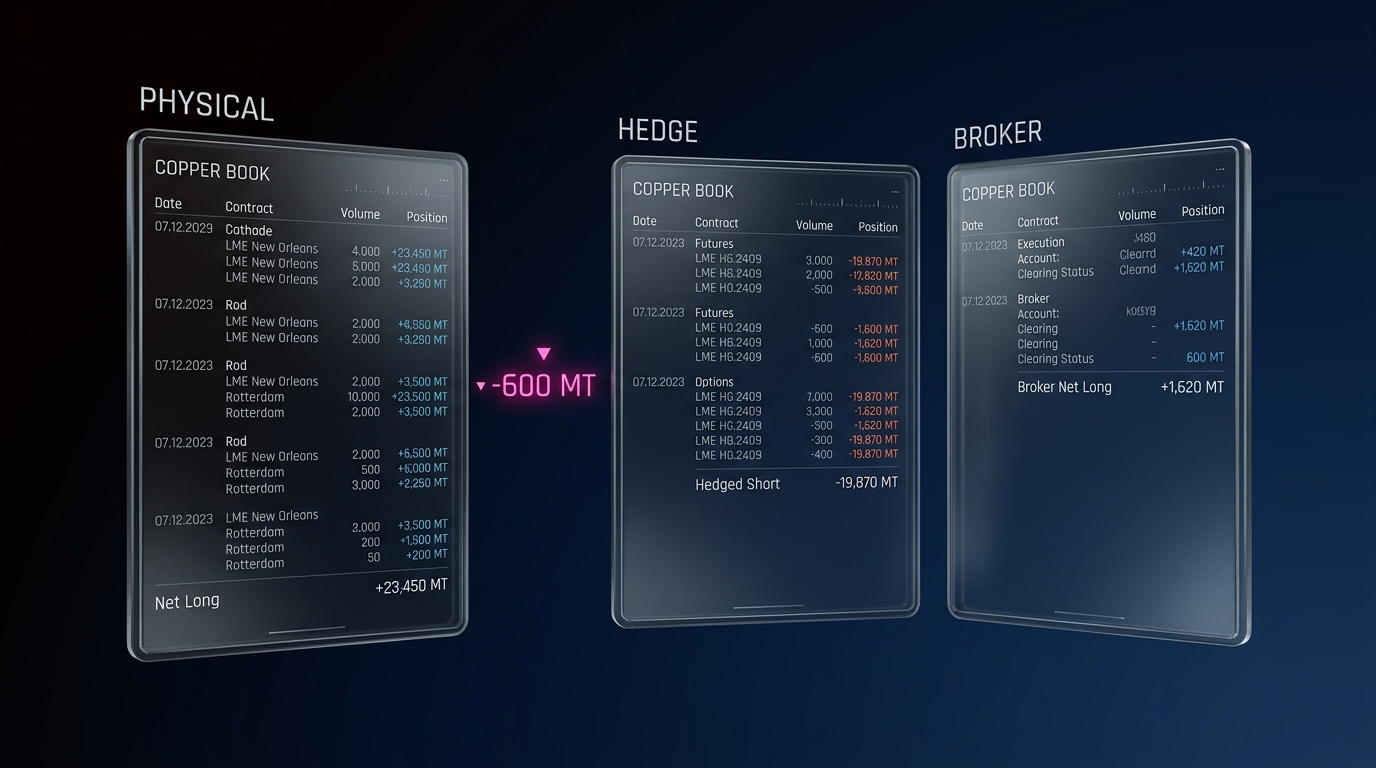
Three P&L numbers, one book, nobody mistyped anything. The physical clock and the financial clock run at different speeds, and the break lives between them.
Risk, accounting and trading P&L disagree because they price the same book at different times. Trading marks open metal to the market. Accounting books what has priced and settled. Risk sits between the two. Each number is correct on its own clock, and the break is timing, not error.
If you closed last month with three P&L numbers and no agreement between them, nothing in that experience is unusual. Most base-metals books close that way. The frustration is real all the same, because the meeting that follows treats a timing gap as a control failure, and the desk spends the next week explaining figures instead of trading them.
Why do risk, accounting and trading P&L disagree at month-end?
Risk, accounting and trading P&L disagree at month-end because each one answers a different question on a different date. Trading P&L asks what the book is worth at the close price. Accounting P&L asks what has legally priced and settled in the ledger period. Risk P&L asks what exposure remains open after hedges. Three questions, three dates, three numbers.
This is why the reconciliation never squares by argument. Each book is internally consistent. The trading sheet foots. The ledger balances. The risk extract ties to its own inputs. The disagreement lives in the dates each book honours, and no amount of rechecking the arithmetic will move it.
What are the physical clock and the financial clock?
The physical clock follows metal, documents and quotation periods. A purchase prices on one quotation period, the sale on another. The invoice goes out before the final price is known. Provisional pricing holds the number open while tonnage moves. Final assays, weight certificates and settlement calendars each add their own lag. The physical book records what has happened to cargo and title, and it moves at the speed of shipments, documents and settlement calendars.
The financial clock follows market prices and hedge valuations. Futures and swaps revalue every evening to the close. Margin moves the next morning. The hedge book knows its value today, to the tonne, before the physical it covers has finished pricing. It moves at the speed of the exchange close.
Month-end freezes both clocks at midnight and asks them to agree. They cannot. One is still waiting on a quotation period, a final assay or a broker confirmation. The other has already marked everything to the market. The close photographs two runners at different points on the track and asks why they are not side by side.
Where does the break actually live?
The break lives in four places, and every close break we have sat through came from one of them.
First, quotation periods. Metal bought on September average and sold on October average carries two prices in the same parcel. Trading marks both legs to the forward curve. Accounting can only book the leg that has priced. The difference sits open until the second period settles.
Second, provisional pricing. Tonnage invoiced provisionally books at an estimate, then reprices when the quotation period closes and the final assay and weights land. Between those dates the physical book and the ledger hold different values for the same shipment, and both are right for their purpose. The wider the metal price moves in that window, the larger the honest disagreement grows.
Third, hedge timing. A hedge placed against an open physical position revalues daily. The physical leg it covers does not. On any given evening the hedge shows a gain or loss with no matching physical offset in the same period, and the risk number parts company from the accounting number by exactly that amount. Rolled positions add a second layer: the closed leg settles into one period while the replacement leg prices in the next.
Fourth, confirmations. Broker statements, tolling returns and warehouse releases arrive on their own schedule, often days after month-end. The broker book at the close is a partial picture. The physical book assumes what the paper has not yet confirmed. The gap between them is paperwork in transit, and it closes only when the documents arrive, not when the spreadsheet is reviewed harder.
What does this look like on one book?
Take an illustrative book, with figures simplified to show the shape and not drawn from any customer. A copper trading book holds 483 tonnes long in physical, priced across two quotation periods, against short futures placed to cover it.
At month-end the trading sheet marks the full 483 tonnes to the close and shows a small net position. The accounting ledger can only recognise the 301 tonnes that have finished pricing, so it shows lower revenue and a higher open provisional balance. The risk extract sits between the two: physical at market, hedges at settlement, with 182 tonnes awaiting a quotation period and one broker confirmation still in transit.
Three numbers. One book. Nobody mistyped anything. The 182 tonnes that have not finished pricing are the entire disagreement, carried at three different values because three books were asked to value them on three different dates.
What should you check before the next month-end?
Pull the three books apart by date before you try to pull them together by value. For each open parcel, write down when the physical prices, when the hedge settles and when the paper arrives. The line where those three dates spread widest is where your close will break.
Most desks find the outlier in the same place: a parcel where the purchase and sale quotation periods straddle month-end, or a hedge whose settlement falls in the next period while the physical stays open. Name that line early and the close meeting changes character. The question stops being which number is wrong and becomes when each number completes.
Which record the desk should treat as the reference on the day is a separate question, and this series takes it up next. For now the work is narrower: know which of your three books is running latest, and why.
Pull the three timestamps on every open parcel tomorrow morning and find the outlier.