Why LME Basis Blowouts Are a Predictable System Failure
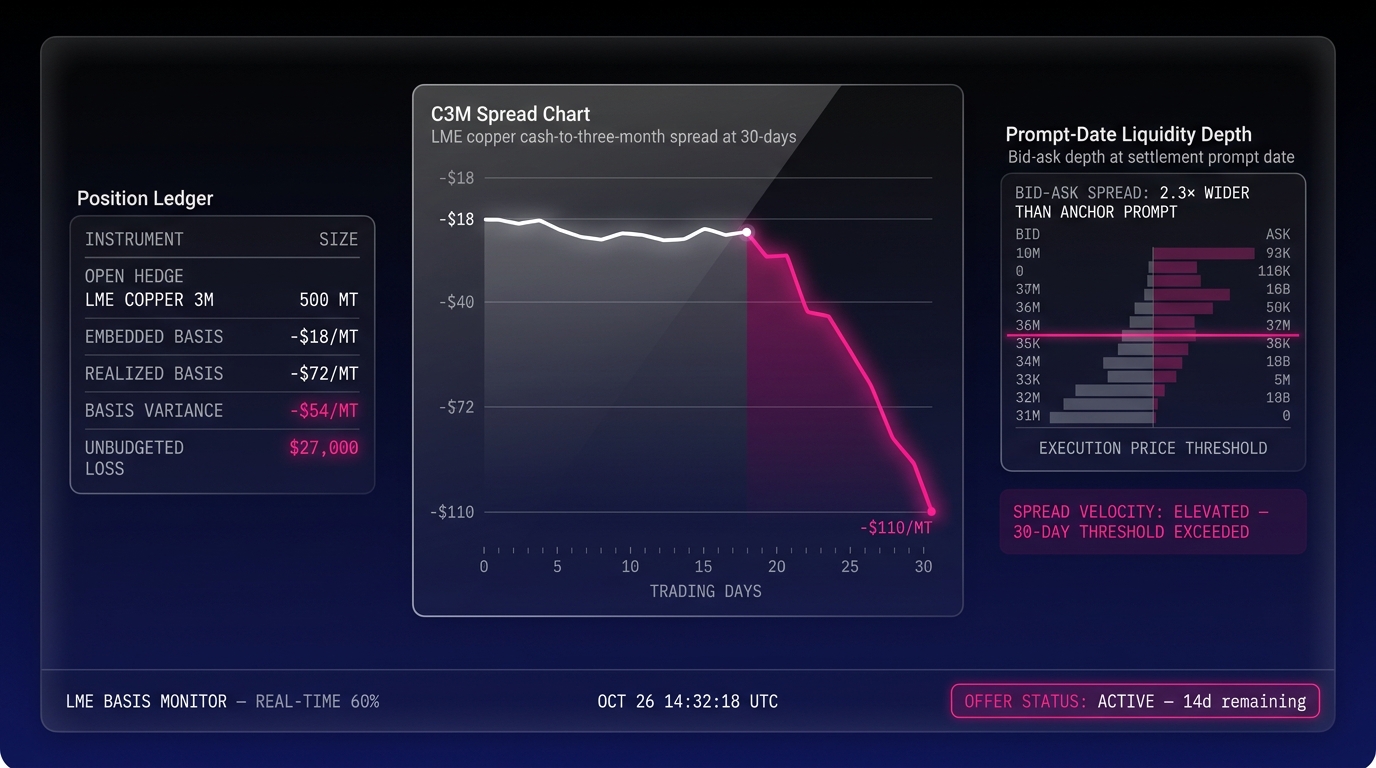
LME basis blowouts during cash-to-three-month spread widening are not random market noise. They are the documented, reproducible output of position management tools that cannot track prompt-date liquidity in real time. The data gap is specific, the failure mode is diagnosable, and the blowout is predictable every time.
The LME cash-to-three-month spread can move $50/MT in under 90 minutes during a supply-shock or dominant-position event. When that happens, an open hedge undoubtedly carries basis exposure. The critical factor is whether the position management platform communicates that exposure to the desk before the close or roll is executed.
At most mid-market base metals desks, it does not. The basis accrues without attribution, and the loss appears post-trade as a variance with no traceable cause in the toolchain. That loss is routinely classified as a cost of doing business in LME markets. That classification is a misattribution. It is the cost of operating end-of-day position management tools inside a real-time spread environment.
This analysis traces the exact mechanics that produce this outcome, documents what the loss looks like at the position level, and defines the toolchain standard that eliminates it.
The Mechanics of LME Basis Blowouts
An LME basis blowout occurs when the realized cost of closing or rolling a hedge diverges materially from the basis embedded at trade initiation. The source of that divergence is movement in the cash-to-three-month (C3M) spread, the price differential between the LME cash contract, which settles two business days forward, and the three-month forward contract.
The C3M spread is not a static reference. It is a live variable driven by physical inventory levels, LME warrant cancellations, dominant position activity, and prompt-date liquidity depth. According to LME market data publications, the C3M spread for copper has ranged from -$200/MT (backwardation) to +$200/MT (contango) within single calendar quarters, with intraday moves exceeding $50/MT during periods of elevated warrant activity LME market statistics. On a 500 MT position, a $50/MT intraday spread move represents $25,000 of basis exposure generated in real time.
End-of-day position management tools do not capture that exposure. They carry the basis at the end-of-day settlement value from the prior session. When the C3M spread widens intraday, the tool does not update. The hedge book does not revalue. The desk executes a close or roll without visibility into the current basis cost.
Understanding the LME Cash-to-Three-Month Spread
The C3M spread represents the cost of borrowing or lending metal across the LME's prompt-date structure. When physical inventory is tight at a specific warranted location, or when a dominant position concentrates warrants at a particular prompt, the cost of borrowing cash metal rises sharply. The spread moves into backwardation, with cash trading at a premium to three-month.
Research on commodity market microstructure documents that LME spread volatility is systematically elevated in the five trading days surrounding monthly third-Wednesday prompt dates, the LME's primary settlement anchor commodity microstructure research. During these windows, the C3M spread can widen by 30, 60% relative to its 20-day trailing average. For desks with open hedges settling near those dates, that window represents the highest basis-risk period on the trading calendar. An end-of-day platform does not flag it as such.
Concentration of Basis Blowouts at Mid-Market Desks
Large proprietary trading desks with direct LME membership carry real-time prompt-date data as a standard infrastructure cost. They observe C3M spread movement on live feeds through LMEselect and dedicated market-data terminals. The cost is justified by position size.
Mid-market desks, typically trading 5,000 to 50,000 MT annually, operate under tighter technology budgets. According to a survey of commodity risk management practices by the International Swaps and Derivatives Association (ISDA), approximately 67% of non-bank commodity trading firms rely on end-of-day or delayed pricing data for intraday position valuation ISDA commodity risk survey. That latency is architecturally acceptable when the C3M spread is stable. When the spread is moving $30/MT intraday, the same latency is the direct mechanical cause of the basis blowout.
The Spread Mechanics That Produce Basis Exposure
Tracing a standard LME copper hedge from initiation to close makes the exposure precise.
A physical copper buyer hedges a 250 MT purchase by selling 250 MT of LME three-month copper. The three-month contract settles on a specific prompt date; 90 calendar days forward. When physical delivery occurs, the buyer closes the hedge by buying back the three-month position and transacting in the cash market to match the physical settlement date. The basis embedded in the original hedge is the C3M spread on trade date. The realized basis is the C3M spread at close. Every basis point of movement between those two dates is basis risk.
This risk is fundamental to LME hedging mechanics and documented in the LME's own Hedging Principles guidance LME hedging principles. The inability to observe it in real time is a toolchain choice rather than a market constraint.
Prompt-date liquidity introduces a second compounding variable. Not all LME prompt dates carry equal order-book depth. Research published in the Journal of Commodity Markets found that bid-ask spreads on off-peak LME prompt dates are, on average, 2.3x wider than those observed at third-Wednesday anchor prompts Journal of Commodity Markets. For a desk closing a hedge against an off-peak prompt date during a period of C3M spread widening, the basis blowout is the product of two simultaneous adverse conditions: an unfavorable spread level and a thin order book that converts adverse spreads into execution slippage. An end-of-day platform tracks neither condition intraday.
A Documented Trade Scenario: How the Loss Accumulates
The following scenario applies the mechanics above to a position profile common across mid-market copper desks.
A metals merchandising desk sells 500 MT of physical copper for delivery in 47 days. On trade date, LME three-month copper prices at $9,200/MT and the C3M spread is -$18/MT (mild backwardation). The desk hedges by buying 500 MT of LME three-month copper at $9,200/MT, booking an embedded basis of -$18/MT.
Over the following 30 days, a drawdown in LME-warranted copper inventory at a major European location pushes cash copper into acute premium. The C3M spread moves from -$18/MT to -$110/MT. The cash prompt is now trading $110/MT above three-month. The desk's position management tool, refreshed at end-of-day, shows the three-month hedge position at original cost. It does not flag the spread movement. The basis exposure accrues without attribution.
Analyzing Basis Loss Upon Hedge Closure
When the desk closes the hedge 17 days later against the physical delivery prompt, the C3M spread has partially recovered to -$72/MT. The realized basis is -$72/MT against an embedded basis of -$18/MT. The $54/MT basis divergence on 500 MT produces a $27,000 unbudgeted loss on a position whose three-month price exposure was correctly hedged throughout.
According to the CTRM Center's annual commodity technology survey, mid-market desks executing more than 200 LME hedge transactions annually report average basis variance costs of $18,000, $45,000 per year attributable to delayed position revaluation CTRM Center survey. These losses manifest as a persistent, unattributed drag on realized P&L, explaining why the toolchain limitation remains undiagnosed at most desks. The attribution gap is the diagnostic gap.
The Recurrence of This Pattern Across Mid-Market Desks
In markets where the C3M spread is compressed, end-of-day basis tracking produces no visible consequence. Desks run for months without a measurable basis blowout and conclude the toolchain is adequate. Then spread volatility returns.
In Q4 2022, LME copper and nickel C3M spreads both exhibited exceptional intraday volatility, with nickel's prompt structure producing spread moves of more than $500/MT within single trading sessions following the LME's nickel market suspension and restart LME market commentary. Desks operating on end-of-day basis data during that period had no intraday visibility into basis exposure of any magnitude. The latent data limitation became a direct source of realized loss the moment spread volatility exceeded the threshold at which end-of-day settlement data could approximate intraday exposure.
Eliminating LME Basis Blowout Risk With Real-Time Prompt-Date Data
The data gap is specific: the toolchain does not consume prompt-date liquidity as a live variable. This foundational data architecture constraint renders an entire class of basis exposure invisible until it is realized.
Real-time prompt-date liquidity tracking changes three operational conditions:
Pre-trade basis visibility. Before entering a close or roll, a trader can see the current bid-ask spread at the target prompt date, the live C3M spread at that prompt, and the intraday spread velocity. This data changes the hedge structuring decision before execution, not after.
Intraday position revaluation. When the C3M spread widens by $30/MT during the trading day, a platform with live prompt-date data updates the mark-to-market basis on every open hedge against affected prompt dates. The exposure is quantified and visible. The desk carries it as a known, sized risk rather than an unattributed accrual.
Roll timing intelligence. According to LME clearing data, prompt-date roll activity peaks in the 48 hours surrounding third-Wednesday settlement LME clearing data, a predictable liquidity window where execution conditions are systematically better than off-peak periods. A real-time platform identifies and flags this window. An end-of-day platform cannot.
Predicting LME Basis Blowouts
Toolchain limitations often obscure the predictability of LME basis blowouts. A basis blowout during C3M spread widening results directly from a known interaction between three measurable variables: the current C3M spread level, the prompt-date liquidity depth at the settlement date of the open hedge, and the intraday velocity of spread movement.
When all three variables are tracked in real time, a desk can identify elevated basis risk before executing a close or roll. The event becomes a manageable decision point with a quantifiable cost rather than a post-trade variance with no traceable cause. The perceived unpredictability stems from data architecture rather than market behavior.
The Standard Mid-Market Desks Should Demand From LME Hedging Tools
According to a 2022 analysis by Commodity Technology Advisory (ComTech), fewer than 15% of CTRM platforms evaluated in the base metals category offered real-time LME prompt-date spread tracking as a native feature ComTech CTRM analysis. The remainder relied on end-of-day settlement imports or third-party data connectors that introduced latency incompatible with intraday spread management. This capability gap represents the dominant architecture across the mid-market segment.
Four evaluation criteria define the minimum viable standard for any platform managing LME hedge exposure:
- Real-time C3M spread ingestion. The platform must consume LME cash and three-month pricing on a live feed instead of relying on end-of-day settlement imports to ensure intraday basis exposure is visible.
- Prompt-date liquidity visibility. The platform must display bid-ask spreads at the specific prompt dates of open hedge positions. Aggregating to a generalized three-month benchmark masks the liquidity differential that drives execution slippage.
- Intraday basis mark-to-market. Embedded basis exposure must be recalculated against live pricing continuously throughout the trading day.
- Spread velocity alerting. The system must flag elevated basis risk conditions when the C3M spread moves beyond a defined threshold relative to the embedded basis of open positions.
Minimum Requirements for Modern LME Hedging Tools
A modern LME hedging platform should treat prompt-date liquidity as a first-class data input instead of a derived or approximated variable. It should recalculate the basis exposure of every open position against live market data continuously, produce an actionable signal when spread conditions create elevated basis risk, and maintain a complete audit trail of basis mark-to-market that separates spread-driven variance from price-driven P&L.
These baseline requirements ensure a platform accurately represents the risk on a book of LME hedges during active spread movement. A desk that cannot attribute realized basis loss to a specific spread event and a specific prompt-date liquidity condition is operating without complete position visibility, regardless of how comprehensive the surrounding analytical environment may be.
Building the Workflow That Closes the Data Gap
Eliminating LME basis blowout exposure requires an architectural shift. The four-layer implementation below converts end-of-day basis tracking into a real-time basis management workflow.
Data layer. Replace end-of-day LME settlement imports with a live market data feed covering cash, three-month, and all active prompt dates. LME data is available through certified vendor channels including Bloomberg, LSEG Refinitiv, and direct LME datafeed subscriptions LME data services. The feed latency should be sub-minute for the C3M spread and all prompt-date bid-ask prices relevant to open positions.
Position layer. Configure the position management system to mark each open hedge against the prompt-date price at its specific settlement date instead of a generalized three-month benchmark. This single configuration change produces an accurate intraday basis mark-to-market for every position in the book.
Risk layer. Set C3M spread velocity thresholds calibrated to the desk's trading calendar and position profile. A threshold of 15 points of intraday C3M spread movement, for example, triggers a basis risk review for all open hedges with settlement dates within 30 days. Generic defaults are inadequate; thresholds must reflect the actual prompt-date distribution of the book.
Execution layer. At the point of closing or rolling a hedge, the platform should display three data points simultaneously: the current prompt-date basis, the embedded basis at trade initiation, and the expected execution cost given the current bid-ask spread at the relevant prompt. This converts the roll decision from a point-in-time transaction into a cost-informed analysis against a visible baseline.
Implementation Timelines for Real-Time Basis Tracking
For desks operating on configurable CTRM systems with live data connector support, the data layer integration can typically be completed in two to four weeks with vendor assistance. Position layer reconfiguration is a parameter change that takes only hours.
The longer timeline is the analytical calibration phase. Establishing spread velocity thresholds specific to the desk's position profile requires 60 to 90 days of live operation to generate the prompt-date liquidity data needed to set meaningful parameters. Research published by the Metal Bulletin Research division found that desks implementing intraday spread monitoring reduced measurable basis variance by an average of 34% within the first six months of operation Metal Bulletin Research. That reduction was attributable not to different trading decisions, but entirely to the timing of close and roll execution, which shifted toward lower-spread windows once the data was visible. Each day the implementation is deferred extends the period of unattributed basis accrual.
Conclusion
LME basis blowouts during cash-to-three-month spread widening are predictable, attributable, and preventable. The three variables that produce them; C3M spread level, prompt-date liquidity depth, and intraday spread velocity; are all measurable. When they are measured continuously and integrated into position valuation in real time, the basis blowout becomes a pre-trade decision with a quantifiable cost rather than a post-trade surprise.
The problem originates in the platform architecture that makes these events invisible, rather than the trading decisions themselves.
Three steps a mid-market desk can take immediately:
- Audit the current toolchain against the four-point standard above. Confirm in writing whether the platform ingests live C3M spread data or end-of-day settlement prices to determine baseline real-time visibility.
- Pull the last 12 months of basis variance from closed LME hedge positions. Attempt to decompose spread-driven variance from price-driven variance. If the platform lacks this decomposition, the audit finding is confirmed.
- In any CTRM vendor evaluation, request a live demonstration of prompt-date bid-ask depth at the specific settlement date of a sample open hedge during market hours.
Novaex real-time prompt-date liquidity features | LME hedging mechanics guide | Request a Novaex platform demonstration