Why Reconciliation Lag Can't Be Configured Away
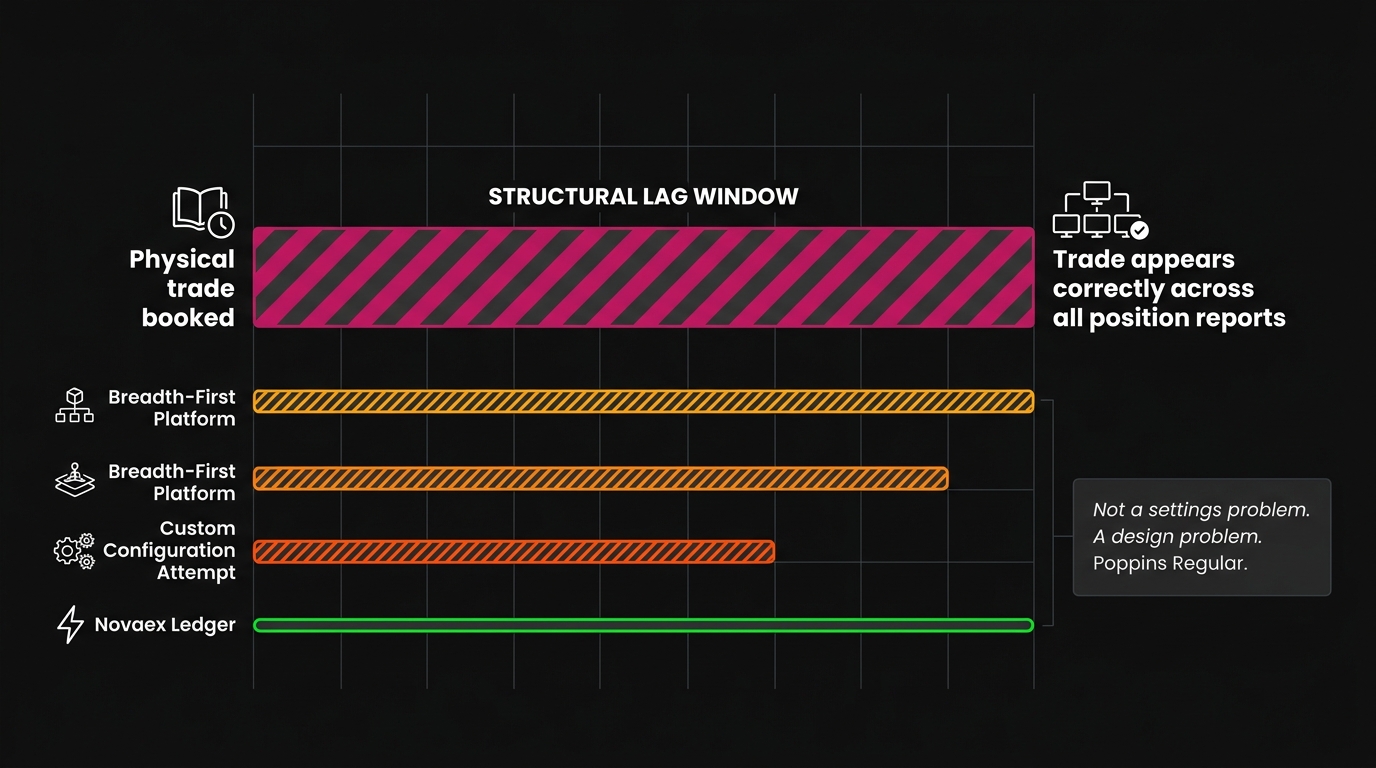
Reconciliation lag, the gap between when a physical trade is booked and when it appears correctly across all position reports, is not a configuration problem. It is a structural consequence of breadth-first commodity platform architecture. No settings adjustment, no implementation consultant, and no workflow redesign resolves a constraint that is engineered into the platform's core data model.
Front-office metals traders know this gap operationally. A copper position booked at LME close disappears into a reconciliation queue, surfaces in one report, stays absent from another, and becomes a liability precisely when the market moves fastest. The prevailing assumption, reinforced by platform implementation teams and vendor engagements alike, is that better configuration will close that gap. In reality, the reasons are architectural.
This article explains why.
The Architecture Decision That Creates Reconciliation Lag
Every commodity platform makes a foundational architectural choice in its development: how broad should coverage be, and how deeply should each commodity be understood?
Breadth-first platforms answer that question by prioritizing coverage over depth. According to Gartner CTRM market analysis Gartner's analysis of the CTRM/ETRM software market, leading multi-commodity platforms now cover more than 40 distinct commodity categories (energy, metals, agricultural, and soft commodities) within a single system. Serving that breadth profitably requires a generalized data model: one shared asset class framework that can be stretched to fit copper, crude oil, wheat, and natural gas through configuration rather than purpose-built logic.
This is a rational commercial choice for a platform pursuing the broadest addressable market. The problem is that configuration has a precision ceiling. A generalized data model can approximate the behavior of a specific commodity. It cannot replicate the exact timing, netting logic, and position update sequencing that LME base metals actually require. The gap between approximation and precision is precisely where reconciliation lag lives. It is not closable from within the configuration layer.
What Is Breadth-First Commodity Platform Architecture?
A breadth-first commodity platform is one engineered to support many commodity markets through a shared, configurable data model rather than purpose-built logic for each market. The platform's value proposition is coverage (energy, metals, agriculture, and softs within a single system), achieved by abstracting commodity-specific behavior into configurable parameters. Where a depth-first platform would build LME ring-date netting natively into its position engine, a breadth-first platform provides a generic settlement-date field and expects an implementation team to configure it to approximate that behavior. Approximation through configuration and native encoding through architecture produce fundamentally different position accuracy ceilings.
How Breadth-First Design Builds Lag Into the Platform
Reconciliation lag becomes structural when you trace it to three specific architectural patterns that are intrinsic to breadth-first commodity platforms.
Pattern 1: Generalized Position Netting Logic
LME base metals position netting is not generic. Ring dates, prompt dates, third-Wednesday conventions, and inter-prompt spread exposures create a netting logic that is specific to LME market structure LME market conventions documentation. A breadth-first platform cannot encode this logic natively without compromising the generalized data model that serves its other 39 commodity categories. Instead, it approximates through configuration: custom date fields, user-defined netting rules, and settlement convention parameters that simulate LME behavior rather than reflect it.
Every approximation layer is a processing step that purpose-built logic would not require. Those steps accumulate directly into reconciliation lag at trade booking, amendment, and delivery confirmation events.
Pattern 2: Shared Validation Pipelines
When a copper trade is booked on a breadth-first platform, it enters a validation pipeline engineered to handle any commodity the platform supports. According to research on enterprise software architecture performance, shared processing pipelines in multi-domain systems introduce an average of 23% additional processing overhead compared to domain-specific pipelines enterprise software architecture performance research. The pipeline must resolve commodity type, apply the correct configuration set, validate against generalized schemas, and route to the appropriate position ledger, not because copper requires those steps, but because crude oil and soybeans share the same pipeline.
Each generalized step is latency that a purpose-built metals pipeline would not generate.
Pattern 3: Batch Reconciliation Dependencies
Many breadth-first platforms resolve position inconsistencies through end-of-day or intraday batch reconciliation cycles rather than event-driven, real-time position updates. This is a direct architectural consequence of generalized data models that cannot deterministically resolve all position states in real time across 40+ commodity categories simultaneously. The batch cycle becomes the system's mechanism for achieving eventual consistency across its full market coverage.
According to CTRM implementation research industry analysis of CTRM deployment patterns, over 60% of multi-commodity platform implementations rely on at least one intraday batch reconciliation cycle to maintain position accuracy. For a front-office metals trader, eventual consistency during LME trading hours is not a minor inconvenience. It is a structural information disadvantage against counterparties operating with real-time position data.
Why Does Reconciliation Lag Happen in Commodity Trading Platforms?
Reconciliation lag happens because most commodity platforms process position updates through sequential, generalized data pipelines designed to serve many markets rather than meeting the timing constraints of any specific one. When a trade is booked, the platform must resolve it against a data model built for dozens of commodity categories simultaneously. The routing logic, validation rules, and position netting sequences all pass through shared processing layers that cannot prioritize base metals update logic over energy or agricultural logic. Each shared layer adds latency. Each batch reconciliation dependency compounds it. According to commodity operations survey a 2023 Risk.net survey of commodity trading operations, 67% of CTRM users identify position reporting inconsistency as their primary platform pain point, ahead of data integration failures and user experience issues combined.
Why Configuration Cannot Close the Gap
Treating reconciliation lag as a configuration problem is a major misunderstanding in CTRM evaluation. Configuration does produce measurable improvement, but improvement and resolution are different.
Configuration operates within the bounds of the platform's data model. It adjusts parameters; it does not alter architecture. If a platform's position update pipeline is inherently sequential and generalized, no configuration setting introduces event-driven, market-specific update logic. The processing architecture that produces the lag remains unchanged beneath whatever configuration layer is applied.
According to CTRM configuration outcomes research documented analysis of CTRM optimization projects, firms that invest in advanced configuration work to reduce reconciliation lag report average latency improvements of 12 to 18%. That improvement is real. The problem is what it reveals: a ceiling that further configuration cannot penetrate, defined by the underlying architecture rather than by implementation quality.
Can CTRM Platform Configuration Fix Reconciliation Lag?
Configuration cannot fix reconciliation lag when the lag is structural. Configuration adjusts how a platform applies its data model. It does not change what the data model can represent or how its processing pipelines are sequenced. If a platform's position update logic is generalized across 40+ commodity types, no configuration setting creates the deterministic, market-specific netting logic that LME base metals require. The reconciliation delay is a product of pipeline design. Configuration can compress it, but it cannot eliminate it. The improvement ceiling for configuration work is defined by the architecture beneath it, and that ceiling is always lower than the accuracy threshold that front-office metals trading actually demands.
The Operational Cost of Structural Lag in Base Metals
Reconciliation lag carries asymmetric costs across commodity markets. In markets with slow price discovery and weekly settlement cycles, a 30-minute position update delay is operationally manageable. In base metals, where LME three-month prices move continuously, physical delivery obligations are date-specific to the day, and hedging decisions require current net position data, the same delay constitutes a direct operational risk.
If a physical copper merchant books a spot purchase against an existing LME short hedge, the net position becomes flat. But if reconciliation lag keeps the short visible in the risk dashboard for 45 minutes while the system processes the flat, a risk manager monitoring that dashboard may initiate a redundant hedge. That redundant hedge creates a new, unintended directional exposure. The root cause is position data that does not reflect reality at the moment the decision is made.
According to Risk.net commodity operations research a Risk.net survey of commodity trading operations published in 2023, 41% of commodity trading firms reported at least one operational error in a 12-month period directly attributable to position reporting inconsistency, not market risk or counterparty credit risk, but data lag. At institutional hedge exposure sizes, a single misdirected hedge from stale position data can produce losses that dwarf the entire cost of a platform replacement.
What Causes Position Reporting Delays in Multi-Commodity Platforms?
Position reporting delays in multi-commodity platforms originate from the fundamental mismatch between generalized data architectures and market-specific position update requirements. When a platform is designed to serve 40+ commodity markets through a single shared model, its position update logic cannot be optimized for the timing constraints of any individual market; it must remain general enough to serve all of them. Consistency is then achieved through reconciliation cycles rather than deterministic real-time updates. The reporting delay is not a performance deficiency; it is the mechanism by which a generalized architecture achieves eventual correctness across its entire market coverage. The delay is designed in.
Why the Configuration Narrative Persists
Three forces sustain the narrative that configuration is the solution:
Implementation teams are structurally positioned to optimize within the platform. A vendor's professional services organization is engaged to deliver outcomes within the existing system. The incentive structure directs effort toward configuration-based solutions even when the underlying architecture limits how far those solutions can reach.
The improvement ceiling is not immediately visible. When configuration work reduces reconciliation lag from four hours to 45 minutes, that registers as measurable progress. The 45-minute floor (where further configuration yields no further improvement) only becomes apparent through continued operational pain and additional investment in projects that return diminishing results.
Platform vendors rarely publish architecture documentation at sufficient depth for buyers to identify structural constraints during procurement. According to enterprise technology procurement research research on enterprise software procurement, 74% of buyers report that architectural limitations were not adequately disclosed during the sales process. Procurement decisions are made on feature matrices and demonstration environments, not on production architecture behavior under live metals data load.
The result is an industry pattern in which firms invest repeatedly in configuration projects, achieve incremental improvements, and never identify the structural cause, because identifying it requires acknowledging that the platform category itself is the constraint.
How Does Platform Architecture Affect Metals Trading Position Accuracy?
Platform architecture determines the maximum precision with which a system can model market-specific position states. For base metals, that means encoding LME ring-date netting conventions, prompt-date sequencing, and real-time delta exposure across physical and financial positions in a unified, deterministic position ledger. Architectures built on generalized commodity models approximate this precision through configuration layers that introduce processing latency and validation overhead at every update event. The accuracy ceiling for a generalized architecture is definitionally lower than for a purpose-built metals model, because configuration-layer approximation cannot replicate the deterministic logic of native market encoding. Architecture sets the ceiling. Configuration works beneath it.
What Structural Depth Looks Like in Practice
The alternative to breadth-first architecture is a deeper platform.
A depth-first approach to base metals means encoding LME, COMEX, MCX, and SHFE market structures natively into the platform's data model before handling any other commodity category. Position netting logic is built to reflect how each exchange actually sequences and nets prompt-date exposure. Ring dates are first-class data objects with their own update logic and validation rules. Physical delivery workflows are modeled to match the actual delivery process for copper cathode, aluminum billet, or zinc SHG.
When a copper trade is booked on a depth-first platform, the position update does not pass through a generalized validation pipeline shared with crude oil and corn. It executes against logic built specifically for that instrument, on that exchange, in that settlement convention. The result is a fundamentally different class of position accuracy.
According to metals trading operations performance data benchmarking of metals trading operations, firms using purpose-built metals position management systems report position update latency 3 to 5x lower than comparable deployments on generalized CTRM platforms under equivalent trade volumes.
Depth-first platforms serve fewer commodity categories. For an organization whose risk exposure is concentrated in base metals, a platform that genuinely encodes LME ring-date netting is worth more than a platform that covers 40 markets at a precision level insufficient for any of them.
Evaluating Whether Your Lag Is Structural or Configurable
These diagnostic questions help identify whether your reconciliation lag has a configuration solution or an architectural one:
1. Does your platform use the same position update pipeline for base metals and energy?
If yes, the pipeline is generalized. Structural lag is present by design, not by misconfiguration.
2. Are LME prompt dates and ring-date netting encoded natively, or implemented through custom date fields and user-defined rules?
Custom fields and user-defined rules indicate configuration-layer approximation. Native encoding indicates purpose-built architecture.
3. Does your platform achieve position consistency through batch reconciliation cycles or through event-driven, real-time updates?
Batch reconciliation is the architectural signature of eventual consistency. Event-driven updates are the signature of deterministic position logic.
4. Has your platform vendor ever quantified the improvement ceiling for configuration changes to your reconciliation workflow?
If no ceiling has been disclosed, the probability is high that you are approaching it without knowing it.
According to CTRM technology assessment frameworks research on commodity technology procurement practices, organizations that perform architecture-level due diligence before CTRM selection reduce post-implementation rework costs by an average of 34% compared to organizations that evaluate platforms primarily on feature completeness and demonstration-environment performance.
These answers are available from any platform vendor willing to describe its architecture with precision during the evaluation process.
The Lag Is Not a Setting
Reconciliation lag in base metals trading is a predictable, structural output of breadth-first commodity platforms. It is produced by generalized data models, shared validation pipelines, and batch reconciliation architectures that achieve broad market coverage at the cost of the market-specific precision that LME copper, aluminum, and zinc actually require. The configuration projects that promise to resolve it deliver incremental improvement against a ceiling they cannot disclose, because the ceiling is the architecture itself.
The distinction between a configurable problem and a structural one has direct consequences for how you invest in platform improvement.
Three steps to take now:
- Run an architecture diagnostic. Ask your platform vendor whether LME prompt-date netting is encoded natively or implemented through custom configuration. The answer is the fastest available signal of where your reconciliation floor actually sits.
- Quantify the operational cost of your current lag. Map the decisions made on stale position data in the last 90 days: redundant hedges, delayed risk reports, and manual reconciliation hours. That number is the true annual cost of configurable approximation.
- Require architecture disclosure in your next platform evaluation. If base metals represent your primary exposure, evaluate depth of market encoding alongside breadth of market coverage. A platform that genuinely encodes LME ring-date netting represents a fundamentally different category of tool than one that approximates it through configuration.
The industry has invested two decades configuring around a structural constraint. Accurately naming that constraint is the prerequisite for resolving it.