Why Spreadsheet Reconciliation Creates a Structural Audit Gap
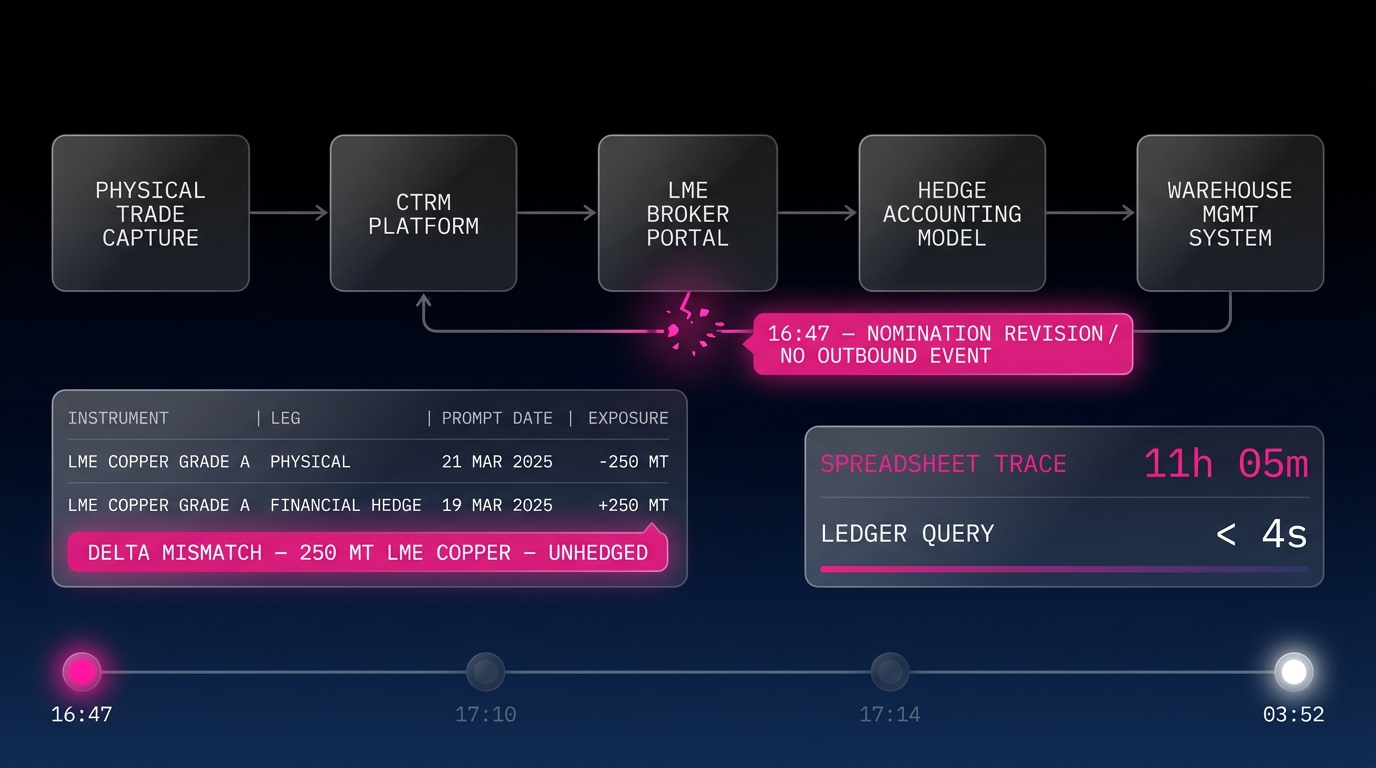
Spreadsheet-based position reconciliation creates a structural audit gap rather than a mere operational inefficiency. The chain of custody between a trade event and a verified position state is severed by design. A 250-tonne LME copper delta mismatch, traced manually through five disconnected systems over eleven hours, demonstrates this precisely. No process improvement closes this gap. The resolution is architectural.
That eleven-hour trace represents the operational baseline for any physical-financial book managed through spreadsheet reconciliation, rather than an exceptional failure.
Understanding why requires following the trace in full: from the 16:47 nomination revision that initiated it, through five systems and one overnight session, to the structural condition that post-incident reviews consistently fail to name.
[position reconciliation in commodity trading]()
The Break: A 250-Tonne Delta Mismatch on LME Copper
It started at 16:47 on a Tuesday, twenty-three minutes after LME official settlement.
A physical copper purchase contract (250 tonnes, standard warrant, CIF Rotterdam) had its delivery nomination revised at the warehouse layer. The revision was routine: a shipping delay advanced the prompt date by three business days.
The corresponding LME futures hedge (a three-lot short position covering flat price exposure on the physical leg) had already been confirmed by the broker that afternoon. The hedge was dated to the original prompt. The warehouse system's revision generated no outbound data event to the trading systems.
By 17:10, the position sheet showed the firm long 250 tonnes on a flat price basis. The hedge accounting model showed flat. The discrepancy was 250 tonnes of unhedged copper exposure on the balance sheet during an overnight LME session.
The prompt date mismatch, a delta discrepancy between the physical delivery leg and the financial hedge leg, had originated in the warehouse management system at the logistics workflow stage. It surfaced in the trading book only after settlement, when the states of two systems were compared manually.
According to research by the CTRM Center CTRM Center industry survey, over 68% of commodity trading firms rely on spreadsheets as their primary position-keeping tool despite having enterprise CTRM platforms in place. This represents the structural condition of the industry rather than a resourcing failure at smaller firms.
Eleven Hours, Five Systems, One Position Discrepancy
The trace began at 17:14 by attempting to find the origin of the 250-tonne long, a query that should have taken one second.
Instead, it required moving through five systems in sequence:
- Physical trade capture spreadsheet (Version 14 of 17 saved that day): confirmed the original purchase contract terms but contained no record of the nomination revision
- CTRM platform: showed the original hedge position, unmodified, with no flag on the prompt date conflict between the physical and financial legs
- LME broker confirmation portal: confirmed the futures hedge was dated to the original prompt, not the revised delivery date
- Internal hedge accounting model (Excel, maintained separately from the CTRM): showed flat net exposure because it pulled from the CTRM, not the warehouse system
- Warehouse management and logistics system: contained the nomination revision timestamp (16:47) and the revised prompt date, with no outbound data feed to any trading system
By 03:52 the following morning, the discrepancy was resolved. The prompt date mismatch was confirmed as the source. The hedge was amended. Total elapsed trace time: eleven hours and five minutes.
Before the trace could begin, the team spent forty minutes identifying which of seventeen saved versions of the physical trade capture spreadsheet was the authoritative one. That forty minutes perfectly illustrates the spreadsheet audit gap in its most concentrated form.
The Mechanics of a Delta Discrepancy
A delta discrepancy in a metals hedge book occurs when the flat price exposure of the physical leg and the flat price coverage of the financial hedge leg diverge, leaving a net unhedged position that does not appear as an open exposure in either system individually.
In LME physical-financial hedging, this most commonly occurs when prompt dates shift without automatic propagation to the futures leg. Each system records accurate information for its own domain. No system is responsible for the relationship between them. The discrepancy exists in the gap between systems.
LME prompt date hedging mechanics
The Limits of Spreadsheet Discipline
Better spreadsheet discipline addresses human behavior instead of data architecture. The warehouse system updated the prompt date at 16:47 and created no event record in the trading book. There was nothing to reconcile against. This revealed a missing architectural layer rather than a simple missed step.
According to a 2023 report by Oliver Wyman Oliver Wyman CTRM operations report, commodity trading firms that implement additional manual check processes on spreadsheet-based reconciliation see a 12% reduction in discrepancy frequency but a 340% increase in the time required to trace discrepancies when they do occur. Process discipline reduces error frequency while significantly expanding resolution cost. It does not close the structural gap.
Why Spreadsheet Reconciliation Fails at the Structural Level
The eleven-hour trace is operationally costly. Its deeper significance is architectural.
Spreadsheet-based reconciliation fails because it relies on state-based rather than event-based tracking. A spreadsheet records the current position without documenting the sequence of events that produced it.
This distinction is decisive in a physical-financial hedge book. A physical commodity trade passes through procurement, logistics, treasury, and risk before it becomes a line in the position sheet. At every stage, data is written into a different system by a different team on a different schedule. The spreadsheet at the end of that chain functions as a summary instead of a ledger.
When a discrepancy appears, the spreadsheet cannot identify where it originated. It can only confirm that the current state does not match expectations. The eleven-hour trace, moving backward through five systems, is the process of reconstructing the event sequence that the spreadsheet should have captured but is structurally incapable of capturing.
According to a joint study by F1F9 and the European Spreadsheet Risks Interest Group spreadsheet risk research, 88% of spreadsheets containing more than 150 rows contain at least one material error. In a metals trading book where a single spreadsheet carries physical contracts, delivery nominations, prompt schedules, and hedge relationships, that error rate points directly to a data architecture problem rather than poor quality management.
According to McKinsey's Global Commodity Trading survey McKinsey commodity trading survey, back-office reconciliation consumes an average of 23% of total operational staff hours in mid-market commodity trading firms. This represents the steep cost of reconstructing unrecorded event sequences.
The Audit Gap That Spreadsheet Reconciliation Creates
An audit gap is distinct from an audit error and an audit delay. An audit error is a wrong number. An audit delay is a slow process. An audit gap means the evidence does not exist.
If a regulator, a risk committee, or an external auditor requested a trace of the 250-tonne copper discrepancy from origin to resolution, the answer would require eleven hours of manual reconstruction instead of a simple system query. The positions were corrected. The audit lineage was never written.
EMIR, REMIT, and Dodd-Frank reporting requirements all mandate the ability to trace positions back to originating trades with timestamps and counterparty detail. commodity trading regulatory reporting requirements Spreadsheet-based reconciliation produces corrected states. It does not produce traceable lineage.
According to the Financial Conduct Authority's 2022 commodity markets review FCA commodity markets review, 41% of enforcement actions related to position reporting failures cited an inability to produce a complete audit trail, rather than an error in the reported position itself. The positions were often correct. The audit evidence was structurally absent.
Defining the Audit Gap in Commodity Trading
An audit gap in commodity trading means that the chain of custody between a trade event and a verified position state cannot be reconstructed from existing system records without manual intervention.
It differs from a conventional compliance failure. No rule is violated at the moment the gap is created. The gap originates in the absence of event-level recording. When the warehouse system revised the prompt date at 16:47, no ledger entry was made. No system captured the event as a position-affecting action. The gap is the silence between systems.
EMIR position reporting requirements
This Eleven-Hour Trace Is Not an Anomaly
The instinct when reviewing a trace of this kind is to search for the exceptional circumstance: an unusual instrument, an under-resourced team, a complexity specific to this one situation.
That instinct reflects a misdiagnosis.
The conditions that produced the eleven-hour trace are present in any physical-financial commodity book managed through spreadsheet reconciliation:
- Multi-system data custody: Physical, financial, and logistical data reside in separate systems with no enforced synchronization and no shared event log
- State-only recording: Each system records current values, not event sequences. There is no system of record for the relationship between systems
- Manual propagation dependencies: Nomination revisions, contract amendments, and prompt date changes require human action to travel between systems, creating gaps wherever that action is delayed or missed
- Version proliferation: Seventeen saved versions of one spreadsheet on one trading day happens routinely. It demonstrates the expected entropy of a state-based file used as a position-keeping tool
The Ledger Truth Layer as an Architectural Category
The resolution to the eleven-hour trace is not faster manual reconciliation, a better notification protocol for nomination revisions, or additional training on hedge book version control.
The resolution is architectural: a ledger truth layer positioned between the event-generating systems and the position-keeping tools.
A ledger truth layer operates as an architectural category instead of a standalone product. It acts as a design principle that treats every change to position state as a ledger entry: timestamped, attributed to a source system, linked to an originating trade event, and immutable once written.
In the 250-tonne copper case, a ledger truth layer would have:
- Captured the warehouse system's nomination revision at 16:47 as a timestamped ledger event with source attribution
- Automatically evaluated the revised prompt date against open hedge positions in real time
- Flagged the delta discrepancy as an unreconciled event before settlement instead of discovering a state difference afterward
- Provided a complete event chain from original trade capture through the nomination revision to the discrepancy flag, queryable in seconds
According to Gartner's research on event-driven data architecture Gartner event-driven architecture, event-driven architectures reduce audit trace time by 85-94% compared to state-based reconciliation systems in financial services workflows. The ledger principle serves as the foundation of double-entry bookkeeping, applied to an environment where spreadsheet-based workflows have structurally delayed its adoption.
Defining the Ledger Truth Layer
A ledger truth layer in commodity trading is an architectural layer that records every change to position state as an immutable, timestamped, source-attributed event, creating a queryable chain of custody from trade origination to current position without manual reconstruction.
It functions as the missing layer between transaction-generating systems (CTRM platforms, warehouse management systems, broker confirmation portals) and the position book. Rather than reconciling states at end-of-day, it reconciles events in real time, before discrepancies become overnight exposure.
event-driven position management architecture
Resolving Position Discrepancies
A ledger truth layer resolves position discrepancies by making them visible at the moment they occur, at the event level, rather than surfacing them as unexplained state differences after settlement.
When a nomination revision at 16:47 is captured as a ledger event, the system evaluates immediately which downstream positions it affects. The discrepancy is identified, attributed to its source, and flagged before it carries market risk through an overnight session. The eleven-hour reconstruction is replaced by an event log that already contains the answer.
What Position Reconciliation Should Actually Look Like
The performance standard for position reconciliation in a physical-financial commodity book rests on whether the system makes discrepancies structurally impossible to miss.
This is the distinction between operational competence and architectural soundness. A team that resolves an eleven-hour trace is competent. A system that required eleven hours to surface a 16:47 event is not sound.
A position reconciliation architecture that meets audit and regulatory standards must satisfy three conditions:
- Event capture: Every change to position state, regardless of which system originates it, must be recorded as a timestamped, attributed event the moment it occurs, avoiding the delay of human propagation
- Real-time cross-system reconciliation: Delta discrepancies must be identified at the event layer, not the state layer, and flagged before settlement rather than discovered after it
- Immutable audit lineage: The complete chain from trade event to current position must be queryable without manual reconstruction, eliminating the need to assemble data from seventeen spreadsheet versions and five system exports by a team working through the night
physical commodity position management best practices
Three steps define the path from current infrastructure to audit-ready position management:
- Map every data handoff point in your position workflow. Identify every point where position-relevant data moves from one system to another through manual action. Each of those points is a structural audit gap location.
- Evaluate whether your current platform records events or states. If your CTRM or position management tool records states and not events, it cannot provide audit lineage regardless of how sophisticated its interface appears.
- Define the ledger truth layer requirement before evaluating solutions. Immutable, timestamped, source-attributed event recording is an architectural specification, rather than a mere feature. Evaluate every solution against that specification, not against interface capabilities or integration counts.
That is the structural condition that spreadsheet-based reconciliation produces across every metals book, every trading day, at every firm that has accepted this as the operational norm. These structural blind spots represent permanent gaps rather than momentary errors.