Zinc treatment charges are negative. Which TC does your hedge book carry?
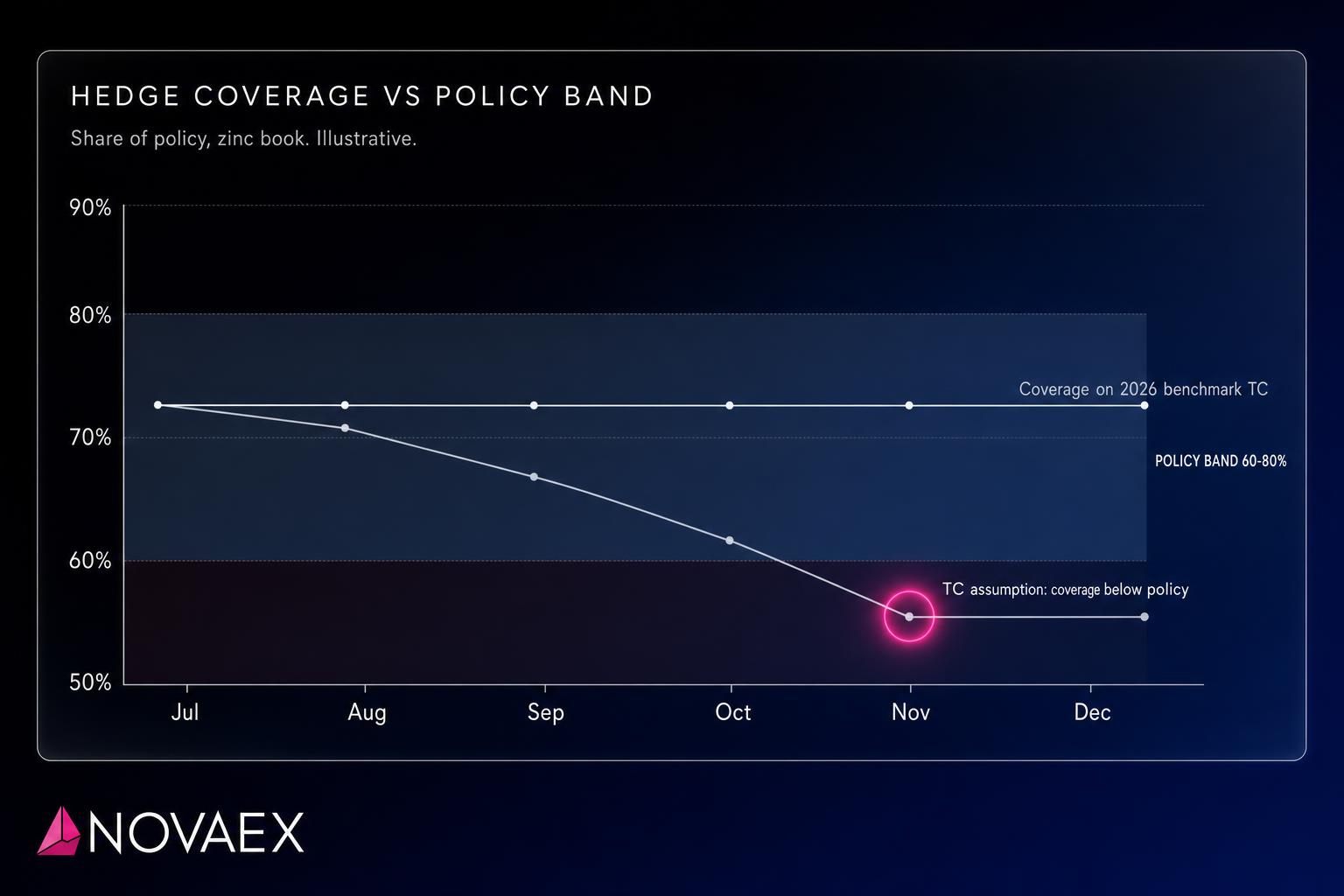
Spot zinc TCs sit more than $250 below the 2026 benchmark, and whether China keeps exporting refined zinc is still open. Here is how to check which TC your book carries and whether hedge coverage still matches board policy.
Zinc concentrate treatment charges are negative. Fastmarkets assessed the spot TC, CIF China, at $(115)-(150) per tonne on 9 October, and SMM's imported index stood at -$167.5 per dry tonne on 6 November. A hedge book still carrying the +$85 2026 benchmark overstates how much margin it protects. Check which TC each tranche of feed carries, then re-run coverage against policy.
Where are zinc treatment charges now?
Deep in negative territory, and still falling. Fastmarkets' twice-monthly spot zinc concentrate TC, CIF China, hit a record low of $(115)-(150) per tonne on 9 October. Its LME Week preview quoted a South American trader calling the zinc market "uncharted territory" and put 2027 benchmark talks firmly in focus. In January the same assessment was $40-60 per tonne.
The latest print we could retrieve is SMM's weekly review of 6 November. The SMM Imported Zinc Concentrate Index fell $9.6 to -$167.5 per dry tonne, spot offers sat at -$170 to -$200, and talks on 2027 long-term contracts were described as a stalemate. The 2026 annual benchmark was $85. From +$85 to -$167.5 is a gap of $252.5.
Two houses, two indices, two units: Fastmarkets quotes per tonne, SMM per dry metric tonne. Name the index and the unit on every TC in your book.
Will China export refined zinc?
That was the open question at LME Week, as Fastmarkets reported on 22 October, and it is still open. China swung to a small net export position in July, with exports of 9,235 tonnes against imports of about 5,130. SMM puts September exports at 70,400 tonnes, up 73% on the month. In the same note SMM expected October exports of around 20,000 tonnes, as the SHFE/LME price ratio recovered and the window closed.
Whether exports resume depends on that ratio. A smelter source told Fastmarkets the export margin on screen had at times reached $100-200 a tonne in theory, but that a margin of just over $20 a tonne on a few hundred tonnes was not worth the effort. Treat continued exports and a closed window as two scenarios, not a forecast.
Exports do not set the concentrate TC. Fastmarkets' sources tie the pace of any TC recovery to mine supply in 2027 and to winter smelter cuts in northern China. What exports change is the refined side: LME stocks, the premium, the price leg of your hedge. So the TC and the export question feed the same book from two directions.
How does a TC assumption reach hedge coverage and EBITDA protection?
A treatment charge sits inside margin, and your zinc hedge does not cover it. The hedge fixes the price leg. The TC leg moves on its own, so a coverage ratio built on the wrong TC reports protection the book does not have.
The sign depends on which side you sit. For a smelter, TC is income when positive and a cost when negative. For a miner selling concentrate, the reverse: a negative TC adds to net revenue. Either way, a board policy that says "hedge 70% of expected margin" is only as good as the margin it is measured against.
Spot and benchmark terms also run side by side. Feed bought on annual terms settles at the benchmark. Feed bought spot settles at the spot TC. A book that carries one number for all of it is wrong on whichever tranche it did not model.
What does a wrong TC look like on a real book?
Take an illustrative smelter, with figures chosen for the arithmetic and not drawn from any customer. It plans to buy 20,000 dry tonnes of concentrate on spot terms next quarter. The budget carries the 2026 benchmark of +$85 per dry tonne as income. The SMM index says -$167.5, a cost.
That is a swing of $252.5 per dry tonne, so about $5.05 million on 20,000 tonnes, if the spot tranche prices at the index. The zinc hedge covers none of it. A coverage report that shows the book at 70% of policy is accurate on metal and silent on the $5.05 million.
The fix is a coverage figure that states which TC it was built on, for which tonnes, as of which date.
How do you check policy against actual, with a trail?
Run it as five steps, and keep the working.
List every tranche of feed by tonnage, delivery month and contract basis: annual benchmark or spot.
Record the TC each tranche carries, with the index, the unit and the date it was taken.
Replace any stale TC with a dated current print, and restate margin.
Recompute hedge coverage against the board policy band on that margin.
Flag every tranche where coverage leaves the band, and attach the line-by-line trail.
Then run steps 3 to 5 twice more, once with exports continuing and once with the window shut. If coverage leaves the band in either case, that belongs in the board pack before it turns up at the close.
Where does Ledger fit?
Ledger holds the physical and the financial position in one reconciled view, audit-ready, with the trail behind every number, and your system of record stays where it is. The check above is a reconciliation job: tonnes against contract basis, hedges against policy, one figure at the end. See it on your own book in Ledger, and how it reads for finance.
Seeing it run on your own zinc book is a call away.